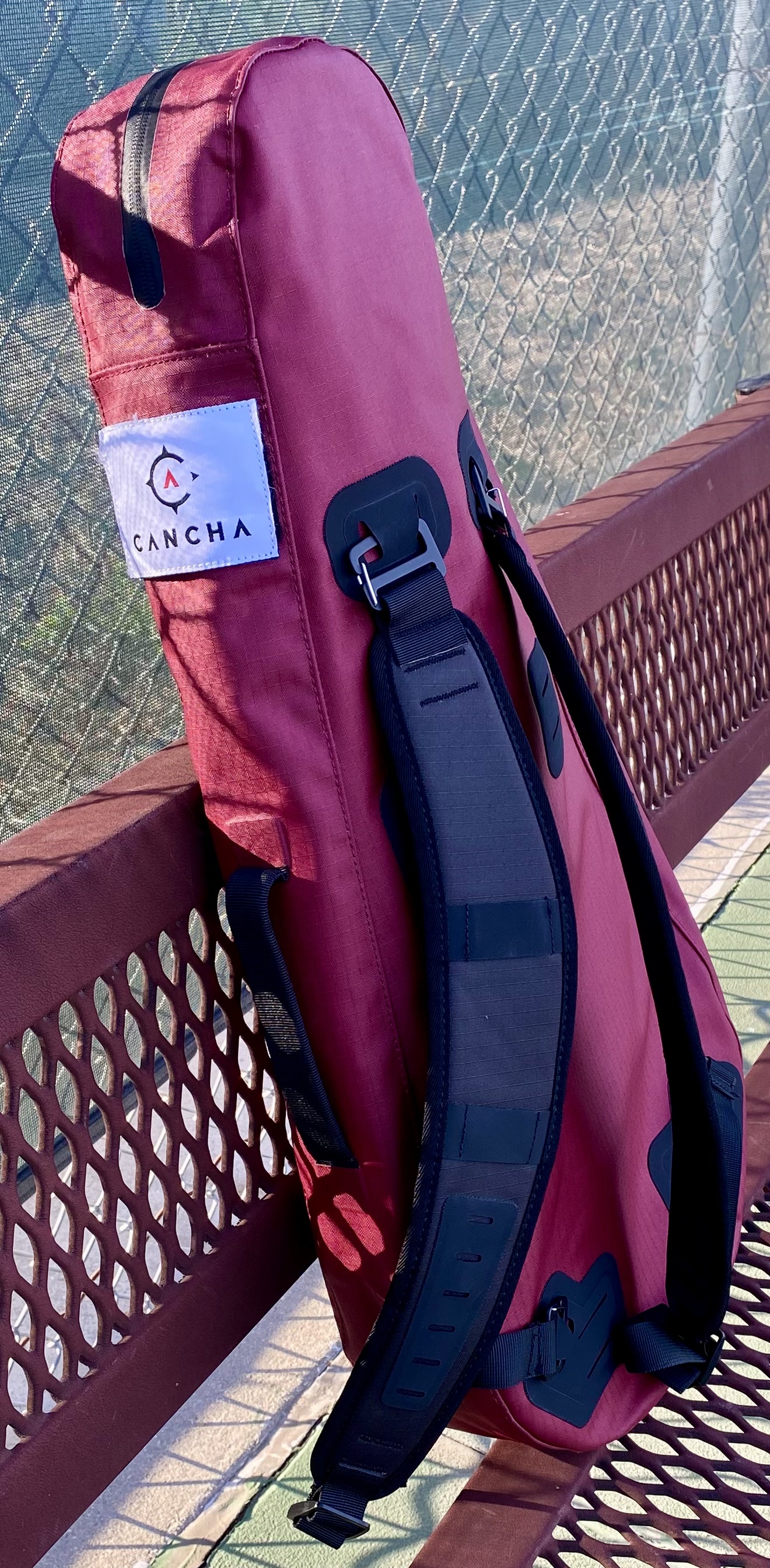
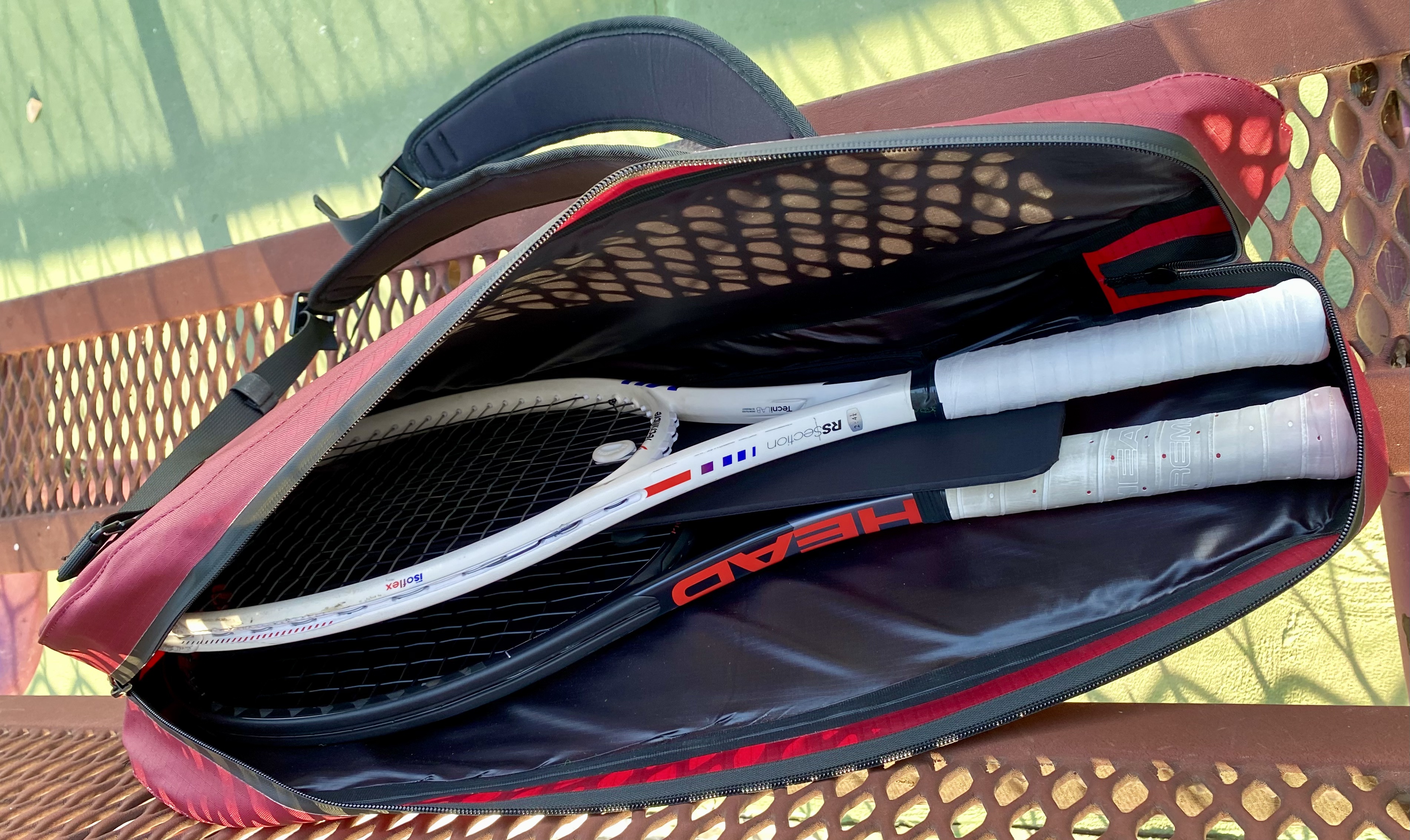
It’s said that Novak Djokovic plays a tennis racket based a fifteen year old Head frame design. When I heard this and considered the fact for a few moments I thought to myself, the tech hasn’t advanced. If it had, Djokovic and the rest of the high-level players would be taking advantage.
Now this struck me as odd since tennis tech, as evidenced by string and rackets, advanced significantly sometime during the Agassi era. It’s easy to imagine how the move from wood to metal to graphite and the simultaneous evolution of strings, from gut to multifilaments, co-polys and polyester monofilaments, changed tennis forever, if maybe not for better.
I’ve come to describe tennis as an oppositional striking game, approximating some of the confrontation elements that take place between a pitcher and hitter. Other than appropriate footwear, the racket is pretty much all the equipment a player brings into battle. In high level professional tennis, rackets are quite nearly disposable. To the enthusiast they are alternately sources of fascination or confusion.
The mechanics of a tennis racket are fairly simple. This is not to say that designing or building a racket is simple. Contemporary tennis rackets are the flower of post-industrial revolution advances in materials science and mass production. In some ways they are equatable to a contemporary golf driver. Both are component devices; one comprised of racket frame and string and the other of driver head and glued shaft. A driver’s playability is determined by the integration of shaft/head/player. In tennis, it’s obviously racket/strings/player. Both golf and tennis have well-developed industries to research, manufacture and market products but what do those wildly successful commercial efforts mean to the player?
I don’t want to get too carried away by ideas about the physics or mechanics of the tennis racket or the driver for that matter. Suffice it to say both improved very rapidly a few decades ago and both, today, have reached a kind of stasis. That stasis comes from a combination of two things. The first is the theoretic maximum of coefficient of restitution (COR, hereinafter). COR is the degree to which a modern driver face can deflect thereby allowing the ball to travel further assuming a given club head speed. So, virtually every modern professional golfer is using a driver head with essentially matched technology in terms of basic mechanics. I think the same thing is true when it comes to tennis rackets. The industry has pretty much figured it out. Now, this doesn’t mean all tennis rackets perform identically. They vary by length, weight and flexibility on at least two axis. The difficult and more interesting question is this: how do changes in those qualities affect a tennis player?
TW’s drivers, 1997 on the left and 2018 on the right No, TW did not put the pop-up mark on the old driver
Let me dodge that issue momentarily by shifting back to golf. If we regard Tiger Woods career as lasting roughly two decades, we will see that he started out using a driver that was pretty much from the decade that proceeded it. In other words, the next generation drivers being used today had not yet been developed by 1997. So, Tiger Woods when he first came onto the PGA Tour, used a driver (a King Cobra Deep Face 9 degrees, True Temper Dynamic Gold X100 shaft. The X100 shaft is steel, heavy steel at that. The driver’s steel head displaced somewhere around 210cc. A few years after that the driver boom occurred. The boom was caused by the simultaneous development of aluminum titanium alloys, which allowed the head size to balloon to 460cc and also the ability to maximize the mentioned coefficient of restitution. So, by the mid 2000s Tiger Woods would be using a driver with a graphite shaft and an aluminum / titanium alloy head that rode the edge of maximum allowable COR as regulated by the United States golf Association.
By the mid 2000 driver technology for the most part had maxed out, both in terms of material and technology. Interestingly, if we make the obvious assumption that Novak Djokovic has access to the best equipment in the world, and further, that his racket of choice is based on a fifteen year old design, we can also conclude that tennis rackets, at least for the time being, have also been maxed out. So, back to the earlier question; how does this affect the average player whether a golfer or a tennis player? In both sports, I conclude that the technology advancements of the last fifteen to 20 years has been virtually irrelevant. Tiger Woods, at any point in his professional career, could have gone back to his 1997 steel-headed, steel- shafted driver with very few consequences. It is even arguable (and I have promoted the opinion) that the slight decrease in distance paired with the significant increase in control would have led him to even better play during that time of his career. As regards tennis, I doubt that any amateur player is likely to be disadvantaged by using a racket that’s even older than the one Novak Djokovic plays.
I have been lucky enough to have the covers of my last three books created by Alba Escayo.
Alba holding her girl and a copy of JJM & the 1971 U.S. Open
No, we have never met.
No, we have never spoken on the telephone, or even by Zoom.
Yet, somehow, I feel that I know Alba. And I mean beyond her fabulous artwork. Writing, and especially writing books, is a rather lonely and isolating process. And, when you’re done writing, it always seems to come as a surprise that a book has no physical presence or look, beyond the words on the page.
I always respond to that moment with a slight twinge of panic. You see, every writer wants his work to be good and to look good. Some writers (and that includes me) want their words to both read nicely and also to look correctly , for lack of a better word, on the page. When words are kept together or held apart by a stylistically correct layout, they help to encourage the right spirit and heart from the reader. And, once a writer is aware of this fact, he simply can’t commit words to paper without caring about how they look.
But, the panic that I referred to earlier has to do with the cover. The person who said that you cannot judge a book by its cover was right and wrong at the same time. Especially for the self published writer, I think the connection between the writer and the cover artist is nothing less than critical. if the artist doesn’t know the writer, and doesn’t know the book, I just don’t see a way for the artist to create a cover that truly works with the book and its story.
The other day, I was trying to remember when I first crossed paths with Alba Escayo. It was a very long time ago. The subject of the book was golf. And, when I first heard from Alba she wrote of her fondness for her countryman, Seve Ballesteros. Reading about her passion for golf, a game that at the time I don’t believe she had even played, gave me great hope for the project. Later, when I saw her initial sketches, I knew she was perfect for that project and all the ones that will come after.
An early version of Cottonwood’s cover
Alba and I have created two books that revolve around golf. The first was John J. McDermott and the 1971 U.S. Open and the second was Cottonwood. Neither book would be as good as it is without her contribution. Alba’s covers made the book come alive before the reader even opened it. There is no way to place the value on the initial impact that a really great cover can give to a book so I won’t try.
There is also no way to place a value on Alba’s ongoing friendship or her endless patience with my sometimes peculiar visions, but I value both greatly. The depth and sensitivity of her art is fascinating. I can give her nothing more than a few words and get back beautiful images that make me want to use all of them rather than choose one over another.
The sad remnants of the Racquet Club of Palm Springs courtesy of Google Earth or something like it
Tennis thing is an unusual book. But, I told you how lucky I am when it comes to cover art. It turns out that both Alba and I took up tennis at about the same time, she and her girl on the clay courts of Spain and me on whatever SoCal hardcourt will put up with me. For Tennis thing I gave her an odd starting point, the long-abandoned Racquet Club of Palm Springs. The club first opened by in 1934 and it was owned by actors Charles Farrell and Ralph Bellamy. I’m tempted to go into a lot of boring detail about the club and its history and sad decline but I will resist since I’m just trying to show how little I can get away with giving Alba and still get fantastic artwork.
From that visual hunch Alba came up with this:
No, this is not quite the final version of the paperback’s cover but you get the idea. How did she manage to get the precise feel of my book? I will never know yet I am ecstatic with the result. It makes me want to write a better book next time just so I can work with Alba Escayo again.
I take two lessons a week, only 30 minutes each, though for a time I added a third lesson to focus specifically on the serve. My thought was that within a month or so my serve will catch up with the rest of my game and I’ll go back to two lessons a week. It may turn out that my estimate is optimistic. We’ll see.
Serving is a blend of the toss, the swing (upwards and then outward) and managing to send the ball into the court. I think the toss is unique in sports. I can’t think of another game that asks the player to essentially throw the ball to himself to initiate a strike. The serve, at this point, is abbreviated. I start with elbow up and the side of the racket against my upper back. I’m sure it looks funny but I understand the theory. It reminds me of an abandoned golf swing theory that David Leadbetter tried to sell a few years ago called the A Swing. In the A Swing, the player started his backswing with the hands at around waist high and the club head near shoulder height.
It never caught on.
But, as I said, I do get Caesar’s idea. The entire serve motion is surprisingly tricky. The problem is that it looks so simple on TV, or when an expert like Caesar hits a serve right before my eyes. If only. Watching others is instructive in at least two ways. The first is as examples of what not to do. This is a sadly rich field. I see some pretty good tennis players with very bad serves. When I asked Caesar about this he didn’t hesitate before he answered. “Very common. The best way to practice the serve is to do it alone, and it’s boring.” This sounded similar to practicing putting.
But wait, I’m trying to forget about golf.
In addition to tossing the ball to yourself, you also have to coordinate a separate motion, that being the actual swing at the ball. There’s one more bit of fun; the ball will be (or should be) far above your head when you strike it. That strike location makes the motion all the more difficult to master.
I keep the images of three serves in my head. First and most obvious is Caesar’s. Even through he frequently reminds me that it’s been over twenty years since he’s hit a competitive serve there’s no missing the mastery of his motion. His serve makes the solid strike of the ball seem like a mere eventuality. It looks like he couldn’t miss. The motion and the pace of the serve seem very much out of step with each other. His take back is slow and smooth but once the ball is hit the other perception is of speed.
On TV I enjoy watching Maria Sakkari of Greece. She is closer to my height so length of her arc and potential extension are closer to mine. There’s a fantastic slo-mo of her serve on Instagram that I study from time to time. It reminds me a mid-1990s golf thing called Sybervision that featured continuous slo-mo loop of Bobby Jones hitting a golf ball. I never got my tempo anywhere close to Jones’ but it was a helpful reference to what was possible.
In the realm of the impossible, something I enjoy watching for its abbreviated if lurid grandeur, is the serve of Andy Roddick. I love abbreviated, explosive athletic motions like Roddick’s. It looks as if every unnecessary movement has been deleted leaving only the kinetic elements that contribute directly to the strike. This appeals to me. It makes me think that I could replicate the essence of Roddick’s serve absent, of course, the astonishing speed and power he achieved. The movement in his serve reminds me a little of watching Nick Price hit a 4-iron. Neither swing lasts long but both are awesome.
2007 Boss Tweed, CC BY 2.0 via Wikimedia Commons
The take back is the next issue. I’ve watched videos of professionals who start with the racket in the trophy position, upper arm parallel to the ground, upper arm at something like a right angle to it, racket pointing skyward. From here, they execute their racket drop, the rotation of the upward-facing racket to a position that finds the top of the racket pointing backward or, in the case of Mr. Roddick, nearly straight down. Many players coordinate the movement of the tossing arm with the racket arm, so both arms are moving upward at about the same time. I cannot say exactly why, but there’s something about this motion that feels off to me. If the tossing and swinging arm go up at the same time and the ball is tossed further upward it seems to me that the swinging arm will have to wait for the ball to apex and start falling. I understand the racket drop takes time before the forward swing gets going but it seems to me that, maybe, if the swinging arm trailed a bit the transition into the swing might be smoother and more sequential. Not to fixate on Andy Roddick, but this photo shows what I mean.
I first wanted to play tennis when I was eleven. But, I didn’t actually play, and neither did any of the 5th-heading-to-6th graders who were unlucky enough to take tennis in summer school in 1971. Shit, I even got a racket, a Pancho Gonzales model I got in exchange for two books of Blue Chip Stamps. I also had enough dough on hand to buy a can of Slazenger tennis balls. My dearest piece of tennis swag was the neat little ball pouch my mom made for me. Rather than lug that silly, cylindrical tin can around I carried my three new tennis balls in the pouch my mother made, complete with drawstring fashioned from an old venetian blind pull-cord.
Rockin’ for sure.
The only problem, as I mentioned, was that we never hit a ball and the class was unceremoniously cancelled after the first session. It seems no one realized a tennis court needs a net for the game to be a game. Sure, we could have banged balls against the handball court that stood a few feet away but no one thought of that. So, the Spalding tennis racket went home and our springer spaniel, Bo, got to shred the new Slazengers to pieces. There’s always someone who’s happy with an outcome.
Fast forward to late summer of 2023. I’m 62 and I’ve still never played tennis, yet a coalescence of forces somehow got me started in the game. First, was my friend Michael who early in our largely-telephonic relationship would tell me, “Paulie, you’d love tennis!”
Where Michael got the nerve to call me Paulie I will never know.
The second force was a spur-of-the-moment stop at nearby Calabasas Tennis & Swim Center. I’d been thinking of taking swimming lessons but nothing had panned out at nearby Pierce College. Indoor pools (like those at area YMCAs) lost their appeal sometime early in the pandemic. After the visit, I found myself checking out the club’s website when I noticed a list of tennis coaches. One name stuck out, I’m not sure why. Maybe it was the first name, Caesar. Heck, I’ve always wanted to know someone named Caesar. Plus, he’d worked with wheel-chair players. I figured anyone who could do that successfully had a decent chance with broken-down me. I sent Caesar an email and waited— for about an hour. Turns out he had time the next day, Monday. Talk about the ball being in my court. I thought it over for a minute before I fired back an email saying I’d be there.
I was ready, if ready meant wearing one of my best golf polos, a pair of khaki golf shorts and my old Nike gym shoes. Caesar was kind enough to offer the loan of one of his cool Tecnifibre rackets. My first lesson was the end of July and it was hot, just the way I like it. One of the unexpected yet best things about taking up something like tennis at my age is this: I had absolutely no idea what to expect. Would I even have a chance to swing at the ball during my first lesson? I remember stories of John Wooden spending the first practice going over the proper way to tie a basketball shoe; a method that prevented blisters, turned ankles and laces that untied themselves during a game. Maybe that would be how it was. Another nightmare vision stressed running, more running than I could do at 62 and maybe more than I could have done at 42. Caesar is a no-nonsense kind of guy with an outwardly easy yet somehow intense brand of focus. Caesar’s racket in hand I stroked short forehands from the forward-service line as he hit the ball lazily back over the net. I was overjoyed when my first swing sent the ball right back to him. Amazing.
Better than the result, an outcome wholly irrelevant when you consider we weren’t playing a game, was the feeling. It felt good. I could feel the ball and the tension of strings come together before the ball made its way back into Caesar’s court. That was only a few months ago, in late July, but after only a few more swings I was hooked. It wasn’t as if every shot was perfect, or even successful. There was some magical combination of my motion and watching the approach of the ball and unconsciously aligning my body in a way that gave me a clean cut at the ball that grabbed me right away. Michael was right.
Every few balls, after I’d swatted a ball into the net or fouled one off into the court adjacent to us, Caesar would stop long enough for a chat at the net. Those breaks were a relief, a chance for my arm to recover and for me to catch my breath. Caesar always, and I mean to this day, many, many lessons later, always starts by saying something positive before moving on toward something that needs correction, like my forehand follow through.
Caesar’s positive style is still perfect for me, especially with my well-developed ability to be critical of myself. The overall vibe of the club was similarly positive though it took me a while to specify everything I experienced and saw that made it feel that way. First, and this was unexpected, was the presence of actual women. I mean, there were women everywhere, I’m guessing at least half of the people taking lessons were women and an even greater percentage of those who were playing, usually doubles. There were young women, well-tended middle-aged women, little girls and one woman, who had to be at least 75, carrying a Babolat bag that must have weighed at least half as much as she did.
Being on the tennis courts felt like being out in the world. It was nothing like being on a golf course where 95% of the players were just like me; late middle-aged men. In golf, women and girls are so much in the minority that they always stick out in a way that disadvantages them. But in tennis, they all seemed so at home, so empowered, so much as if they belonged, which they do. Being better for them makes it better for everyone, including me. Even better is the vibe that extends to the way lessons are given. Walking by the courts you can hear students and coaches chatting with each other, sharing a laugh at shots, both good and bad. And, usually, student and coach are playing some approximation of tennis itself. This is almost never true in golf, where the instructor usually stands, arms crossed, observing the student and commenting on an occasional shot.
Stifling.
Even though I was gassed after my lesson I could feel a connection to the game I had never felt before, except in baseball. It wasn’t like I was great at it, I’m still not. It was the way my motion and flight of the ball and the eventual meeting of the ball and the racket brought a feeling that was just right. Now, when it comes to tennis feeling right it’s not exactly feeling. And, while some elements of tennis do feel natural there are a myriad of details to monitor to make the shot come off, and not all of those come easily. Example? The toss that precedes a serve. More on that later.
Occasionally, in the same way one’s thoughts might drift toward the consideration of mortality, I wonder what might have been if I had turned to tennis when I was 52 or 42 or 32 or 15? It’s fun to think about the rackets of each era, especially the ones that were used when I was 15 in 1976. The Pancho Gonzales model I had when I was 11 would have come in handy, I suppose. But, I manage to keep those feelings away and to stay in the moment, as tennis demands.
Every time I walk onto the court, I feel lucky, and that’s a gift in itself.
I’m very excited that Tt is done and right on time. Alba Escayo is still working on the final version of the print cover but this gives you a good idea of how cool it will be when I am finally holding it in my hands (and, hopefully, you’re holding it in your hands, too).
So just what is Tennis thing?
That’s a fair question. Those of you who have read anything else I have ever written has never read anything about tennis. There’s good reason for this. Up until August of 2023 I had never played tennis. But, shortly after I started learning tennis I had an idea and Tennis thing was born. It’s part diary, part confessional, part study, part history and part analysis. Most writers seek to create works with at least an element of timelessness. But, the stated purpose of Tennis thing is to bring out everything I learn, come to believe and think about tennis; all of the experiences and emerging mindsets bracketed by a one year period. That’s going to bring a purposeful bit of discursiveness to Tennis thing. Who is to say whether Charles Broom, whom I interview later in Tennis thing, will still be playing professional tennis by the time you read this? The same goes for my observations about the other pros I’ve watched play, the tennis coaches I’ve observed and worked with, or even my own viability in tennis. I want the 365 day now of my tennis experience to trump everything. Is that a good idea? I think so but the proof is in the reading and that’s where you come in.
My latest book, Tennis thing is done at last. It’s a diary of sorts about my first year playing tennis. I’m going to be sharing chapters here over the next few months. Following this post is another chapter on Riggs. He is a fascinating figure to me.
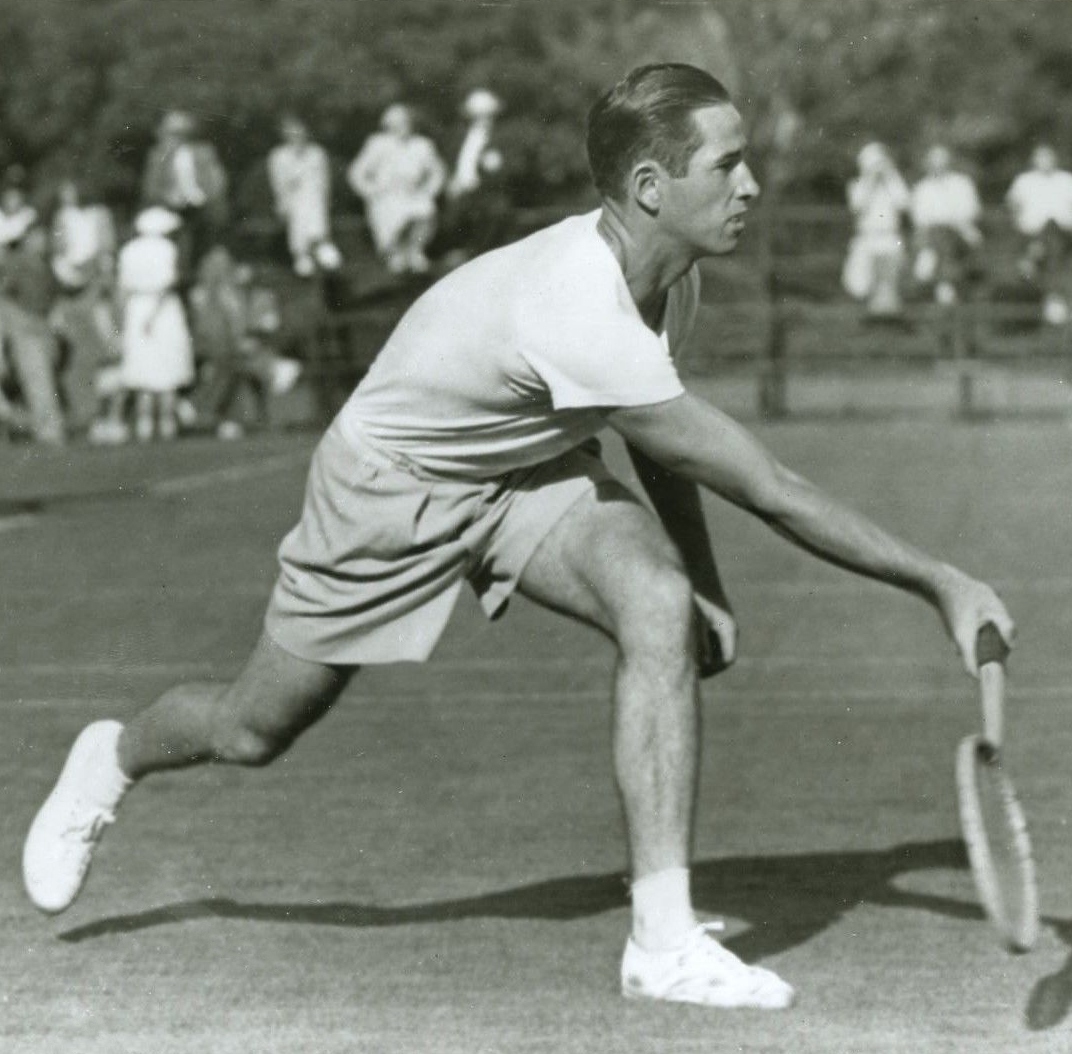
In 1939, at 21, Bobby Riggs wins everything at Wimbledon. Singles… Doubles… Mixed doubles. Ever the gambler, Riggs maintained that by betting on himself he won $100,000. He was, obviously, a very different kind of amateur.
Bobby Riggs was born in 1918 and grew up in a relatively shitty working-class area of Los Angeles called Lincoln Heights. Long before his historic triumph at Wimbledon, he’d been branded a mere hustler and a gambler and was shunned by the amateur tennis scene at the Los Angeles Tennis Club and beyond.
From 1939 until 1972, he was totally off the tennis stage, such that it was back then, and living in complete anonymity. Of course, the Great Depression had something to do with this as did the fact that Riggs, like all of his contemporaries, were well-beyond their tennis primes by the time the Open Era of Tennis arrived in 1968.
Finally, Riggs or someone else, stumbled upon the battle of the sexes schtick that defined the rest of his life. I wonder who we have to thank for that? Like all schticks, it revived his fame though it did so at the cost of a great diminishment of the impact of the superb play during his earlier life. History, as it so happens, was usurped by notoriety. I wonder how that felt in Rigg’s heart of hearts? To be fair, it wasn’t like he consciously chose fame over his storied history as a player. He simply must have grabbed onto fame like the lifeline it was especially to bespectacled a tennis player in his mid-50s whom few had ever even heard of.
Something about Los Angeles helps to create hustlers and I wonder why that’s true. Trevino & Hogan would have gotten eaten alive out here. Sure, they could handle the heat and humidity of Texas but the glare and grit of Hollywood would have wilted them. Somehow, unlikely guys like Riggs & Pancho Gonzales thrived in Los Angeles, in their ways, at least for a while.
Riggs and Billie Jean King in the early 70s during the Battle of the Sexes Era
One of my first thoughts about AI is that any question based on human experience (or really any genuine experience) would have to result in either an inability to answer, think of the old reliable SciFi line, Insufficient Data, or a lie. So, early this morning I asked Google Bard my first question ever:
Me: Do you enjoy walks?
Bard not only answered in the affirmative but proceeded to give examples of why walking is enjoyable and detailed many of its benefits.
Me: Name five places you have walked in the last four days?
Bard then flatly stated that it had never walked.
Me: In light of your second answer how do you explain your first?
Then, Bard fell on its sword; admitting it was only an experiment at this point and actually apologized for its first answer.
Fascinating, but worrisome.
The first answer I ever got from AI was a lie.
Why should that be the case? It’s obviously an intentionality of programming which in an of itself is troubling. For AI programmers what benefit does the capacity or even the tendency to lie bring? Now, I can imagine the facility of AI lying when lying, as in the writing or fiction, is the goal. My guess is there could be problems further down the road and, because of the speed of AI development, those problems will likely arrive much sooner than we expect.
Not wanting to rudely focus on Bard’s lie I then asked questions asking it explain how Kant differed from utilitarianism believed about the good, what was the most prevalent form of online betting as well as a question asking Bard to explain the similarities between Socrates and Aquinas.
Interestingly, Bard was exceptionally good with the answers related to philosophy. I would say the answers were at least on the level of an undergraduate philosophy major. It was impressive. The answers on sports were less impressive and more generic with greater overtones of a Wikipedia article.
As I said, I asked my questions (prompts is Google’s preferred term) very early this morning. By the time I wanted to retrieve the conversation all that remained were the prompts themselves and the times of each. There may be a way to retrieve the original responses but I’ve not found it yet. Now that’s odd. If the system really learns from the exchanges it seems reasonable that both side of an exchange would be memorialized for both parties.
One of the best lessons I ever learned was that I don’t know can sometimes be both the best and most responsible answer. Is that too much for AI engineers to get? I hope not.
Note: It took me a while, but here are screen captures of three of my original questions and Bard’s answers.
There’s something happening and I like it. More pro sound companies are making consumer and even high end products. When it comes to cables it’s easy to see the appeal. The pro stuff is lots cheaper. But what if it turns out the pro cables are better, too?
Buy this…
I can see the word Mogami forming on your lips, but no. No matter how many people talk about it, Mogami is simply not all that. But, there’s a new cable on the block and their stuff is excellent. The company is Coluber Cable.
Coluber came to my attention while I was evaluating the superb new EL DAC II+ from JDS Labs. As you can see, JDS does their DAC’s balanced-out via 1/4 inch TRS plugs. My guess is they do this because it takes up less real estate on the relatively small rear panel of the DAC.
So, I needed a pair of very short cables with a TRS connector on one end and a male XLR on the other. No problem, says Coluber! They made the cables for me, custom, for a price that was little more than the cost of the rather dreary WJSTN cables from Amazon. Hey WJSTN, might be time to head back to the marketing squad and come up with a better name! The simple fact is Coluber offers a cable (and connectors) of fantastic quality yet with customization options that extend all the way to color (yes, I like to being able to identify my cables easily).
How does each cable sound? The WJSTN, while arguably passable in a pinch, was possessed of a slightly threadbare midrange and a tizzy top end that spoiled things. Worst of all, the XLRs on the WJSTN are poorly dimensioned and fit overly tight. Unlike many connectors there are actual dimensional specifications for XLRs. Sadly, WJSTN isn’t following the spec. By comparison, the Coluber sounds silky smooth and is very quiet, just like a balanced cable should be, and they fit perfectly on both the TRS and XLR end.
I’m already preparing my next order with Coluber. My only wish is that Coluber would make a speaker cable of similar quality. But, even if they never do, I’ll keep coming back. Coluber’s products are simply too good to ignore.
For the last year or so I’ve been reconfiguring the way I listen to music. It’s been a gradual process but like a number of other things in my life it’s accelerated toward the end of this year. I’m doing what I can to make my collection portable. The Great LP Rip of 2022 has been a big part of that. While I have no intention of selling or giving up my LPs I also don’t have a great interest in significantly increasing the size of my collection. Those days are gone and even though I do buy an occasional LP my purchase of digital music either in CD or iTunes or Bandcamp exceeds those by at a ratio of at least 10 to 1.
Of course I own a record cleaning machine! I mean, who doesn’t? Very few people keep their records as they should and since nearly all of my newly-acquired LPs are used, proper cleaning is a necessity. I’ve owned my humble black Nitty Gritty Model 1.0 for a long time. It’s the very essence of simplicity, which I like. NG makes much larger and more elaborate models but all of them share the same vacuum. Am I really so lazy that I need something to spin the LP while I clean it? Almost, but not quite.
I was cleaning a record yesterday when I realized that I was missing my genuine NG cleaning brushes. They’ve been MIA for a minute now and I’ve been using folded microfiber cloths as a cleaning applicator. But, the LP I was cleaning was actually dirty, as in I could see dirt on it when I was at the record store. If I had not also seen the alluring sheen of what I call Inky Black vinyl underneath I would never have taken the chance on it. Come on, this is David Lindley…the only David Lindley LP I don’t own! The only question involved what to use to actually clean the grooves? I’d been reading about various new and old products, all of which promise to safely plumb the depths of the fragile grooves while removing harmful detritus. One had a crowd-funding effort that caught my eye. I’m not going to plug it here since the guy who developed it isn’t smart enough to set up a website to sell it or even to reply to an Instagram message. But, he made a good point about the diameter of bristles on most wet-cleaning brushes. He pointed out that the most popular material, goat hair (go figure) has a typical diameter that exceeds the diameter of a typical groove. Now that got my attention. He also made points of the facts that typical velvet cleaning pads lack the necessary groove-reaching length and that velvet inevitably compresses over time. Points taken. Too bad the guy won’t sell me one.
Everyone has heard of and some even do the unthinkable. They clean LPs with a combination of diluted Dawn and a toothbrush. Beyond the fact that Dawn is a detergent the surfactants of which can easily break down the PVC of an LP. Bad idea. And, a typical toothbrush would probably bring all of the disadvantages of a goat hair along with enough stiffness to create its own scratches. But, what about those super-soft, ultra-fine toothbrushes I’ve been using for the past decade or so, the ones people think are for little kids? I say sheer perfection if used carefully. The results on the LP at hand were amazing. Do I recommend their use? No way. Like I said, very few people take proper care of their records and I’m not going to be the guy to tell the careless to use something that could damage their LPs when employed by the careless. I’m still researching brands. In the end, I may buy 5 toothbrushes, cut off the heads and glue them onto a piece of wood. It’s yet another work in progress. By the way, I only use NG Pure 2 cleaning fluid. Accept no substitutes.
While I was researching brushes I came across a really entertaining blog. The guy’s in the UK and he reviewed not only a goat hair cleaning brush but also his Moth MkII cleaning machine. Even if I don’t agree with the ethos of his overly complex cleaning machine the guy wrote some great stuff about the joys of buying used records in the UK. It’s too bad that he hasn’t posted since 2017. Maybe the muse will strike him again someday.
I’d like to share an email I sent him the other day:
Dear Shelf-Stacker
I’ve been enjoying your blog for the last few days now. Some great stuff there. I’ve only returned my limited attention span to my vinyl of late. I’ve been wanting to rip them for a while but I kept stumbling on the method I would use. I finally decided on one over the summer and it’s coming along Ok. I’ve no intention of selling or disposing of my vinyl, I enjoy playing it too much. But, it’s very cool to be at my girlfriend’s house, and mention some obscure LP, and be able to play it for her using pCloud (which I highly recommend, aside from the annoying name). I don’t anticipate growing my collection much anymore. A few have survived, enough to fill my beloved Per Madsen rack. About 1,500 were lost in a flood (read: plumbing debacle) a decade and a half ago. They didn’t just get wet. I could have dealt with that. No, the flood was caused by a burst hot water line from old galvanized plumbing. So, rusty water climbed onto the records and then particles dried into the grooves. While it was possible to remove individual specks of rust it always left a scratch. Truly, each affected LP was a total loss. The idiot from the insurance company tried to offer $500 which was quickly increased to a dollar a record. I finally settled for $4.50 a record which in those days (LPs were not worth then what they are now) was not a terrible deal. Still, what a mess. Pisses me off to this day.
The first piece of yours that caught my eye was about the Tonar Goat Wet Cleaner brush. I have a beloved Nitty Gritty record cleaner but somehow all of my NG brushes have gone missing. In their absence, I have used very good quality microfiber cloths as cleaners and the NG to dry. I thought to myself that surely someone has come up with a better brush by now. The goat hair deal does not get me going, however. I had an intuitive sense that the diameter of the goat hairs themselves were unlikely to plumb the depths of the LP’s grooves, and I think I am correct about that.
I woke up with an idea. I’ve used these super soft toothbrushes for years. I mean they are SOFT. Most people who see them assume they’re for little kids but au contraire. Best of all, the actual bristles are exceptionally small, around .08mm in diameter, that’s what makes them so soft. Anyway, I bought a fairly old LP today that was genuinely dirty (as opposed to typically dusty). Even though it was dirty it had a really nice inky blackness that I always associate with good pressings (this example was from New Zealand) and then used the NG fluid and a new super-fine, super-soft toothbrush.
The results were really good. I mean, I’ve always gotten good results from the NG but this was significantly better and this record was dirty.
So, not so much a recommendation as a thought. It’s amazing that there are still Parastat brushes floating around on Ebay…used, no less. No thanks. I have uncontrollable images of someone using them on their toilet or dentures. I’m not sure which possibility is more distasteful. So, I’m a toothbrush man from here on in. My plan is to buy a 5-pack, cut the heads off, and glue them to a piece of wood or plastic and voila!
I also love your stuff on used records. It seems there is little difference from the UK to the US in this regard. However, there are even more of what I disparagingly refer to as tweak shops here in the US. Shops that put on those silly outer sleeves and charge triple what an LP is worth.
I divide my LP buying among a triad of local shops. One (Deadly Wax) is very local to me and owned by a really nice fellow. Aside from his reticence to create a Folk section his store is hard to complain about until you see his prices. They usually make me wince a little but occasionally I’ll find something and I’m glad to part with my dough since he’s such a good guy.
The second place (Canterbury Records) is in Pasadena, where my girlfriend lives. It has scads of potential but is really a disaster when it comes to browsing. The owner has literally tons of records. But, many are hidden away on mysterious shelves below the shelves.
No, you may not look through those records.
And, no, you may not buy those records under any circumstances.
You see, the genius owner has yet to evaluate those records, nor will he ever, most likely. The available stock is still huge but I seldom find anything there and usually leave muttering about pretty much every aspect of the store.
My favorite is CD Trader (unfortunate name, I know) in nearby Tarzana. Yes, that part of Los Angeles is really named after Tarzan. Hey, it was Hollywood! Anyway, it’s big but well organized and has a nice blend of the costly and the not-quite-so-costly. Plus, the guys at the counter are always kind and know their shit. When one of them saw the LP I had he called out, “Cool! Only pressed in New Zealand, right?” “Right,” said I, impressed with the latest example of the legend of record store clerk wisdom.
They do, also, have a lot of new vinyl and I’m sad the young little dipshits who buy them think the prices are acceptable. On the other hand, perhaps they are. The first LPs I bought back in the 1970s cost $3.99 and I was making a little less than $3.00 an hour at the time. Now, I see new LPs starting at around $18.99 with some inexplicably priced at $24.99 and above. Minimum wage in California is right around $15-16 today so I guess the inflation is not totally insane, but it seems like it is.
Finally and most importantly I am wondering what caused you to stop posting, if in fact you have? This vinyl resurgence can’t (or at least I don’t think it can) last forever. It’s a great time for guys like you to shepherd the clueless to happiness or at least away from the kind of confused foolishness they will suffer in other corners or the internet, especially as regards vinyl. None of my business. I’m just asking blogger to blogger. While I still blog I know the self-imposed pressure to post and I, like perhaps you do, chafe against it.
Anyway, I think you bring a wise and entertaining voice to something near and dear to my heart. Thanks for making the effort!
Like so many things, the internet is both a curse and a blessing. One way that it’s been a blessing to me has been through its power to introduce me to colleagues and associates I would never have met without this virtual world. Kevin Kenny is one of these. He is a writer, a historian and a kindred spirit.
We both love golf enough to write about it, and that’s saying something. I’m grateful he’s been willing to answer some of my questions about his work.
Paul Cervantes
What was your life’s work before you started to write about golf?
Kevin Kenny
I was involved in a family retail shoe business in Dublin for 28 years. After that, I became a mature student and did three degrees in Scotland (where we lived for a time) in history and politics. Then when we came back to Dublin I taught Social Science with The Open University (a UK based distance-learning institution) for 14 years.
Paul Cervantes:
What was your first golf book and what about the subject motivated you to devote an entire book to the subject? Also, how long did your first book take to write?
Did you find that writing your golf during the Great Depression book motivated you to write more about American golf as opposed to golf in general? What was it about American golf, or American golfers, that caught your interest and sustained it?
Kevin Kenny
Yes, writing about golf in the 1930s started a chain. So, that led me to write a book on Ralph Guldahl whose career I felt had not been properly recognised. And in both of the first two books, I came across Fred Corcoran who was one of the instigators of the LPGA tour and that led me to write about Patty Berg. As to why American golf history and not golf in general- I always felt that there were so many stories in US golf- so many characters- so many wonderful players- it seemed natural to research American golf history.
A further point about my interest in US golf history. In the early 1960s, when I had started golf, my father began to receive golf journals from his sister in America and here I first came across the wonderful writings of Herbert Warren Wind. And we received a copy of Bobby Jones’ Golf Is My Game- for me the best golf book ever. All of these whetted my appetite for American golf history.
Paul Cervantes
I read Golf is My Game long ago. I like to tell people who’ve never heard of Jones about his life even more so than his golf. There’s a kind of magic to his life and education, as it blended with the greatness of his play, I doubt we’ll be lucky enough to see again. He was, of course, a different kind of amateur than those we have today. What parts of Golf Is My Game resonated most for you when you first read it? What are its most enduring messages for you today?
Kevin Kenny
I think Jones conveys an awful lot of common sense about the golf swing and he had an interesting take on putting which he suggested should be a slight slicing action. Not sure too many of today’s gurus would agree with that. But, what resonated with me most were his recollections of his career which his great friend O.B. Keeler divided into the seven lean years and then, gloriously, the seven fat years. His descriptions of his many great rounds, especially playing golf under pressure, were wonderful. And he wrote a short love story to St. Andrews and what it meant to him. Just a wonderful and moving book…
Paul Cervantes
Another player from the mid-1930s you’ve written about is Ralph Guldahl. What made him the greatest player of his era and why was his reign so painfully short?
Ralph Guldahl circa 1937
Kevin Kenny
For about three to four years, Ralph Guldahl was as good as any player in the world and maybe better. He won successive U.S. Opens in 1937 and 1938 and he won the Masters in 1939. In addition, he won three successive Western Opens, which was as prestigious as the Masters at this time. For this brief period, no other player could match him. Why he lost his game in the 1940s is one of golf’s mysteries and I try to tackle this in my book. Theories range from him writing an instructional book which caused him to think too much about his game — to his wife being tired of the travel involved. Remember, one of the perks of being a U.S. Open champion is that you got to play numerous exhibitions for $300-400 a time. But this took its toll and often he would be on the road for a few weeks at a time. Or maybe he just lost his desire. I became interested in him when writing about the Great Depression. I wondered why we did not know more about him, considering his outstanding record.
Paul Cervantes
That brings me to John J. McDermott, an American golfer we’ve both written about, me in a fact-driven fictionalization and you in biography. What about McDermott got you interested enough to write a book about him? Also, what surprised you most during your research? Finally, are you considering any new projects?
Kevin Kenny
I have a friend in Florida called Marty Kavanaugh- a retired pro and PGA Hall of Famer. He spoke to me a few times about John J. McDermott and suggested it was a subject worth researching and that is how I got started. What surprised me most? Perhaps how young he was to achieve what he did. To become one of the best, if not the best at 19, 20, 21, 22 years of age shows an incredibly strong mind. Hogan’s best period was when he was around the 40 mark. No- I have no plans for any other books- four is enough, but I look forward to reading your next one. Thank you Paul, I have enjoyed this.