Why book clubs are an abomination; not really, well, kinda.

I was out to lunch when someone mentioned how the pace of her book club was making her forget what she had read.

She said, “I vividly remember books I read in high school and college just fine but I don’t remember book club books from just a few months ago!”

I said, always trying to be helpful, “That’s because book clubs are an abomination.”

“Hey,” she said. “I really love my book club. You suck.”

Who invented book clubs anyway?

I did wonder about that but in the end the answer doesn’t matter. Book clubs are here to stay and people (think) they like ‘em. And, isn’t liking something what life generally and reading specifically is all about? Could be, but there’s something else going on here. All of us have easy access to way more books than we can ever read. That’s not always been true, of course. Back to lunch. Before being canceled on charges of anti-book club heresy I tried to stimulate a moment of deeper thought when I asked, “How many books would you guess Shakespeare read over the course of his 52 years?”

Dozens, possibly hundreds but unlikely thousands as so many of today’s avid readers consume. Yes, I said consume as humans consume food as part of an endless cycle of food in / waste out. Imagine a food that continues to nourish over weeks, days and years. In reading, those are books remembered, returned to, quoted and treasured. Book club books are destined to be forgotten, like an unsubstantial meal that provides little if any sustaining nourishment.

The same effect, also driven by increasing ubiquity, also happens with music. Casual listening drove omnipresent music first into elevators and now Spotify. Now, think about the last series you binge-watched, unable to be sated, uninterested in waiting, until next week before devouring the next episode. Have you ever started what looks like an interesting series only to realize somewhere during the first episode that you’ve already watched the series from beginning to end? For all of this to work, an endless stream of media has to exist and it does. So, we consume more but with less and less genuine respect for what is being created.

Reading and listening; are they the same?

Of late, a book reviewer at the New York Times wrote a piece telling the world she’d come to fully embrace audio books over actual reading. I could not fight my way through the entire article. When she went so far as to contend that listening to a book was the same as reading I had to close the virtual pages of the newspaper I was reading. Can you imagine being a teacher of first or second grade students, trying to teach your students to read. Then, imagine an indignant parent scolding you for requiring students to learn to read when even reviewers at the New York Times prefer listening to reading. Why should my child bother to learn to read?

By the next morning it struck me that the reviewer was actually minimizing both reading and listening by unwisely equating each. Do I actually have to say that reading and listening are two different processes? The reviewer went on to sing the praises of audio books because she could listen while she knitted, crocheted, wove baskets or whatever. Full disclosure, I’ve done the same except I’m doing something truly constructive. Namely, practicing my tennis serve. Still, I am not reading while hitting my out-wide slice. I am listening and listening is an active and rewarding process.

We can dig a bit deeper by thinking about music. We nearly always listen to music but some cognoscenti read the musical score while listening which might give insight as to the performer’s fidelity to what’s been notated onto the score. That kind of listening is quite intense and so is also uncommon. Listeners to audiobooks may like or dislike the narrator’s voice. But hearing the narrator’s interpretation doesn’t bring anyone closer to a genuine — and certainly not a dispositive — understanding of what the author meant.

As an aside, I just finished an audio book called Meet Me at the Museum by Anne Youngson. It’s an unusual novel. The entire book consists of letters sent back and forth between a woman and a man. What’s interesting? Well, I think whatever quality exists in this book is primarily conveyed by the female and male readers, one an English woman and the other a Danish man writing in English (or someone doing a fair impression of a Dane speaking English). The point here is only that interpretation is an art, whether it is the interpretation of words on a page or musical notes on a score.

My hope is that we will all read and listen and watch with greater care and deliberation. Sensitize your own preferences when it comes to the media you consume. Look within rather than relentlessly asking others to recommend books or music. I think part of what makes art memorable is, sometimes, the effort we put into finding it. And, importantly, once you find something, read it again as you would play a song you have come to love, again and again. Read some of the dialog and narrative descriptions out loud. For just a few minutes, you be the narrator. Seek to treasure what you consume and it will nourish you now and tomorrow. Put another way, read less and you may find that you enjoy reading more in addition to remembering more of what you read. No, you don’t have to quit your book club but you might be a better reader if you do.

Why book clubs are an abomination; not really, well, kinda.

914 part 1 is done!

It will be up at Amazon within a couple days. When it’s live I will put a link here.

914 is part of a collection of short stories I had hoped to finish by now. Alas. My new plan is to release each (or small mini-collections) while I continue to work on the collection. This will give me time to revise the stories individually before dealing issues related to the collection.

The collection will be available both in ebook and on paper, the individual stories are electronic exclusively.

A note my workflow evolution. I composed 914 in Apple Notes, as always. But, this time I imported the copy into Pages so I could eventually export it to EPUB. Who knows how long KDP will allow EPUB? No matter, I’m taking advantage for now.

A small lesson learned was that EPUB doesn’t support headers or footers, so no pagination. This makes sense when one considers the resulting copy has to be reflowable.

Pages is not especially intuitive. I can imagine a day when it will be even more like Word. But, it’s manageable and that’s all I ask for today.

914 part 1 is done!

My short story 914 and the cover ChatGPT has been working on.

I’ve finished Part 1 of 914 and I’m pretty happy with it.

It seems our friends at Amazon’s KDP have given up on their MOBI file in favor of their new creation, KPF. For a writer, KPF is just the latest hurdle on the journey to getting what our work onto the KDP platform, but who am I to complain?

Then I thought of something. I composed 914 in my usual app, Apple Notes. Then, after reading about the demise of MOBI on March 18 I noticed that KDP will grudgingly accept an EPUB file. I recalled Apple’s Pages allowed for export to EPUB so I decided to export to Pages and then to EPUB. Part 1 of 914 is long for a short story (about 6,000 words) but simple in terms of layout. There are no sections or chapter headings and I don’t care much about widows and orphans for something that won’t appear on paper until my entire short story collection is done. So, I dumped the 914 copy into Pages, worked out pagination and a header, and now I’m down to editing. If the resulting file is really cool with the wise algos at KDP then I’m cool, too.

I had some ideas about the cover but I really don’t want to spend too much time on it. 914 is only one of a collection of short stories I decided to publish by itself. Why not? There’s no downside and it seems wise to keep up with how KDP’s machinery works as well as I can. Enter ChatGPT. Chat is all in and came up with two promising ideas in the snap of the finger. After I made a few corrections Chat said:

Great choice! I’ll modify the image to include a classic blue-and-yellow California plate with a slightly obscured number while keeping the overall aesthetic intact. I’ll get that done and share it with you shortly. I’ll start working on the modifications now. Once it’s ready, I’ll share the updated version with you.

And then, nothing. When I reached out this morning to check progress Chat said:

Good morning! I haven’t started editing the image yet, but I’ll get to work on it now. I’ll update you as soon as it’s ready!

At least he’s positive and enthusiastic. Who knew working with AI would feel exactly the same as working with a living, breathing artist?

My short story 914 and the cover ChatGPT has been working on.

February 14: Finally, an idea

Reliably, my endless babbling typically goes nowhere. But today I was telling stories of another era of my life, probably for the 10th time. When I finished I found myself thinking that there could be a book in the stories I told. It would be set in the 1980s. It would be somewhat biographical and somewhat of a period piece. As an aside, I am continually disappointed by the way stories from the 70s and 80s are told in today’s television and movies.

I have no doubt that it is ever thus, but it’s still distressing. Most efforts seems so enamored with the styles of hair and clothes as to ignore entirely the differences and similarities that the era portrayed has to today. As another aside, I would cite an exception with Mad Men. Any series that could actually make a teenage girl quit watching because the relentless sexism of the series was so distressing was definitely doing a lot of things right.

Let’s just say I’m not lining up to see Licorice Pizza.

Like a lot of other folks my age are thinking (and saying), fuck that…I lived it and it was a hell of a lot more entertaining, believe me.

Anyway, my idea would go from the mid-1980s to the mid-90s, ending in the genuine purgatory I endured living in the Santa Clarita Valley.

Without realizing it, I relive that decade a lot. To paraphrase Jackson Browne, you don’t know the big reasons of your life until after they’re gone.

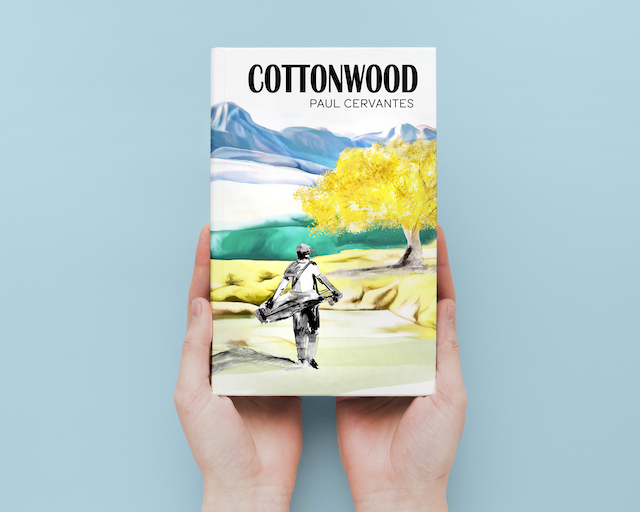
Wait. I also got the second concept for the cover of Cottonwood tonight. Like the first, it’s not quite in line with what I wanted, but I love it. I called a bit of a timeout since we don’t yet know the thickness of the spine. That dimension will affect how much of the cover image has to wrap around to the left. It will be give me time to choose between wonderful and wonderful.

Finally, tonight’s writing soundtrack is Poor Ellen Smith by Gillian Welch & David Rawlings from their 2020 record, All The Good Times (Are Past & Gone). Finally, tonight’s writing soundtrack is Poor Ellen Smith by Gillian Welch & David Rawlings from their 2020 record, All The Good Times (Are Past & Gone).

No, it’s not exactly cheery but it’s perfect.

Thanks for reading.

February 14: Finally, an idea