Throwing away an idea

One of the reasons I insure my now-aged 2006 Mini Cooper with Hagerty is the ongoing enjoyment I get from reading their superb Drivers Club quarterly magazine. First of all, the issues are printed. This fact makes me think think back on the USGA’s defunct magazine, Golf Journal, surely one of the best golf periodicals ever and also a stinging example of the USGA’s lack of vision and why golf sucks. I have collected a handful of year’s worth of Drivers Club issues. I keep them in wooden magazine holders I’ve owned for decades. When the dedicated holders got full about a year ago I decided to purge the least-interesting past issue whenever a new issue arrived in my PO Box.

Wednesday is happy hour day (I say day because my friends at Institution don’t do HH every day but only on Wesnesdays and only from 4-6pm. Geez.) at Institution Ale and I made sure to bring my reading glasses so I could devour the issue in a hop and sunshine-augmented vibe. The issue was a little disappointing but I still read most of it. By the time I finished my one-and-done ON PINS & NEEDLES (Session IPA) I had closed the magazine, done with it and sure it was the latest issue not to make it into the vanishing space of my wood magazine holders. By the way, I don’t usually care for session IPAs but this one was excellent, while not at all like being hit over the head as are so many of the big-boned, broad-shouldered IPAs I typically enjoy. After leaving my empty glass on the bar I noticed a trash can and unceremoniously dumped the current issue of Drivers Club.

Then, I forgot all about it.

Until this morning.

While on my 30-minute drive to tennis I made a couple voice memos, two of them actually. After I finished the second recording my mind flashed to the day before and the trashed magazine. And then I remembered the largely subliminal urge that caused me to throw the magazine away.

There was an article in the magazine about a guy who set out in his crappy old Mitsubishi pickup / camper to visit some of the environs of California’s own, John Steinbeck. Something about the guy’s set up irked me. I may not have appreciated the Steinbeck works he focused on, especially Travels with Charley, but there was something else that kept me from reading an essay that might have been right up my reading alley. I know Steinbeck’s work well, having read all of his works (even his superb short stories) with the exception of East of Eden. I could easily do what this guy did (absent the mini-truck camper). What afflicted me was simple road trip envy.

Yes, we recently returned from my family reunion in the midwest.

Yes, we extended our trip with a three-day visit with my dear friend MIB in south-eastern Michigan.

And, yes, we hope to make it to Sacramento sometime this fall.

And, that was enough when it comes to travel for a while.

But, a true road trip is different. I haven’t been on one of those for years. To me, road trips differ significantly from simply traveling by car. One of the main differences is a lack of advanced hotel/motel reservations. This is especially doable when on one’s home turf, which I am whenever I am in California. Unless I’m way north of Redding, I’m more than happy to head for home if I can’t find anywhere to stay. A big challenge for me is finding places in California I’ve not been before or places I’ve forgotten about or would actually like to visit. A friend of mine just got home from riding the historic Skunk Train in Fort Bragg. Fort Bragg is a weak maybe while the Skunk Train is a big probably not.

Even though I’m not excited by the prospect of riding a near-silent rail car I would like to spend some time in California in the 300+ miles from Fort Bragg to Medford, Oregon. Here I am thinking of the Trinity National Forest and the Six Rivers National Forest.

But now the calendar says September and that makes me wonder when we will have the chance to take another road trip.

I hope it’s soon.

In the meantime, I wonder if I can find a copy of the current issue of Hagerty Drivers Club on Ebay?

Throwing away an idea

Cancha Original Tennis Racquet Bag (15L) review

I love small companies.

They can (and this is certainly true of Cancha) create products that fill a void for buyers (like me) who are tired of seeing and using the same old products.

It’s hard to believe there’s so little variety when it comes to tennis racket bags. There are the moving billboards offered by the big tennis companies. You know, the kinds your favorite pro drags on and off the court to make sure you know he or she is being well-paid by Wilson, Head, Babolat, Yonex or whomever. I wouldn’t say these bags don’t have their place. My coach uses one but in addition to carrying a whole gaggle of rackets every day he pretty much has to live out of it at times.

If you’ve seen one of these big bags you have pretty much seen them all. And, although many of my fellow club players are happy to bend their backs carrying them, many others prefer something lighter and more thoughtfully made. I think that way and obviously so does Cancha’s head honcho, Jack Oswald. You can read more of Oswald’s story at the Cancha website so I’m not going to rehash his story here.

Finally, I want to let you know that Cancha is giving the ax to the model I am reviewing here. I think that’s a shame since the bag they’re replacing it with with is significantly larger and more expensive. Oh well. I guess all we can do is wait and see what Cancha’s product offerings look like in the near future.

Look, a tennis bag is not a complicated thing. But, even a simple thing can be done well or poorly. As they say, the (tennis) gods are in the details.

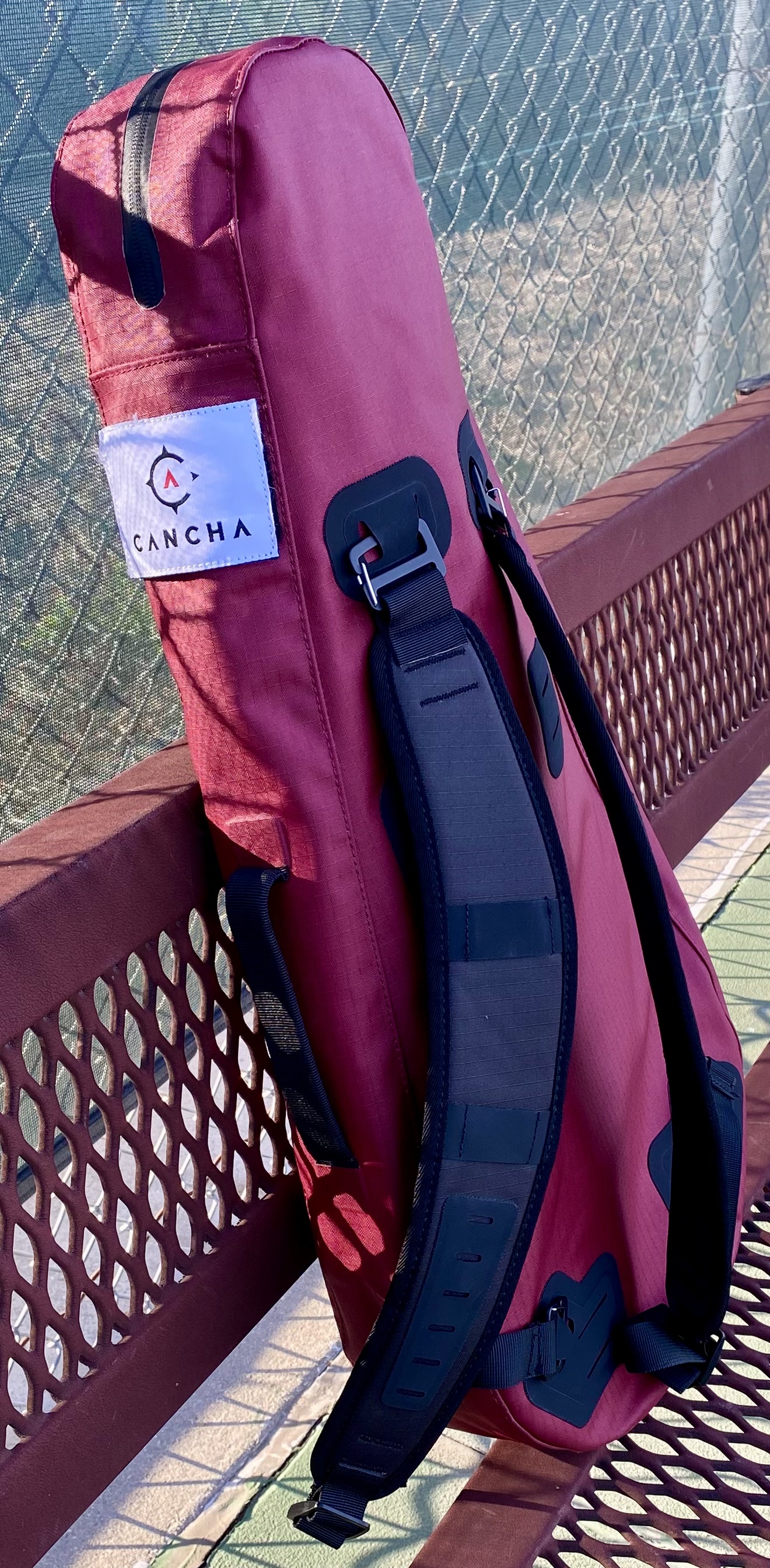
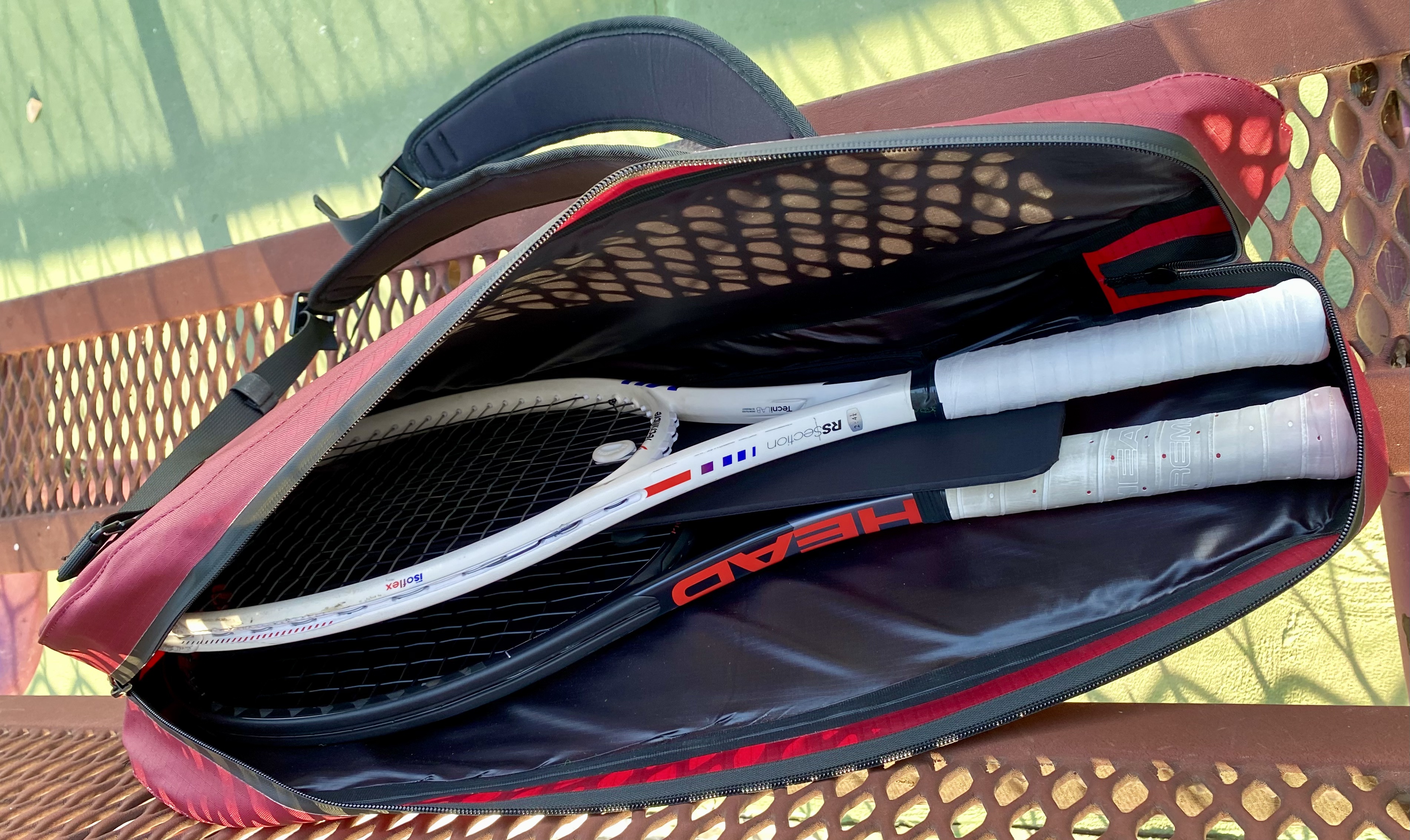
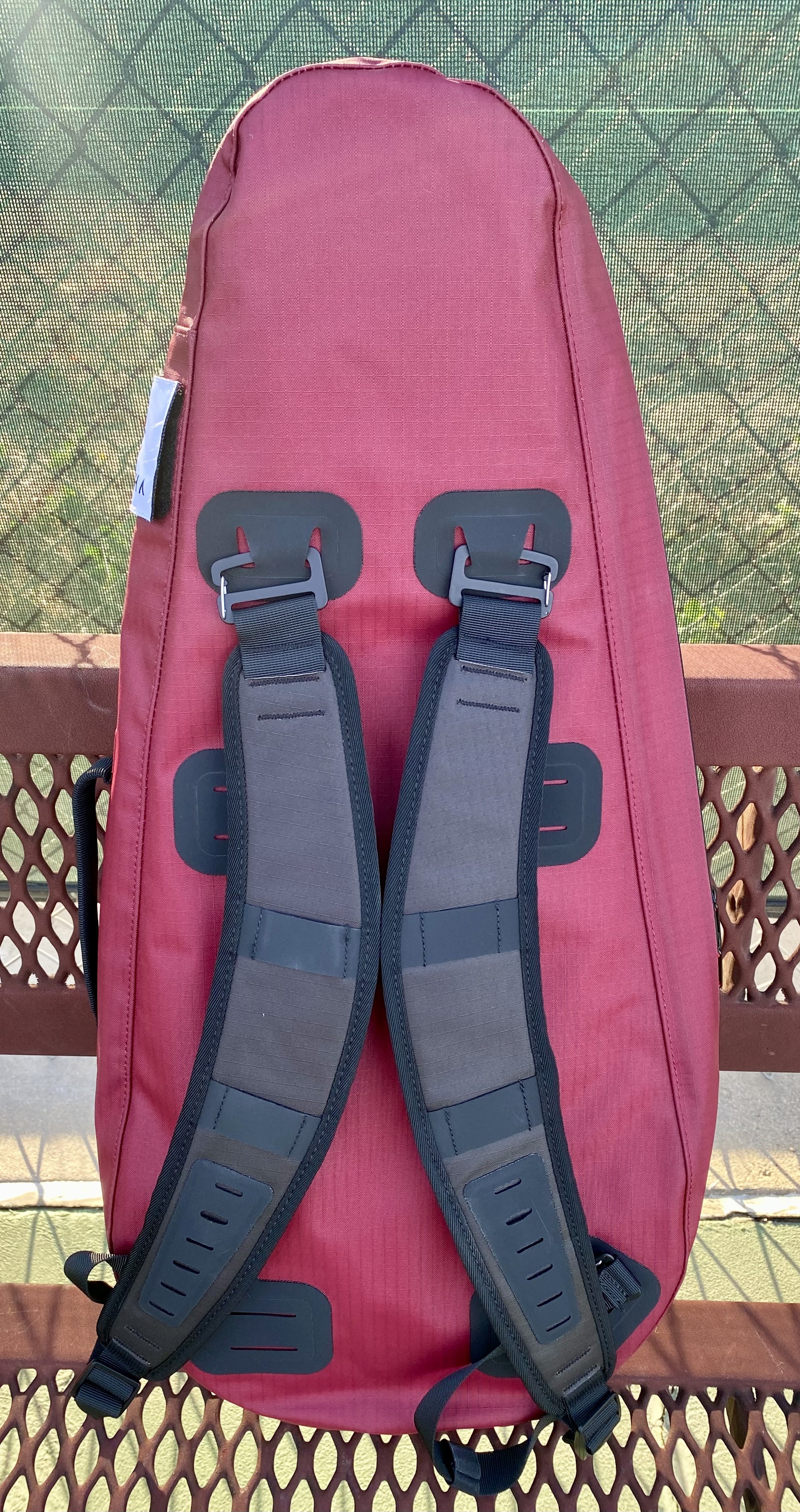
I absolutely love the form factor of the Cancha Original Racquet Bag (15L). Absent the use of racquet for racket, I think the original Cancha fits the average player’s game and needs perfectly. It comfortably holds two rackets and three in a pinch. Double shoulder straps are an absolute must and they were one of the reasons for the Cancha being on my short list of bags.

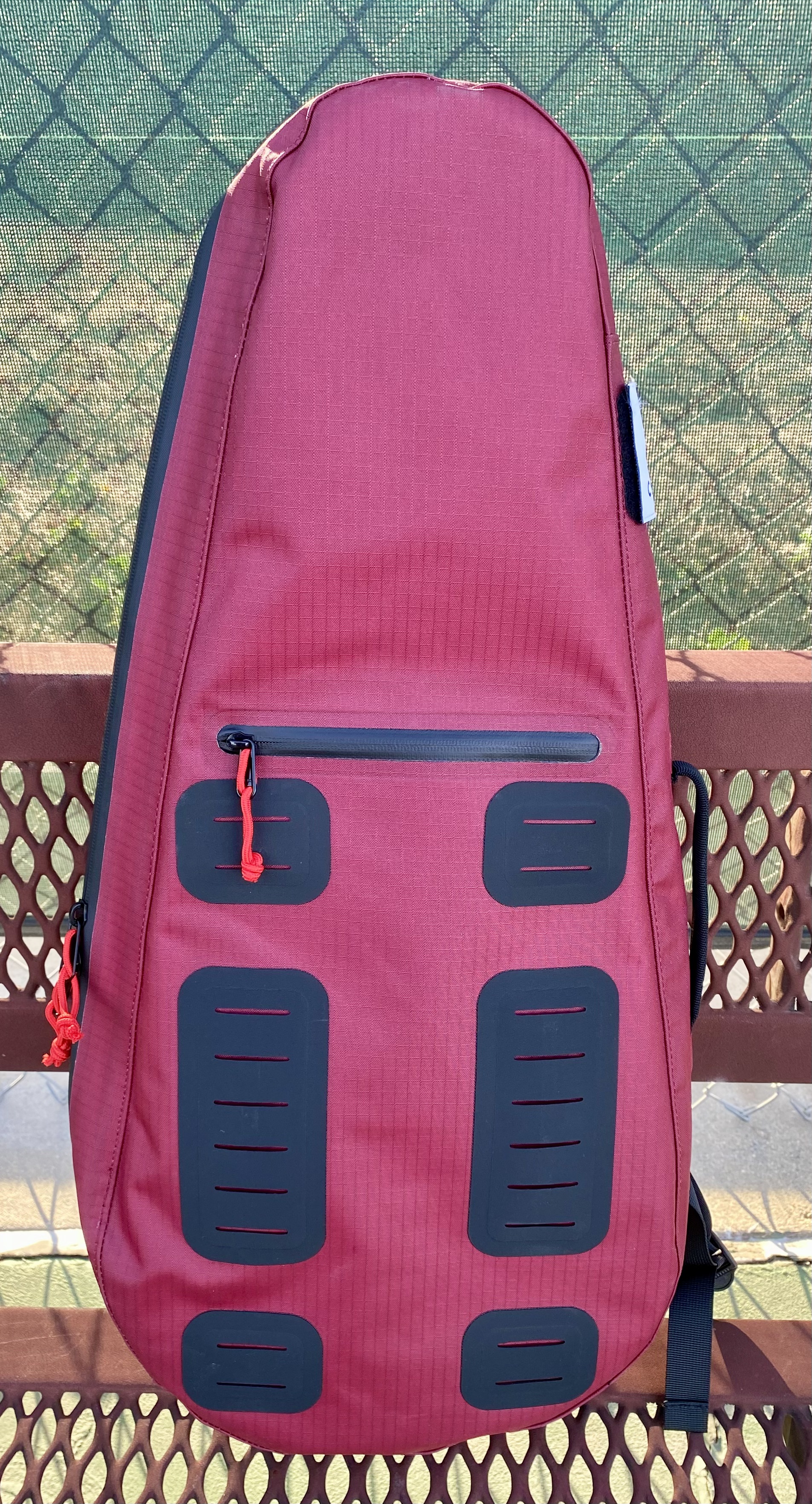
Overall construction looks dandy. The materials appear to be resistant to water (not that it matters much here in SoCal) and the zippers are smooth and rugged feeling. The single zippered pocket on the outside is too shallow to be as useful as it could be. The pocket barely has enough room for my wallet, keys and phone. Forget about my sunglasses. Remember Cancha: phones are getting bigger all the time.

A unique and promising feature of all Cancha tennis bags are the RF Bonded Hypalon Molle Patches. These allow for quick attachment of various Cancha accessories like their Dry Bag. Cancha creates their bags to be truly modular and that flexibility appeals to me. For day to day use I don’t need (or want) a shoe bag piggy-backed on my tennis bag but when I hit the road with my rackets I will definitely want that option.

Though it’s a little hard to see there’s a half-divider between my rackets.

Even with the single velcro Cancha patch in place the bag is pretty stealthy and I appreciate that. Only my friends at Courierware go further in their effort to avoid obvious promotion of their brand by placing their name and phone number on a tiny tag on the inside of their bags!

I was a little disappointed that by the time I was ready to take the Cancha leap the only available color was red. The red is actually quite nice. The problem, of course, is many of the locals associate any shade of red with USC and that’s an association I usually would not tolerate.

But, for the Cancha bag I will make a rare exception. I hope my Cancha bag lasts me a good long time. So far, it’s been a joy to use. Well Done, Cancha!

Cancha Original Tennis Racquet Bag (15L) review

Tennis thing: Racket thing 

It’s said that Novak Djokovic plays a tennis racket based a fifteen year old Head frame design. When I heard this and considered the fact for a few moments I thought to myself, the tech hasn’t advanced. If it had, Djokovic and the rest of the high-level players would be taking advantage.

Now this struck me as odd since tennis tech, as evidenced by string and rackets, advanced significantly sometime during the Agassi era. It’s easy to imagine how the move from wood to metal to graphite and the simultaneous evolution of strings, from gut to multifilaments, co-polys and polyester monofilaments, changed tennis forever, if maybe not for better.

I’ve come to describe tennis as an oppositional striking game, approximating some of the  confrontation elements that take place between a pitcher and hitter. Other than appropriate footwear, the racket is pretty much all the equipment a player brings into battle. In high level professional tennis, rackets are quite nearly disposable. To the enthusiast they are alternately sources of fascination or confusion.

The mechanics of a tennis racket are fairly simple. This is not to say that designing or building a racket is simple. Contemporary tennis rackets are the flower of post-industrial revolution advances in materials science and mass production. In some ways they are equatable to a contemporary golf driver. Both are component devices; one comprised of racket frame and string and the other of driver head and glued shaft. A driver’s playability is determined by the integration of shaft/head/player. In tennis, it’s obviously racket/strings/player. Both golf and tennis have well-developed industries to research, manufacture and market products but what do those wildly successful commercial efforts mean to the player?

I don’t want to get too carried away by ideas about the physics or mechanics of the tennis racket or the driver for that matter. Suffice it to say both improved very rapidly a few decades ago and both, today, have reached a kind of stasis. That stasis comes from a combination of two things. The first is the theoretic maximum of coefficient of restitution (COR, hereinafter). COR is the degree to which a modern driver face can deflect thereby allowing the ball to travel further assuming a given club head speed. So, virtually every modern professional golfer is using a driver head with essentially matched technology in terms of basic mechanics. I think the same thing is true when it comes to tennis rackets. The industry has pretty much figured it out. Now, this doesn’t mean all tennis rackets perform identically. They vary by length, weight and flexibility on at least two axis. The difficult and more interesting question is this: how do changes in those qualities affect a tennis player? 

TW’s drivers, 1997 on the left and 2018 on the right
No, TW did not put the pop-up mark on the old driver

Let me dodge that issue momentarily by shifting back to golf. If we regard Tiger Woods career as lasting roughly two decades, we will see that he started out using a driver that was pretty much from the decade that proceeded it. In other words, the next generation drivers being used today had not yet been developed by 1997. So, Tiger Woods when he first came onto the PGA Tour, used a driver (a King Cobra Deep Face 9 degrees, True Temper Dynamic Gold X100 shaft. The X100 shaft is steel, heavy steel at that. The driver’s steel head displaced somewhere around 210cc. A few years after that the driver boom occurred. The boom was caused by the simultaneous development of aluminum titanium alloys, which allowed the head size to balloon to 460cc and also the ability to maximize the mentioned coefficient of restitution. So, by the mid 2000s Tiger Woods would be using a driver with a graphite shaft and an aluminum / titanium alloy head that rode the edge of maximum allowable COR as regulated by the United States golf Association. 

By the mid 2000 driver technology for the most part had maxed out, both in terms of material and technology. Interestingly, if we make the obvious assumption that Novak Djokovic has access to the best equipment in the world, and further, that his racket of choice is based on a fifteen year old design, we can also conclude that tennis rackets, at least for the time being, have also been maxed out. So, back to the earlier question; how does this affect the average player whether a golfer or a tennis player? In both sports, I conclude that the technology advancements of the last fifteen to 20 years has been virtually irrelevant. Tiger Woods, at any point in his professional career, could have gone back to his 1997 steel-headed, steel- shafted driver with very few consequences. It is even arguable (and I have promoted the opinion) that the slight decrease in distance paired with the significant increase in control would have led him to even better play during that time of his career. As regards tennis, I doubt that any amateur player is likely to be disadvantaged by using a racket that’s even older than the one Novak Djokovic plays.

Tennis thing: Racket thing 

Tennis thing: Learning the serve

I take two lessons a week, only 30 minutes each, though for a time I added a third lesson to focus specifically on the serve. My thought was that within a month or so my serve will catch up with the rest of my game and I’ll go back to two lessons a week. It may turn out that my estimate is optimistic. We’ll see.

Serving is a blend of the toss, the swing (upwards and then outward) and managing to send the ball into the court. I think the toss is unique in sports. I can’t think of another game that asks the player to essentially throw the ball to himself to initiate a strike. The serve, at this point, is abbreviated. I start with elbow up and the side of the racket against my upper back. I’m sure it looks funny but I understand the theory. It reminds me of an abandoned golf swing theory that David Leadbetter tried to sell a few years ago called the A Swing. In the A Swing, the player started his backswing with the hands at around waist high and the club head near shoulder height. 

It never caught on. 

But, as I said, I do get Caesar’s idea. The entire serve motion is surprisingly tricky. The problem is that it looks so simple on TV, or when an expert like Caesar hits a serve right before my eyes. If only. Watching others is instructive in at least two ways. The first is as examples of what not to do. This is a sadly rich field. I see some pretty good tennis players with very bad serves. When I asked Caesar about this he didn’t hesitate before he answered. “Very common. The best way to practice the serve is to do it alone, and it’s boring.” This sounded similar to practicing putting. 

But wait, I’m trying to forget about golf. 

In addition to tossing the ball to yourself, you also have to coordinate a separate motion, that being the actual swing at the ball. There’s one more bit of fun; the ball will be (or should be) far above your head when you strike it. That strike location makes the motion all the more difficult to master. 

I keep the images of three serves in my head. First and most obvious is Caesar’s. Even through he  frequently reminds me that it’s been over twenty years since he’s hit a competitive serve there’s no missing the mastery of his motion. His serve makes the solid strike of the ball seem like a mere eventuality. It looks like he couldn’t miss. The motion and the pace of the serve seem very much out of step with each other. His take back is slow and smooth but once the ball is hit the other perception is of speed.

2021 © Ben Gauger

On TV I  enjoy watching Maria Sakkari of Greece. She is closer to my height so length of her arc and potential extension are closer to mine. There’s a fantastic slo-mo of her serve on Instagram that I study from time to time. It reminds me a mid-1990s golf thing called Sybervision that featured continuous slo-mo loop of Bobby Jones hitting a golf ball. I never got my tempo anywhere close to Jones’ but it was a helpful reference to what was possible. 

2010 © Kate Tann

In the realm of the impossible, something I enjoy watching for its abbreviated if lurid grandeur, is the serve of Andy Roddick. I love abbreviated, explosive athletic motions like Roddick’s. It looks as if every unnecessary movement has been deleted leaving only the kinetic elements that contribute directly to the strike. This appeals to me. It makes me think that I could replicate the essence of Roddick’s serve absent, of course, the astonishing speed and power he achieved. The movement in his serve reminds me a little of watching Nick Price hit a 4-iron. Neither swing lasts long but both are awesome.

2007 Boss Tweed, CC BY 2.0 via Wikimedia Commons

The take back is the next issue. I’ve watched videos of professionals who start with the racket in the trophy position, upper arm parallel to the ground, upper arm at something like a right angle to it, racket pointing skyward. From here, they execute their racket drop, the rotation of the upward-facing racket to a position that finds the top of the racket pointing backward or, in the case of Mr. Roddick, nearly straight down. Many players coordinate the movement of the tossing arm with the racket arm, so both arms are moving upward at about the same time. I cannot say exactly why, but there’s something about this motion that feels off to me. If the tossing and swinging arm go up at the same time and the ball is tossed further upward it seems to me that the swinging arm will have to wait for the ball to apex and start falling. I understand the racket drop takes time before the forward swing gets going but it seems to me that, maybe, if the swinging arm trailed a bit the transition into the swing might be smoother and more sequential. Not to fixate on Andy Roddick, but this photo shows what I mean.

More on the serve later.

Tennis thing: Learning the serve

Tennis thing: “Paulie, you would love tennis!”

I first wanted to play tennis when I was eleven. But, I didn’t actually play, and neither did any of the 5th-heading-to-6th graders who were unlucky enough to take tennis in summer school in 1971. Shit, I even got a racket, a Pancho Gonzales model I got in exchange for two books of Blue Chip Stamps. I also had enough dough on hand to buy a can of Slazenger tennis balls. My dearest piece of tennis swag was the neat little ball pouch my mom made for me. Rather than lug that silly, cylindrical tin can around I carried my three new tennis balls in the pouch my mother made, complete with drawstring fashioned from an old venetian blind pull-cord.

Rockin’ for sure. 

The only problem, as I mentioned, was that we never hit a ball and the class was unceremoniously cancelled after the first session. It seems no one realized a tennis court needs a net for the game to be a game. Sure, we could have banged balls against the handball court that stood a few feet away but no one thought of that. So, the Spalding tennis racket went home and our springer spaniel, Bo, got to shred the new Slazengers to pieces. There’s always someone who’s happy with an outcome.

Fast forward to late summer of 2023. I’m 62 and I’ve still never played tennis, yet a coalescence of forces somehow got me started in the game. First, was my friend Michael who early in our largely-telephonic relationship would tell me, “Paulie, you’d love tennis!” 

Where Michael got the nerve to call me Paulie I will never know. 

The second force was a spur-of-the-moment stop at nearby Calabasas Tennis & Swim Center. I’d been thinking of taking swimming lessons but nothing had panned out at nearby Pierce College. Indoor pools (like those at area YMCAs) lost their appeal sometime early in the pandemic. After the visit, I found myself checking out the club’s website when I noticed a list of tennis coaches. One name stuck out, I’m not sure why. Maybe it was the first name, Caesar. Heck, I’ve always wanted to know someone named Caesar. Plus, he’d worked with wheel-chair players. I figured anyone who could do that successfully had a decent chance with broken-down me. I sent Caesar an email and waited— for about an hour. Turns out he had time the next day, Monday. Talk about the ball being in my court. I thought it over for a minute before I fired back an email saying I’d be there.

I was ready, if ready meant wearing one of my best golf polos, a pair of khaki golf shorts and my old Nike gym shoes. Caesar was kind enough to offer the loan of one of his cool Tecnifibre rackets. My first lesson was the end of July and it was hot, just the way I like it. One of the unexpected yet best things about taking up something like tennis at my age is this: I had absolutely no idea what to expect. Would I even have a chance to swing at the ball during my first lesson? I remember stories of John Wooden spending the first practice going over the proper way to tie a basketball shoe;  a method that prevented blisters, turned ankles and laces that untied themselves during a game. Maybe that would be how it was. Another nightmare vision stressed running, more running than I could do at 62 and maybe more than I could have done at 42. Caesar is a no-nonsense kind of guy with an outwardly easy yet somehow intense brand of focus. Caesar’s racket in hand I stroked short forehands from the forward-service line as he hit the ball lazily back over the net. I was overjoyed when my first swing sent the ball right back to him. Amazing.

Better than the result, an outcome wholly irrelevant when you consider we weren’t playing a game, was the feeling. It felt good. I could feel the ball and the tension of strings come together before the ball made its way back into Caesar’s court. That was only a few months ago, in late July, but after only a few more swings I was hooked. It wasn’t as if every shot was perfect, or even successful. There was some magical combination of my motion and watching the approach of the ball and unconsciously aligning my body in a way that gave me a clean cut at the ball that grabbed me right away. Michael was right.

Every few balls, after I’d swatted a ball into the net or fouled one off into the court adjacent to us, Caesar would stop long enough for a chat at the net. Those breaks were a relief, a chance for my arm to recover and for me to catch my breath. Caesar always, and I mean to this day, many, many lessons later, always starts by saying something positive before moving on toward something that needs correction, like my forehand follow through.

Caesar’s positive style is still perfect for me, especially with my well-developed ability to be critical of myself. The overall vibe of the club was similarly positive though it took me a while to specify everything I experienced and saw that made it feel that way. First, and this was unexpected, was the presence of actual women. I mean, there were women everywhere, I’m guessing at least half of the people taking lessons were women and an even greater percentage of those who were playing, usually doubles. There were young women, well-tended middle-aged women, little girls and one woman, who had to be at least 75, carrying a Babolat bag that must have weighed at least half as much as she did. 

Being on the tennis courts felt like being out in the world. It was nothing like being on a golf course where 95% of the players were just like me; late middle-aged men. In golf, women and girls are so much in the minority that they always stick out in a way that disadvantages them. But in tennis, they all seemed so at home, so empowered, so much as if they belonged, which they do. Being better for them makes it better for everyone, including me. Even better is the vibe that extends to the way lessons are given. Walking by the courts you can hear students and coaches chatting with each other, sharing a laugh at shots, both good and bad. And, usually, student and coach are playing some approximation of tennis itself. This is almost never true in golf, where the instructor usually stands, arms crossed, observing the student and commenting on an occasional shot.

Stifling. 

Even though I was gassed after my lesson I could feel a connection to the game I had never felt before, except in baseball. It wasn’t like I was great at it, I’m still not. It was the way my motion and flight of the ball and the eventual meeting of the ball and the racket brought a feeling that was just right. Now, when it comes to tennis feeling right it’s not exactly feeling. And, while some elements of tennis do feel natural there are a myriad of details to monitor to make the shot come off, and not all of those come easily. Example? The toss that precedes a serve. More on that later.

Occasionally, in the same way one’s thoughts might drift toward the consideration of mortality, I wonder what might have been if I had turned to tennis when I was 52 or 42 or 32 or 15? It’s fun to think about the rackets of each era, especially the ones that were used when I was 15 in 1976. The Pancho Gonzales model I had when I was 11 would have come in handy, I suppose. But, I manage to keep those feelings away and to stay in the moment, as tennis demands.

Every time I walk onto the court, I feel lucky, and that’s a gift in itself.

Tennis thing: “Paulie, you would love tennis!”