Cancha Original Tennis Racquet Bag (15L) review

I love small companies.

They can (and this is certainly true of Cancha) create products that fill a void for buyers (like me) who are tired of seeing and using the same old products.

It’s hard to believe there’s so little variety when it comes to tennis racket bags. There are the moving billboards offered by the big tennis companies. You know, the kinds your favorite pro drags on and off the court to make sure you know he or she is being well-paid by Wilson, Head, Babolat, Yonex or whomever. I wouldn’t say these bags don’t have their place. My coach uses one but in addition to carrying a whole gaggle of rackets every day he pretty much has to live out of it at times.

If you’ve seen one of these big bags you have pretty much seen them all. And, although many of my fellow club players are happy to bend their backs carrying them, many others prefer something lighter and more thoughtfully made. I think that way and obviously so does Cancha’s head honcho, Jack Oswald. You can read more of Oswald’s story at the Cancha website so I’m not going to rehash his story here.

Finally, I want to let you know that Cancha is giving the ax to the model I am reviewing here. I think that’s a shame since the bag they’re replacing it with with is significantly larger and more expensive. Oh well. I guess all we can do is wait and see what Cancha’s product offerings look like in the near future.

Look, a tennis bag is not a complicated thing. But, even a simple thing can be done well or poorly. As they say, the (tennis) gods are in the details.

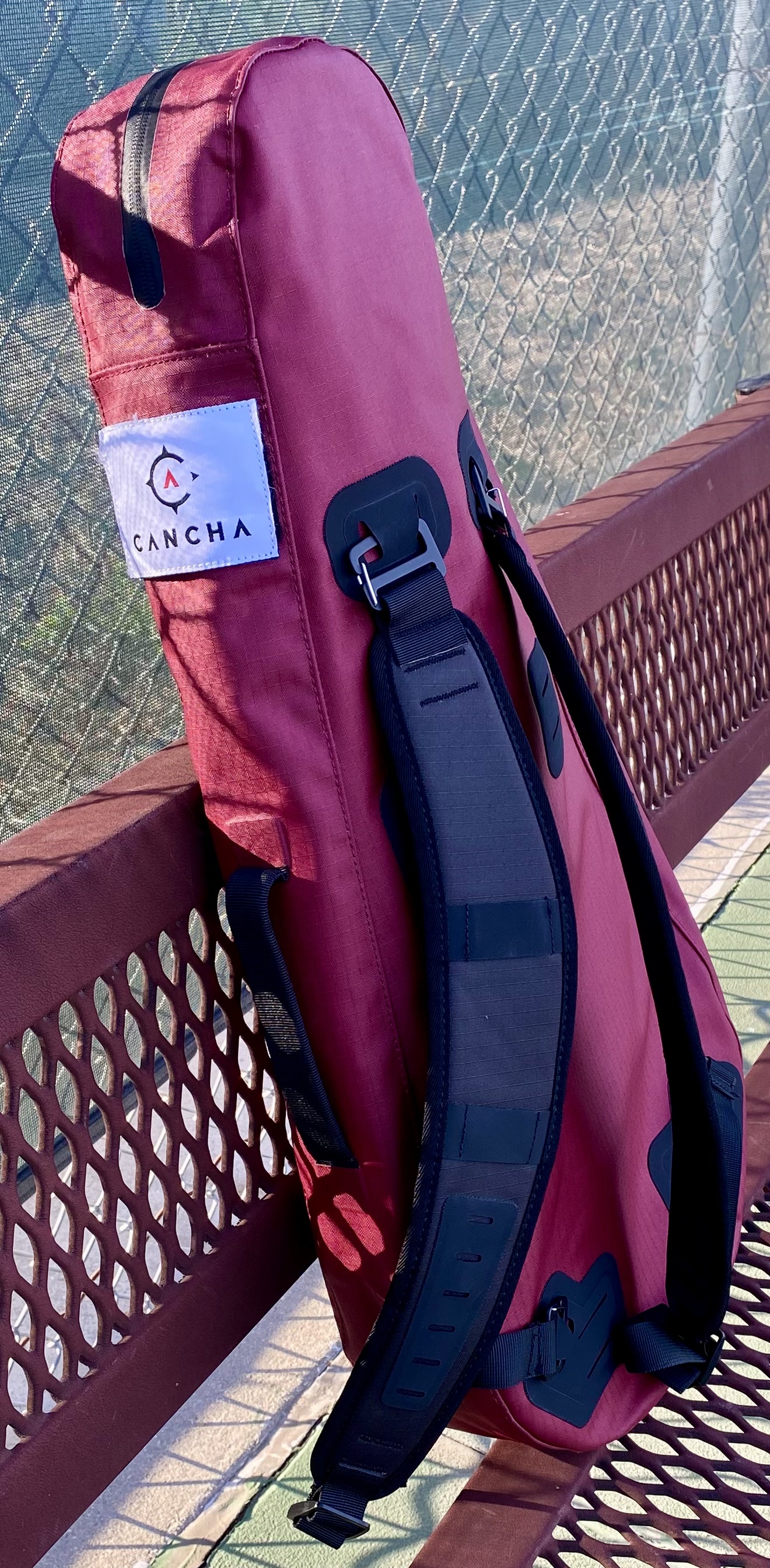
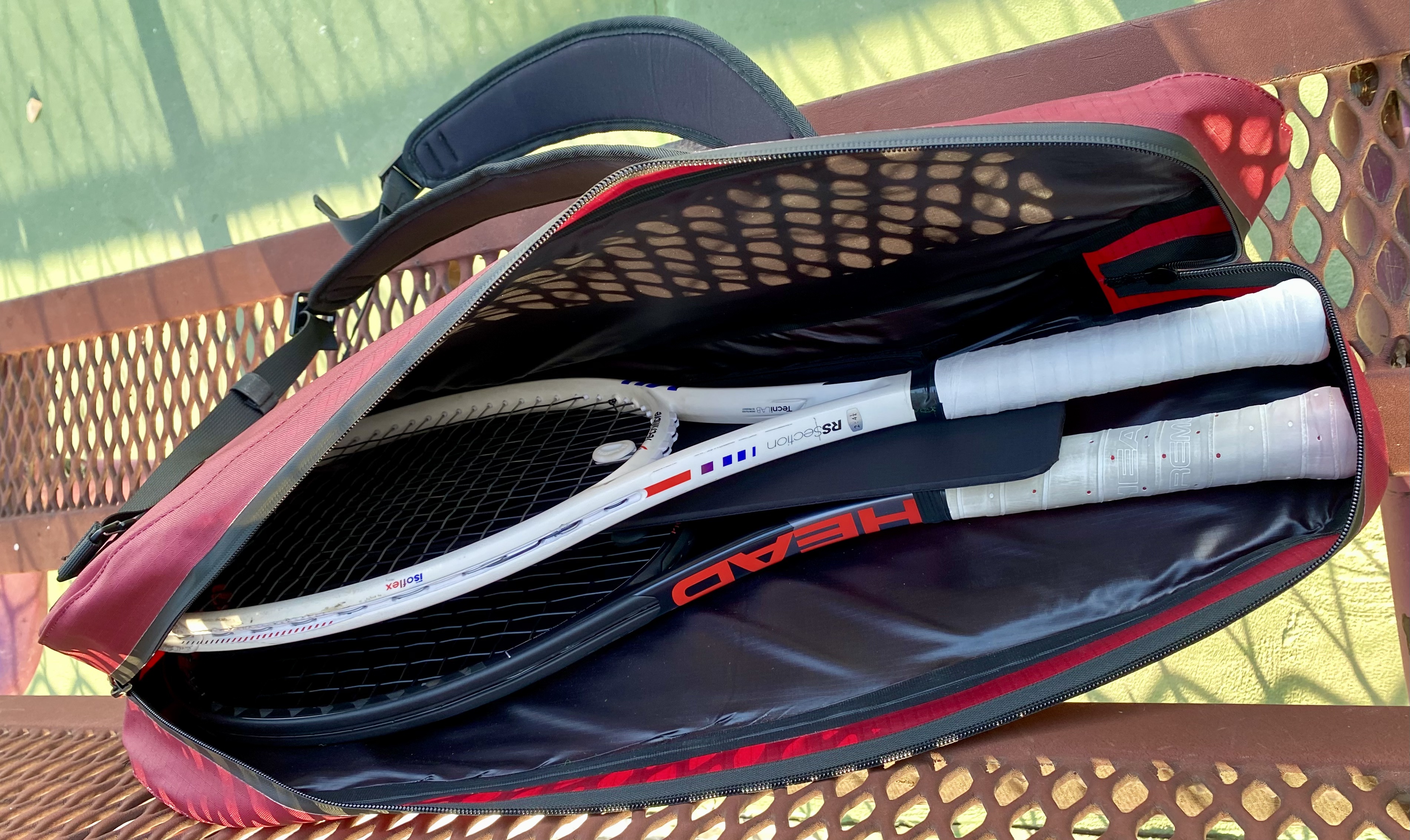
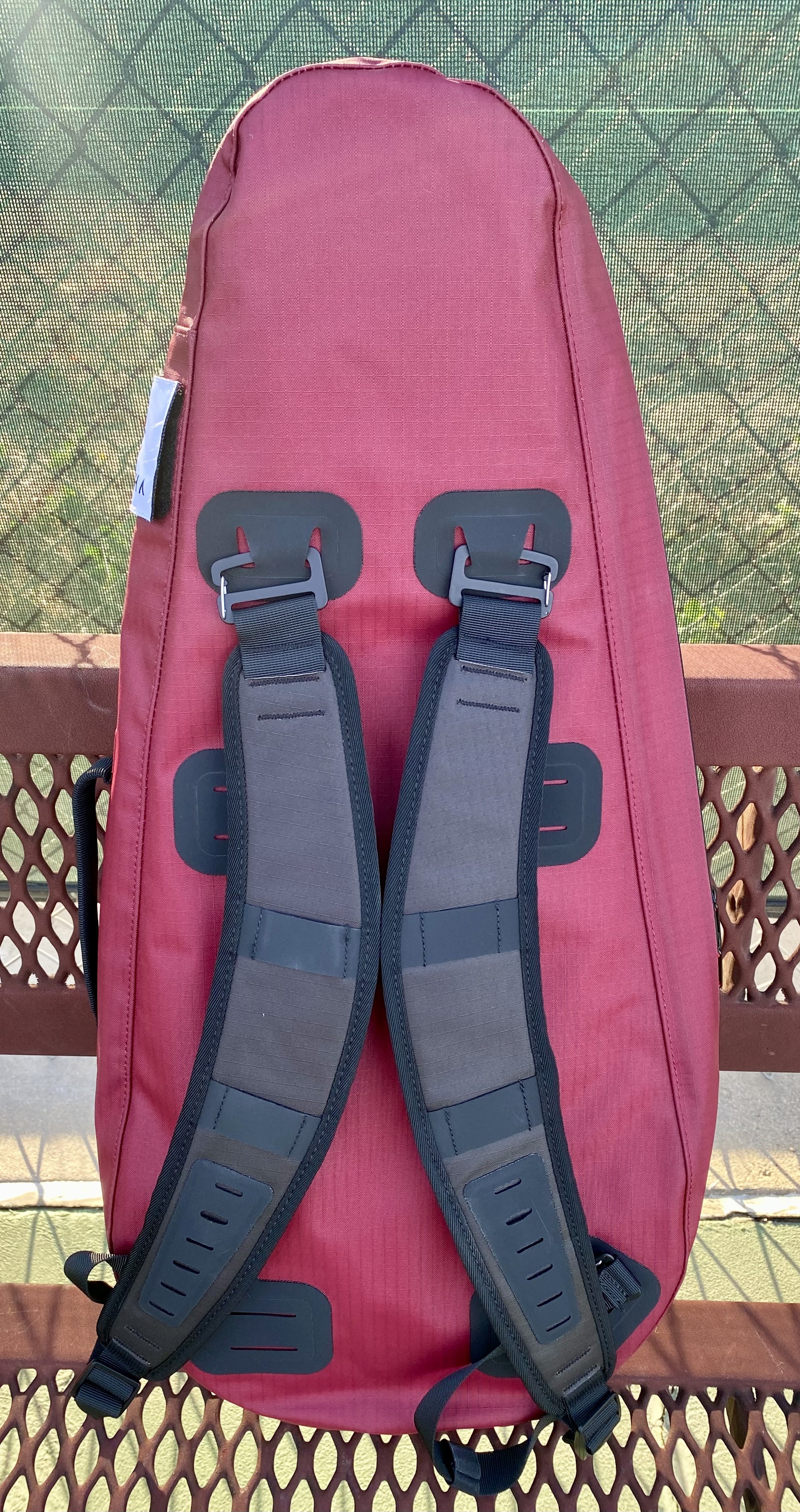
I absolutely love the form factor of the Cancha Original Racquet Bag (15L). Absent the use of racquet for racket, I think the original Cancha fits the average player’s game and needs perfectly. It comfortably holds two rackets and three in a pinch. Double shoulder straps are an absolute must and they were one of the reasons for the Cancha being on my short list of bags.

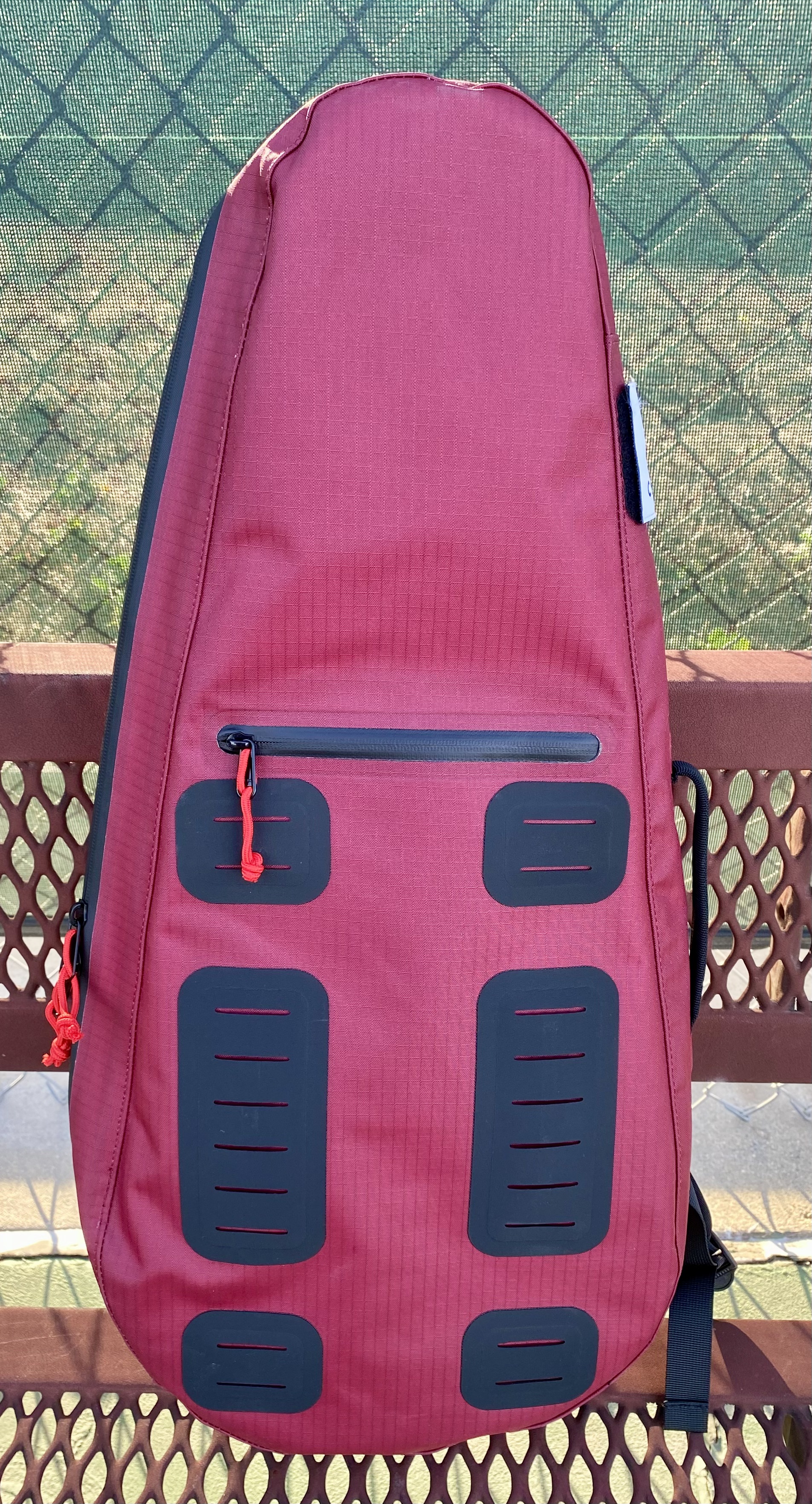
Overall construction looks dandy. The materials appear to be resistant to water (not that it matters much here in SoCal) and the zippers are smooth and rugged feeling. The single zippered pocket on the outside is too shallow to be as useful as it could be. The pocket barely has enough room for my wallet, keys and phone. Forget about my sunglasses. Remember Cancha: phones are getting bigger all the time.

A unique and promising feature of all Cancha tennis bags are the RF Bonded Hypalon Molle Patches. These allow for quick attachment of various Cancha accessories like their Dry Bag. Cancha creates their bags to be truly modular and that flexibility appeals to me. For day to day use I don’t need (or want) a shoe bag piggy-backed on my tennis bag but when I hit the road with my rackets I will definitely want that option.

Though it’s a little hard to see there’s a half-divider between my rackets.

Even with the single velcro Cancha patch in place the bag is pretty stealthy and I appreciate that. Only my friends at Courierware go further in their effort to avoid obvious promotion of their brand by placing their name and phone number on a tiny tag on the inside of their bags!

I was a little disappointed that by the time I was ready to take the Cancha leap the only available color was red. The red is actually quite nice. The problem, of course, is many of the locals associate any shade of red with USC and that’s an association I usually would not tolerate.

But, for the Cancha bag I will make a rare exception. I hope my Cancha bag lasts me a good long time. So far, it’s been a joy to use. Well Done, Cancha!

Cancha Original Tennis Racquet Bag (15L) review

Tennis thing: Racket thing 

It’s said that Novak Djokovic plays a tennis racket based a fifteen year old Head frame design. When I heard this and considered the fact for a few moments I thought to myself, the tech hasn’t advanced. If it had, Djokovic and the rest of the high-level players would be taking advantage.

Now this struck me as odd since tennis tech, as evidenced by string and rackets, advanced significantly sometime during the Agassi era. It’s easy to imagine how the move from wood to metal to graphite and the simultaneous evolution of strings, from gut to multifilaments, co-polys and polyester monofilaments, changed tennis forever, if maybe not for better.

I’ve come to describe tennis as an oppositional striking game, approximating some of the  confrontation elements that take place between a pitcher and hitter. Other than appropriate footwear, the racket is pretty much all the equipment a player brings into battle. In high level professional tennis, rackets are quite nearly disposable. To the enthusiast they are alternately sources of fascination or confusion.

The mechanics of a tennis racket are fairly simple. This is not to say that designing or building a racket is simple. Contemporary tennis rackets are the flower of post-industrial revolution advances in materials science and mass production. In some ways they are equatable to a contemporary golf driver. Both are component devices; one comprised of racket frame and string and the other of driver head and glued shaft. A driver’s playability is determined by the integration of shaft/head/player. In tennis, it’s obviously racket/strings/player. Both golf and tennis have well-developed industries to research, manufacture and market products but what do those wildly successful commercial efforts mean to the player?

I don’t want to get too carried away by ideas about the physics or mechanics of the tennis racket or the driver for that matter. Suffice it to say both improved very rapidly a few decades ago and both, today, have reached a kind of stasis. That stasis comes from a combination of two things. The first is the theoretic maximum of coefficient of restitution (COR, hereinafter). COR is the degree to which a modern driver face can deflect thereby allowing the ball to travel further assuming a given club head speed. So, virtually every modern professional golfer is using a driver head with essentially matched technology in terms of basic mechanics. I think the same thing is true when it comes to tennis rackets. The industry has pretty much figured it out. Now, this doesn’t mean all tennis rackets perform identically. They vary by length, weight and flexibility on at least two axis. The difficult and more interesting question is this: how do changes in those qualities affect a tennis player? 

TW’s drivers, 1997 on the left and 2018 on the right
No, TW did not put the pop-up mark on the old driver

Let me dodge that issue momentarily by shifting back to golf. If we regard Tiger Woods career as lasting roughly two decades, we will see that he started out using a driver that was pretty much from the decade that proceeded it. In other words, the next generation drivers being used today had not yet been developed by 1997. So, Tiger Woods when he first came onto the PGA Tour, used a driver (a King Cobra Deep Face 9 degrees, True Temper Dynamic Gold X100 shaft. The X100 shaft is steel, heavy steel at that. The driver’s steel head displaced somewhere around 210cc. A few years after that the driver boom occurred. The boom was caused by the simultaneous development of aluminum titanium alloys, which allowed the head size to balloon to 460cc and also the ability to maximize the mentioned coefficient of restitution. So, by the mid 2000s Tiger Woods would be using a driver with a graphite shaft and an aluminum / titanium alloy head that rode the edge of maximum allowable COR as regulated by the United States golf Association. 

By the mid 2000 driver technology for the most part had maxed out, both in terms of material and technology. Interestingly, if we make the obvious assumption that Novak Djokovic has access to the best equipment in the world, and further, that his racket of choice is based on a fifteen year old design, we can also conclude that tennis rackets, at least for the time being, have also been maxed out. So, back to the earlier question; how does this affect the average player whether a golfer or a tennis player? In both sports, I conclude that the technology advancements of the last fifteen to 20 years has been virtually irrelevant. Tiger Woods, at any point in his professional career, could have gone back to his 1997 steel-headed, steel- shafted driver with very few consequences. It is even arguable (and I have promoted the opinion) that the slight decrease in distance paired with the significant increase in control would have led him to even better play during that time of his career. As regards tennis, I doubt that any amateur player is likely to be disadvantaged by using a racket that’s even older than the one Novak Djokovic plays.

Tennis thing: Racket thing 

Alba Escayo

Let me tell you about being lucky.

I have been lucky enough to have the covers of my last three books created by Alba Escayo.

Alba holding her girl and a copy of
JJM & the 1971 U.S. Open

No, we have never met. 

No, we have never spoken on the telephone, or even by Zoom. 

Yet, somehow, I feel that I know Alba. And I mean beyond her fabulous artwork. Writing, and especially writing books, is a rather lonely and isolating process. And, when you’re done writing, it always seems to come as a surprise that a book has no physical presence or look, beyond the words on the page.

I always respond to that moment with a slight twinge of panic. You see, every writer wants his work to be good and to look good. Some writers (and that includes me) want their words to both read nicely and also to look correctly , for lack of a better word, on the page. When words are kept together or held apart by a stylistically correct layout, they help to encourage the right spirit and heart from the reader. And, once a writer is aware of this fact, he simply can’t commit words to paper without caring about how they look.

But, the panic that I referred to earlier has to do with the cover. The person who said that you cannot judge a book by its cover was right and wrong at the same time. Especially for the self published writer, I think the connection between the writer and the cover artist is nothing less than critical. if the artist doesn’t know the writer, and doesn’t know the book, I just don’t see a way for the artist to create a cover that truly works with the book and its story.

The other day, I was trying to remember when I first crossed paths with Alba Escayo. It was a very long time ago. The subject of the book was golf. And, when I first heard from Alba she wrote of her fondness for her countryman, Seve Ballesteros. Reading about her passion for golf, a game that at the time I don’t believe she had even played, gave me great hope for the project. Later, when I saw her initial sketches, I knew she was perfect for that project and all the ones that will come after.

An early version of Cottonwood’s cover

Alba and I have created two books that revolve around golf. The first was John J. McDermott and the 1971 U.S. Open and the second was Cottonwood. Neither book would be as good as it is without her contribution. Alba’s covers made the book come alive before the reader even opened it. There is no way to place the value on the initial impact that a really great cover can give to a book so I won’t try.

There is also no way to place a value on Alba’s ongoing friendship or her endless patience with my sometimes peculiar visions, but I value both greatly. The depth and sensitivity of her art is fascinating. I can give her nothing more than a few words and get back beautiful images that make me want to use all of them rather than choose one over another.

The sad remnants of the Racquet Club of Palm Springs courtesy of Google Earth or something like it

Tennis thing is an unusual book. But, I told you how lucky I am when it comes to cover art. It turns out that both Alba and I took up tennis at about the same time, she and her girl on the clay courts of Spain and me on whatever SoCal hardcourt will put up with me. For Tennis thing I gave her an odd starting point, the long-abandoned Racquet Club of Palm Springs. The club first opened by in 1934 and it was owned by actors Charles Farrell and Ralph Bellamy. I’m tempted to go into a lot of boring detail about the club and its history and sad decline but I will resist since I’m just trying to show how little I can get away with giving Alba and still get fantastic artwork.

From that visual hunch Alba came up with this:

No, this is not quite the final version of the paperback’s cover but you get the idea. How did she manage to get the precise feel of my book? I will never know yet I am ecstatic with the result. It makes me want to write a better book next time just so I can work with Alba Escayo again.

There’s nothing better than being lucky.

Alba Escayo

Tennis thing: “Paulie, you would love tennis!”

I first wanted to play tennis when I was eleven. But, I didn’t actually play, and neither did any of the 5th-heading-to-6th graders who were unlucky enough to take tennis in summer school in 1971. Shit, I even got a racket, a Pancho Gonzales model I got in exchange for two books of Blue Chip Stamps. I also had enough dough on hand to buy a can of Slazenger tennis balls. My dearest piece of tennis swag was the neat little ball pouch my mom made for me. Rather than lug that silly, cylindrical tin can around I carried my three new tennis balls in the pouch my mother made, complete with drawstring fashioned from an old venetian blind pull-cord.

Rockin’ for sure. 

The only problem, as I mentioned, was that we never hit a ball and the class was unceremoniously cancelled after the first session. It seems no one realized a tennis court needs a net for the game to be a game. Sure, we could have banged balls against the handball court that stood a few feet away but no one thought of that. So, the Spalding tennis racket went home and our springer spaniel, Bo, got to shred the new Slazengers to pieces. There’s always someone who’s happy with an outcome.

Fast forward to late summer of 2023. I’m 62 and I’ve still never played tennis, yet a coalescence of forces somehow got me started in the game. First, was my friend Michael who early in our largely-telephonic relationship would tell me, “Paulie, you’d love tennis!” 

Where Michael got the nerve to call me Paulie I will never know. 

The second force was a spur-of-the-moment stop at nearby Calabasas Tennis & Swim Center. I’d been thinking of taking swimming lessons but nothing had panned out at nearby Pierce College. Indoor pools (like those at area YMCAs) lost their appeal sometime early in the pandemic. After the visit, I found myself checking out the club’s website when I noticed a list of tennis coaches. One name stuck out, I’m not sure why. Maybe it was the first name, Caesar. Heck, I’ve always wanted to know someone named Caesar. Plus, he’d worked with wheel-chair players. I figured anyone who could do that successfully had a decent chance with broken-down me. I sent Caesar an email and waited— for about an hour. Turns out he had time the next day, Monday. Talk about the ball being in my court. I thought it over for a minute before I fired back an email saying I’d be there.

I was ready, if ready meant wearing one of my best golf polos, a pair of khaki golf shorts and my old Nike gym shoes. Caesar was kind enough to offer the loan of one of his cool Tecnifibre rackets. My first lesson was the end of July and it was hot, just the way I like it. One of the unexpected yet best things about taking up something like tennis at my age is this: I had absolutely no idea what to expect. Would I even have a chance to swing at the ball during my first lesson? I remember stories of John Wooden spending the first practice going over the proper way to tie a basketball shoe;  a method that prevented blisters, turned ankles and laces that untied themselves during a game. Maybe that would be how it was. Another nightmare vision stressed running, more running than I could do at 62 and maybe more than I could have done at 42. Caesar is a no-nonsense kind of guy with an outwardly easy yet somehow intense brand of focus. Caesar’s racket in hand I stroked short forehands from the forward-service line as he hit the ball lazily back over the net. I was overjoyed when my first swing sent the ball right back to him. Amazing.

Better than the result, an outcome wholly irrelevant when you consider we weren’t playing a game, was the feeling. It felt good. I could feel the ball and the tension of strings come together before the ball made its way back into Caesar’s court. That was only a few months ago, in late July, but after only a few more swings I was hooked. It wasn’t as if every shot was perfect, or even successful. There was some magical combination of my motion and watching the approach of the ball and unconsciously aligning my body in a way that gave me a clean cut at the ball that grabbed me right away. Michael was right.

Every few balls, after I’d swatted a ball into the net or fouled one off into the court adjacent to us, Caesar would stop long enough for a chat at the net. Those breaks were a relief, a chance for my arm to recover and for me to catch my breath. Caesar always, and I mean to this day, many, many lessons later, always starts by saying something positive before moving on toward something that needs correction, like my forehand follow through.

Caesar’s positive style is still perfect for me, especially with my well-developed ability to be critical of myself. The overall vibe of the club was similarly positive though it took me a while to specify everything I experienced and saw that made it feel that way. First, and this was unexpected, was the presence of actual women. I mean, there were women everywhere, I’m guessing at least half of the people taking lessons were women and an even greater percentage of those who were playing, usually doubles. There were young women, well-tended middle-aged women, little girls and one woman, who had to be at least 75, carrying a Babolat bag that must have weighed at least half as much as she did. 

Being on the tennis courts felt like being out in the world. It was nothing like being on a golf course where 95% of the players were just like me; late middle-aged men. In golf, women and girls are so much in the minority that they always stick out in a way that disadvantages them. But in tennis, they all seemed so at home, so empowered, so much as if they belonged, which they do. Being better for them makes it better for everyone, including me. Even better is the vibe that extends to the way lessons are given. Walking by the courts you can hear students and coaches chatting with each other, sharing a laugh at shots, both good and bad. And, usually, student and coach are playing some approximation of tennis itself. This is almost never true in golf, where the instructor usually stands, arms crossed, observing the student and commenting on an occasional shot.

Stifling. 

Even though I was gassed after my lesson I could feel a connection to the game I had never felt before, except in baseball. It wasn’t like I was great at it, I’m still not. It was the way my motion and flight of the ball and the eventual meeting of the ball and the racket brought a feeling that was just right. Now, when it comes to tennis feeling right it’s not exactly feeling. And, while some elements of tennis do feel natural there are a myriad of details to monitor to make the shot come off, and not all of those come easily. Example? The toss that precedes a serve. More on that later.

Occasionally, in the same way one’s thoughts might drift toward the consideration of mortality, I wonder what might have been if I had turned to tennis when I was 52 or 42 or 32 or 15? It’s fun to think about the rackets of each era, especially the ones that were used when I was 15 in 1976. The Pancho Gonzales model I had when I was 11 would have come in handy, I suppose. But, I manage to keep those feelings away and to stay in the moment, as tennis demands.

Every time I walk onto the court, I feel lucky, and that’s a gift in itself.

Tennis thing: “Paulie, you would love tennis!”

Tennis thing is done!

I’m very excited that Tt is done and right on time. Alba Escayo is still working on the final version of the print cover but this gives you a good idea of how cool it will be when I am finally holding it in my hands (and, hopefully, you’re holding it in your hands, too).

So just what is Tennis thing?

That’s a fair question. Those of you who have read anything else I have ever written has never read anything about tennis. There’s good reason for this. Up until August of 2023 I had never played tennis. But, shortly after I started learning tennis I had an idea and Tennis thing was born. It’s part diary, part confessional, part study, part history and part analysis. Most writers seek to create works with at least an element of timelessness. But, the stated purpose of Tennis thing is to bring out everything I learn, come to believe and think about tennis; all of the experiences and emerging mindsets bracketed by a one year period. That’s going to bring a purposeful bit of discursiveness to Tennis thing. Who is to say whether Charles Broom, whom I interview later in Tennis thing, will still be playing professional tennis by the time you read this? The same goes for my observations about the other pros I’ve watched play, the tennis coaches I’ve observed and worked with, or even my own viability in tennis. I want the 365 day now of my tennis experience to trump everything. Is that a good idea? I think so but the proof is in the reading and that’s where you come in. 

Tennis thing is done!

Tennis thing: Imagine being Bobby Riggs

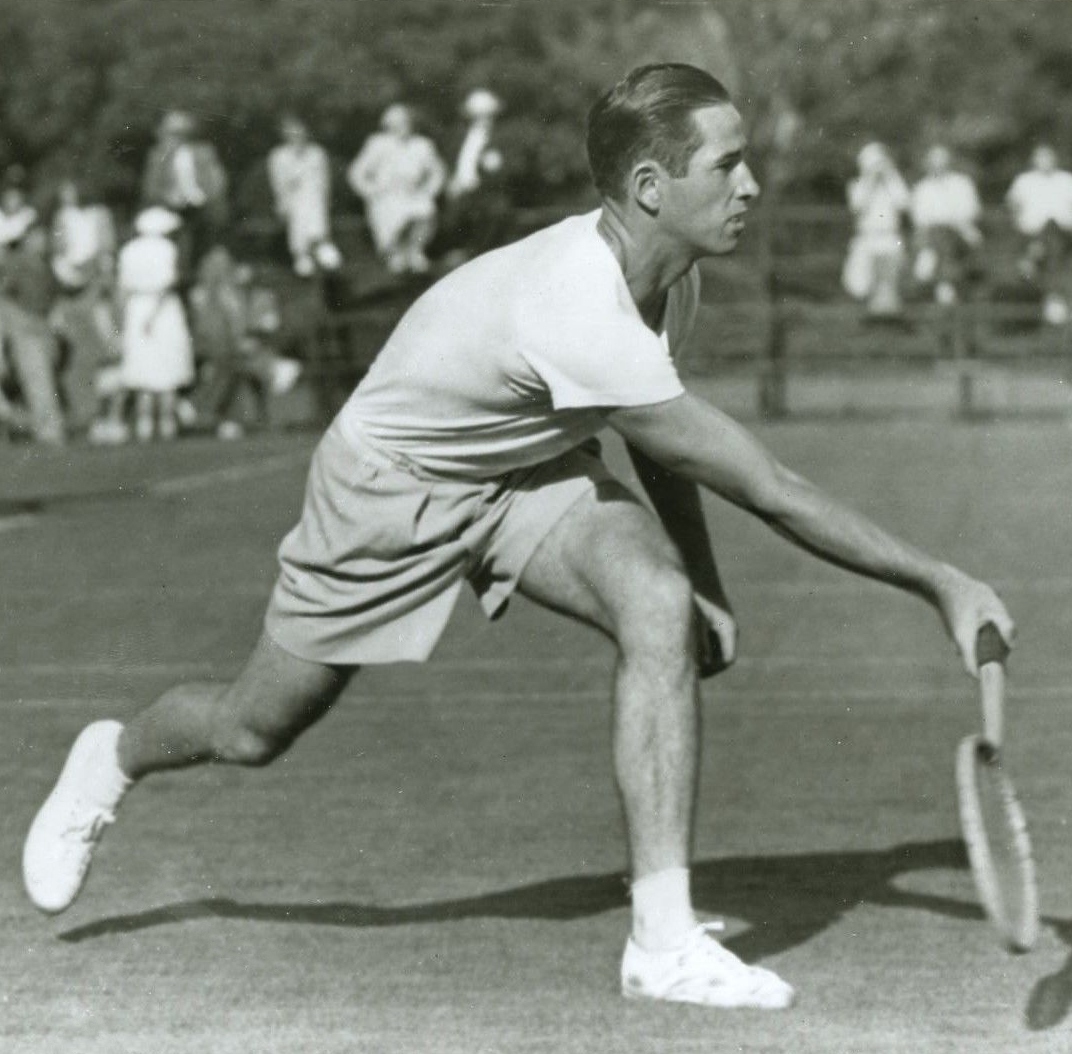
Imagine being Bobby Riggs at age 21 or 55…

Bobby Riggs during the quiet years

My latest book, Tennis thing is done at last. It’s a diary of sorts about my first year playing tennis. I’m going to be sharing chapters here over the next few months. Following this post is another chapter on Riggs. He is a fascinating figure to me.

In 1939, at 21, Bobby Riggs wins everything at Wimbledon. Singles… Doubles… Mixed doubles. Ever the gambler, Riggs maintained that by betting on himself he won $100,000. He was, obviously, a very different kind of amateur.

Bobby Riggs was born in 1918 and grew up in a relatively shitty working-class area of Los Angeles called Lincoln Heights. Long before his historic triumph at Wimbledon, he’d been branded a mere hustler and a gambler and was shunned by the amateur tennis scene at the Los Angeles Tennis Club and beyond.

From 1939 until 1972, he was totally off the tennis stage, such that it was back then, and living in complete anonymity. Of course, the Great Depression had something to do with this as did the fact that Riggs, like all of his contemporaries, were well-beyond their tennis primes by the time the Open Era of Tennis arrived in 1968.

Finally, Riggs or someone else, stumbled upon the battle of the sexes schtick that defined the rest of his life. I wonder who we have to thank for that? Like all schticks, it revived his fame though it did so at the cost of a great diminishment of the impact of the superb play during his earlier life. History, as it so happens, was usurped by notoriety. I wonder how that felt in Rigg’s heart of hearts? To be fair, it wasn’t like he consciously chose fame over his storied history as a player. He simply must have grabbed onto fame like the lifeline it was especially to bespectacled a tennis player in his mid-50s whom few had ever even heard of.

Something about Los Angeles helps to create hustlers and I wonder why that’s true. Trevino & Hogan would have gotten eaten alive out here. Sure, they could handle the heat and humidity of Texas but the glare and grit of Hollywood would have wilted them. Somehow, unlikely guys like Riggs & Pancho Gonzales thrived in Los Angeles, in their ways, at least for a while. 

Riggs and Billie Jean King in the early 70s during the Battle of the Sexes Era
Tennis thing: Imagine being Bobby Riggs