Throwing away an idea

One of the reasons I insure my now-aged 2006 Mini Cooper with Hagerty is the ongoing enjoyment I get from reading their superb Drivers Club quarterly magazine. First of all, the issues are printed. This fact makes me think think back on the USGA’s defunct magazine, Golf Journal, surely one of the best golf periodicals ever and also a stinging example of the USGA’s lack of vision and why golf sucks. I have collected a handful of year’s worth of Drivers Club issues. I keep them in wooden magazine holders I’ve owned for decades. When the dedicated holders got full about a year ago I decided to purge the least-interesting past issue whenever a new issue arrived in my PO Box.

Wednesday is happy hour day (I say day because my friends at Institution don’t do HH every day but only on Wesnesdays and only from 4-6pm. Geez.) at Institution Ale and I made sure to bring my reading glasses so I could devour the issue in a hop and sunshine-augmented vibe. The issue was a little disappointing but I still read most of it. By the time I finished my one-and-done ON PINS & NEEDLES (Session IPA) I had closed the magazine, done with it and sure it was the latest issue not to make it into the vanishing space of my wood magazine holders. By the way, I don’t usually care for session IPAs but this one was excellent, while not at all like being hit over the head as are so many of the big-boned, broad-shouldered IPAs I typically enjoy. After leaving my empty glass on the bar I noticed a trash can and unceremoniously dumped the current issue of Drivers Club.

Then, I forgot all about it.

Until this morning.

While on my 30-minute drive to tennis I made a couple voice memos, two of them actually. After I finished the second recording my mind flashed to the day before and the trashed magazine. And then I remembered the largely subliminal urge that caused me to throw the magazine away.

There was an article in the magazine about a guy who set out in his crappy old Mitsubishi pickup / camper to visit some of the environs of California’s own, John Steinbeck. Something about the guy’s set up irked me. I may not have appreciated the Steinbeck works he focused on, especially Travels with Charley, but there was something else that kept me from reading an essay that might have been right up my reading alley. I know Steinbeck’s work well, having read all of his works (even his superb short stories) with the exception of East of Eden. I could easily do what this guy did (absent the mini-truck camper). What afflicted me was simple road trip envy.

Yes, we recently returned from my family reunion in the midwest.

Yes, we extended our trip with a three-day visit with my dear friend MIB in south-eastern Michigan.

And, yes, we hope to make it to Sacramento sometime this fall.

And, that was enough when it comes to travel for a while.

But, a true road trip is different. I haven’t been on one of those for years. To me, road trips differ significantly from simply traveling by car. One of the main differences is a lack of advanced hotel/motel reservations. This is especially doable when on one’s home turf, which I am whenever I am in California. Unless I’m way north of Redding, I’m more than happy to head for home if I can’t find anywhere to stay. A big challenge for me is finding places in California I’ve not been before or places I’ve forgotten about or would actually like to visit. A friend of mine just got home from riding the historic Skunk Train in Fort Bragg. Fort Bragg is a weak maybe while the Skunk Train is a big probably not.

Even though I’m not excited by the prospect of riding a near-silent rail car I would like to spend some time in California in the 300+ miles from Fort Bragg to Medford, Oregon. Here I am thinking of the Trinity National Forest and the Six Rivers National Forest.

But now the calendar says September and that makes me wonder when we will have the chance to take another road trip.

I hope it’s soon.

In the meantime, I wonder if I can find a copy of the current issue of Hagerty Drivers Club on Ebay?
Throwing away an idea

Cancha Original Tennis Racquet Bag (15L) review

I love small companies.

They can (and this is certainly true of Cancha) create products that fill a void for buyers (like me) who are tired of seeing and using the same old products.

It’s hard to believe there’s so little variety when it comes to tennis racket bags. There are the moving billboards offered by the big tennis companies. You know, the kinds your favorite pro drags on and off the court to make sure you know he or she is being well-paid by Wilson, Head, Babolat, Yonex or whomever. I wouldn’t say these bags don’t have their place. My coach uses one but in addition to carrying a whole gaggle of rackets every day he pretty much has to live out of it at times.

If you’ve seen one of these big bags you have pretty much seen them all. And, although many of my fellow club players are happy to bend their backs carrying them, many others prefer something lighter and more thoughtfully made. I think that way and obviously so does Cancha’s head honcho, Jack Oswald. You can read more of Oswald’s story at the Cancha website so I’m not going to rehash his story here.

Finally, I want to let you know that Cancha is giving the ax to the model I am reviewing here. I think that’s a shame since the bag they’re replacing it with with is significantly larger and more expensive. Oh well. I guess all we can do is wait and see what Cancha’s product offerings look like in the near future.

Look, a tennis bag is not a complicated thing. But, even a simple thing can be done well or poorly. As they say, the (tennis) gods are in the details.

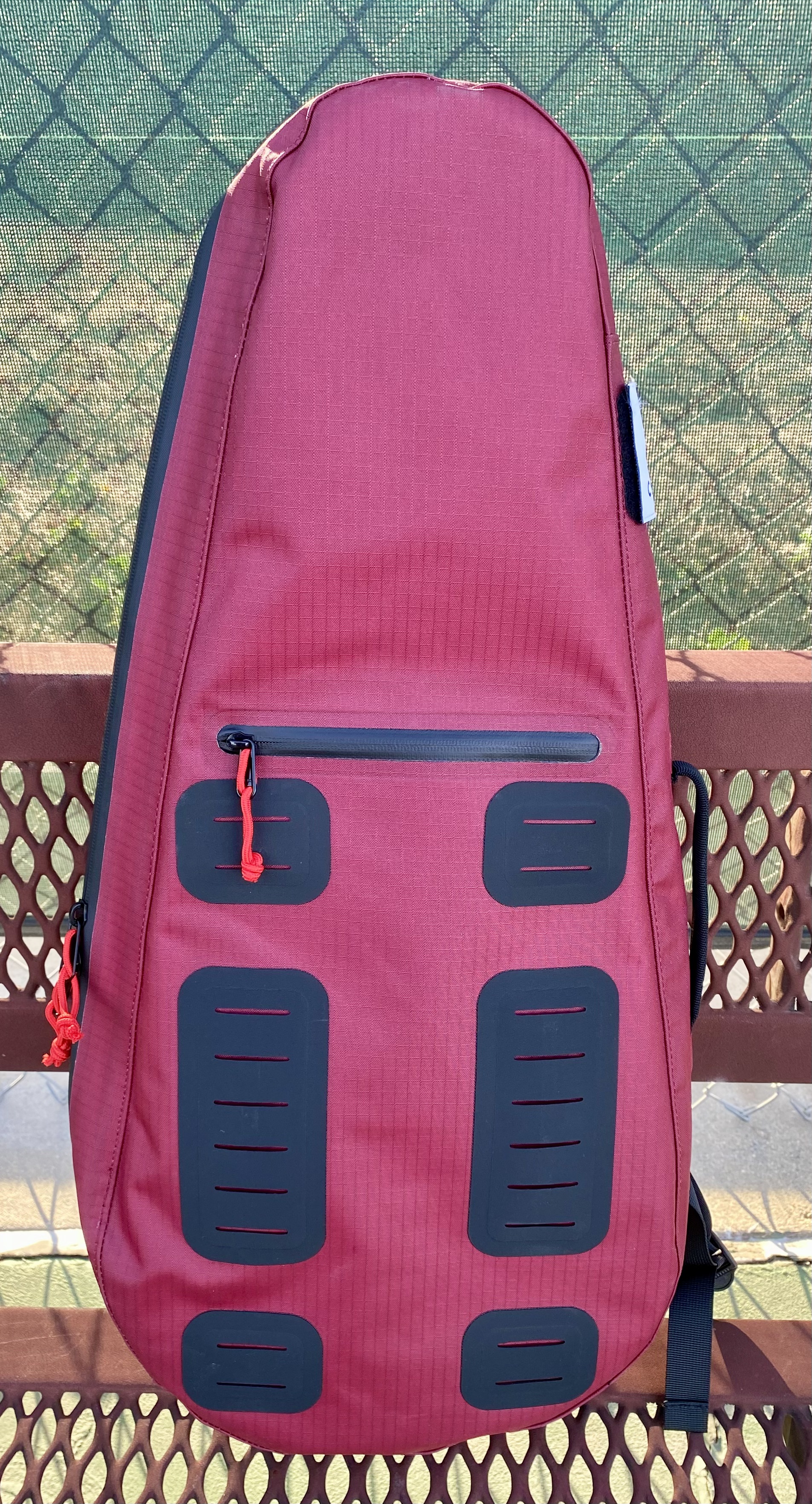
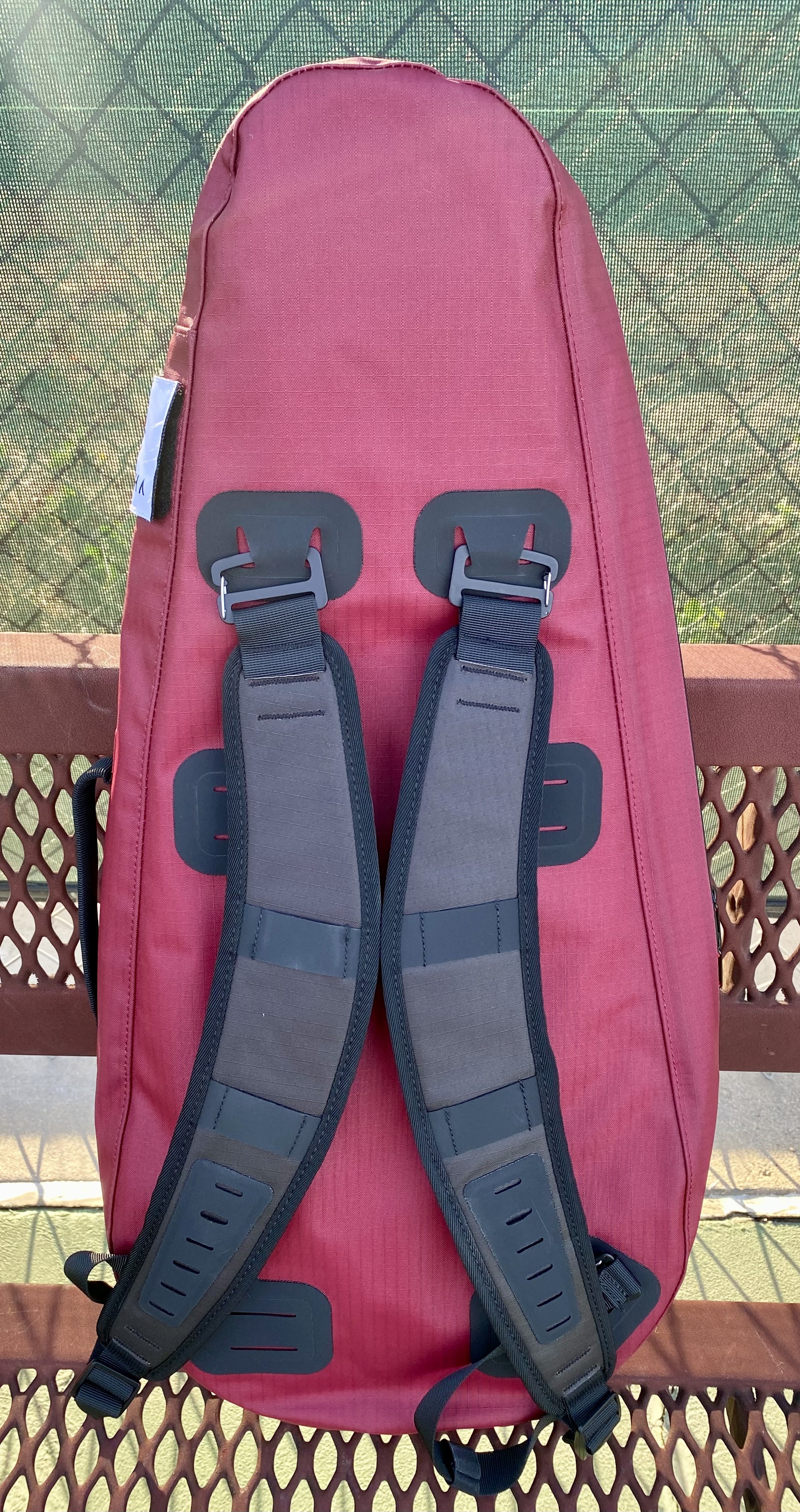
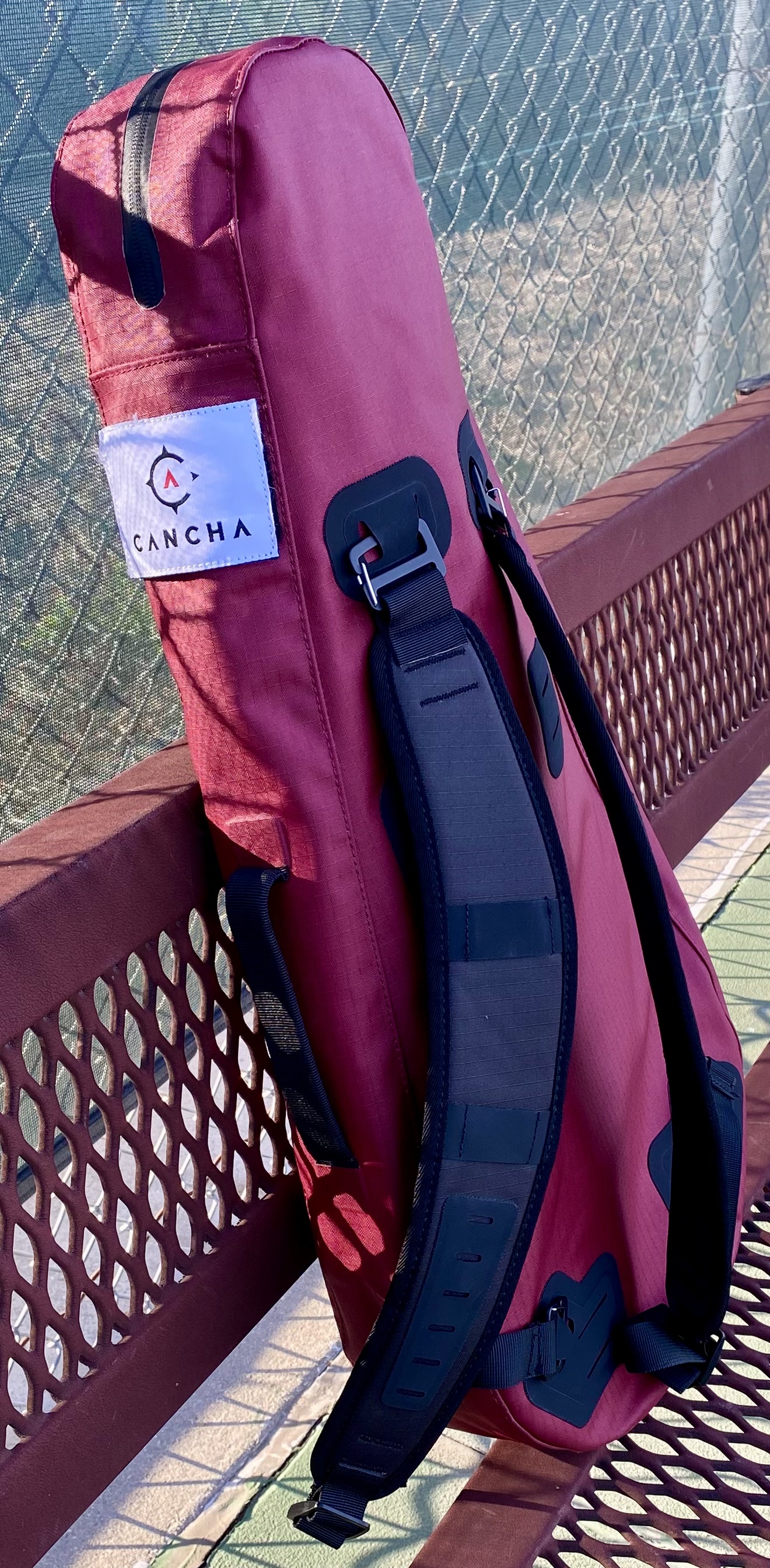
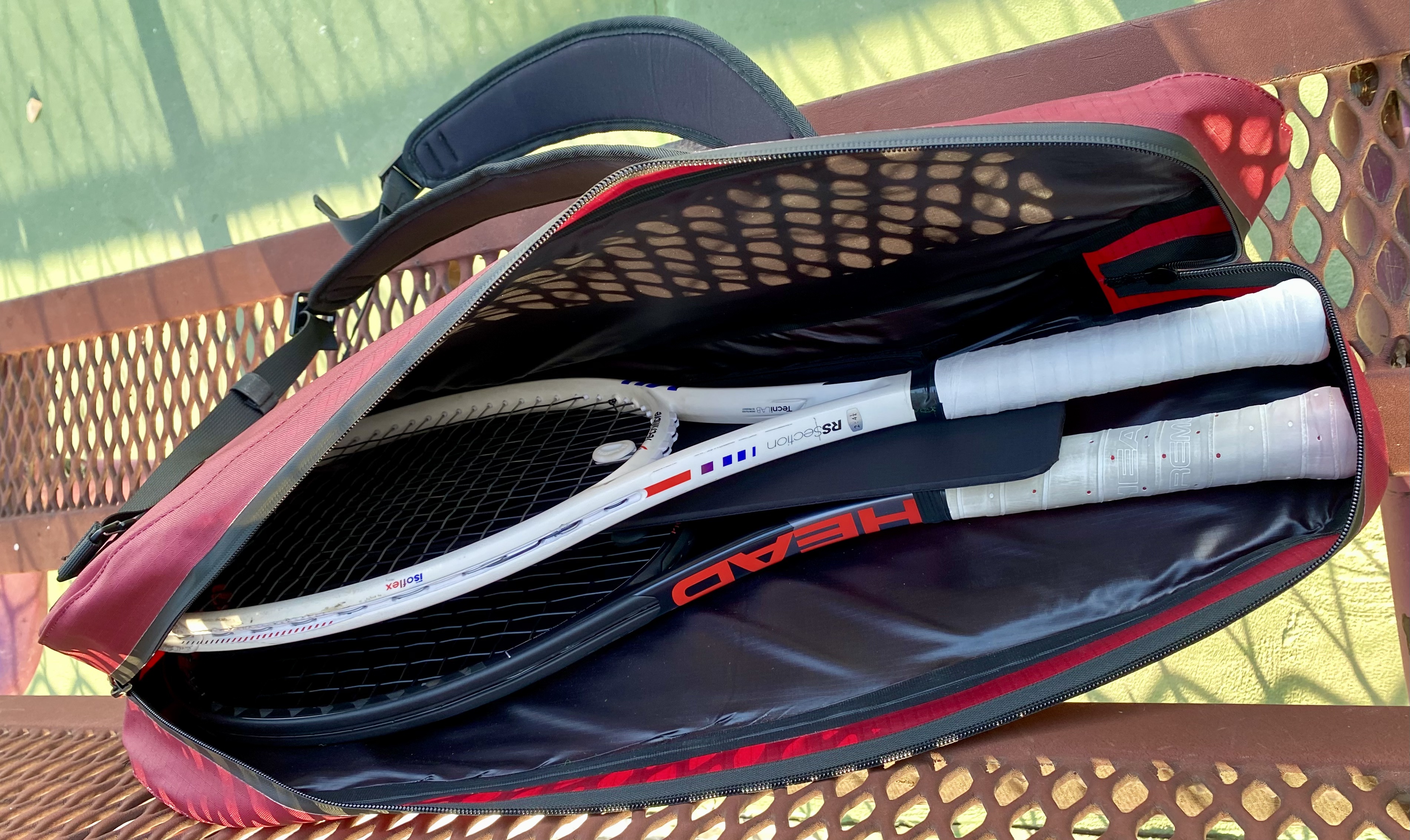
I absolutely love the form factor of the Cancha Original Racquet Bag (15L). Absent the use of racquet for racket, I think the original Cancha fits the average player’s game and needs perfectly. It comfortably holds two rackets and three in a pinch. Double shoulder straps are an absolute must and they were one of the reasons for the Cancha being on my short list of bags.

Overall construction looks dandy. The materials appear to be resistant to water (not that it matters much here in SoCal) and the zippers are smooth and rugged feeling. The single zippered pocket on the outside is too shallow to be as useful as it could be. The pocket barely has enough room for my wallet, keys and phone. Forget about my sunglasses. Remember Cancha: phones are getting bigger all the time.

A unique and promising feature of all Cancha tennis bags are the RF Bonded Hypalon Molle Patches. These allow for quick attachment of various Cancha accessories like their Dry Bag. Cancha creates their bags to be truly modular and that flexibility appeals to me. For day to day use I don’t need (or want) a shoe bag piggy-backed on my tennis bag but when I hit the road with my rackets I will definitely want that option.

Though it’s a little hard to see there’s a half-divider between my rackets.

Even with the single velcro Cancha patch in place the bag is pretty stealthy and I appreciate that. Only my friends at Courierware go further in their effort to avoid obvious promotion of their brand by placing their name and phone number on a tiny tag on the inside of their bags!

I was a little disappointed that by the time I was ready to take the Cancha leap the only available color was red. The red is actually quite nice. The problem, of course, is many of the locals associate any shade of red with USC and that’s an association I usually would not tolerate.

But, for the Cancha bag I will make a rare exception. I hope my Cancha bag lasts me a good long time. So far, it’s been a joy to use. Well Done, Cancha!

Cancha Original Tennis Racquet Bag (15L) review

Zen and the Art of Motorcycle Maintenance and the demise of the UJM

I’ve made no secret of how much I enjoy Robert Pirsig’s Zen and the Art of Motorcycle Maintenance and Drivers Club, the superb quarterly magazine published by Hagerty Insurance. There’s no doubt that HDC is the greatest contribution to society that any insurance company has ever made. You’d think that bringing both Zen and HDC together would be an especially happy day for me. Instead, the HDC piece (written by Matthew B. Crawford) was just another misunderstanding and misstatement of what Pirsig meant when he wrote about quality.

But that’s another subject…

You see, Crawford’s essay also included this photo of Pirsig’s 1966 CB 77 Honda Super Hawk, which is enshrined at the National Museum of American History along with his typewriter and an original manuscript of Zen. When I read this I was heartened by the museum’s recognition of Zen’s influence. Then I began to think about the Super Hawk itself. In Zen, Prisig wrote a lot of things about motorcycles. He admitted elsewhere that some of what he wrote was just plain wrong. I consider this kind of literary error the rough equivalent of Springsteen saying he knew very little about racing yet somehow understood the spiritual significance of the Chevy 396.

The humble Super Hawk was a Universal Japanese Motorcycle. I have no idea who coined this phrase. It refers to the seam that exist between sport bikes, cruisers and touring motorcycles. I know that the categories of motorcycles go on and on and subdivide but the point of UJMs is that they are able to do a lot of things, many of them quite well, without overtly identifying themselves as one thing or another. Harleys either harken to the past or a cartoonish future while contemporary sport bikes ignite the standard Ricky Racer fantasies in a certain kind of rider. While all of this posturing goes on, a good UJM is simply ready to be ridden.

The problem is the UJM is nearly dead. The irony is that I believe the lack of UJMs over the last decade and a half has reduced the number of new riders, which in turn has made life hard on motorcycle companies. Can the argument be made that the UJM is somehow the equivalent of the American middle class? It can, and that’s a part of what I’m saying here. Motorcycles have become so polarized that marketing to the middle has been forgotten even though the middle class of potential riders is still a viable group, something I’m not sure can still be said about the actual middle class. UJM, by being designed for the middle class of riders, welcomed actual riding over style. They were easy and generally safe to ride with their upright, comfy riding position and simple 2-cylinder engines. They have no fairings or cowls. Back in 1966 there was little plastic used other than the tail/brake light lens. Nothing was hidden from view or repair. A lot of people are stunned to learn how much work you can do on a UJM with nothing more than the factory tool kit that was hidden under the seat.

The Super Hawk is not a bad looking motorcycle. But, its soul resides in its functionality rather than its overt styling. The next time you see a new motorcycle on the road make note of its stying. In the same way that vape makers know that kiddie flavors help snag and keep young, new vapers, motorcycle companies know the way to buyer’s hearts goes through their eyes. I have a friend who has 22 motorcycles, most of them Hondas. One of his greatest challenges is finding replacement plastic panels of his many vintage sport bikes. Honda doesn’t make those parts any more and used ones are often in worse shape, cracked, stained, yellowed, than the part they’re meant to replace. A good UJM, like the CB77, can live and look pretty much as it did when it was new, decade after decade, and many have.

So, yes, this is an argument for the UJM. But, more than that it’s an argument for the mindset that made and purchased them in the past. In the end, it’s an argument for a riding mindset. Looking into the soul of the Honda CB77 Super Hawk simply makes me want to go for a ride.

Zen and the Art of Motorcycle Maintenance and the demise of the UJM