My Fond Memory of Brooks Berdan

Originally published in an old blog of mine way back in 2013

I have a lot of fond memories of my old friend, Brooks Berdan. In my early days as a reviewer, he was always kind enough to loan me gear for review that would have been difficult if not impossible to get my hands on otherwise.

Later, when I consulted to Music Reference and Muse Electronics I learned what a truly fantastic dealer Brooks was and how hard he worked for his customers. Brooks was a very unusual dealer. He had a national reputation, but did virtually no business over the phone (let alone over the internet). Brooks was the rare dealer who wanted and, even needed, to know his customers before he would do business with them, let alone separate them from their money.

Brooks loved tube gear and faithfully represented Music Reference and RAM Tubes like no other dealer in the US. His loyalty had its perks. Very often, I would hand deliver his orders directly all the way from Santa Barbara, especially when he was ordering a lot of tubes or a one-off product like a hand-made RM-9 Special Edition.

Of course, just hanging out with Brooks was a special pleasure. We could talk music, or gear, or motorcycles, or the challenges of making a marriage work, for hours at a time, and we often did. Back in 2003, when I was going through my divorce, I dropped by Brooks’ shop one afternoon. I was giving him the summary version of where things were and mentioned, in passing, that it had become tough to write reviews since I hadn’t taken my analog rig when I had moved out of the house. Brooks looked up from what he was doing and asked me what I needed. I told him I could get along fine with a simple set up and that the Kuzma Stabi Reference and Dynavector XL that was back in Valencia were loaners from the distributor anyway.

Without a word, Brooks vanished into his storeroom and emerged with a boxed REGA P3 under his arm. Brooks asked me if I liked Sumiko Blue Point Special EVO. I told him I’d never been a huge fan of the original but had never heard the naked EVO version. “Well,” Brooks said, “try it. It’s a lot better than the old one. If you don’t like it you can always try something else.”

Up until that point, I figured Brooks was setting up the REGA for a customer, or as a demo, but then I realized he was building it for me.

“You know, Brooks, cash is a little tight right now; this whole divorce thing doesn’t come cheap.”

Brooks shook his head. “Don’t worry about it, pay me when you can.”

For the next hour, Brooks lovingly set up the REGA and the Sumiko. He did his work with a level of care that would seldom be afforded to such modest gear, but that was Brooks. For him, it didn’t matter if he was setting up an SPj La Luce or a REGA.

Brooks always took his work very seriously.

When he was done I said, “Thank you, Brooksy; what do I owe you?”

“Don’t worry about it, just send me what you can when you can.”

“Brooks, come on, I’m not that hard up, what do I owe you?”

Grudgingly, he got out his price sheets (on paper, of course) and said, “OK, my cost on this is like $600, so mail me a check for $500 when you can. Make the check for more than that and I won’t cash it.” Then, Brooks looked at the REGA and said, “Divorce is hard. You know what I’d like to ask my ex? Was I really that bad?”

I don’t have a guess about what Brooks was like as a husband, but I know he was much more than a business associate to me. On that day, I had no intention of asking Brooks to help me out. It turned out that I didn’t need to, Brooks was the kind of man to recognize a friend in need and would simply do what he could to to help.

The other day, I was thinking about that now-aged REGA, and how the decade had just flown by me as if it were a breeze. I miss not playing very many records these days. I listen to music every day, usually on my iPhone, occasionally on my small system at home. But, it has become the rare day when I have the time to play an LP and I miss the sound, the life and the pure joy of it. I’m sure the suspension on that old Sumiko has gotten a little dry and hard, but it still sounds great.

Someday I may have to replace that cartridge but I really don’t want to…

It was set up by the all-time master of analog, Brooks Berdan, and I’m proud to say that he was a friend of mine.

My Fond Memory of Brooks Berdan

One strap, one bag; Crumpler & BBB

Man, talk about bored. Bored is the only possible motivation to write about a camera bag and a camera strap.

There you have it; I’m bored.

First the strap. You all know the Crumpler name. You know the make nice stuff, especially their somewhat unusual bags. But, did you know they made a nice strap, too?

No, not their lackluster and bulky Industry Disgrace. Today I’m talking about their very lightweight (and somewhat light duty?) Popular Disgrace. This 2.5 centimeter strap is da bomb for a lightweight camera like my aged Fuji X100. Its magic resides in its simplicity, and also the perfectly textured neoprene that covers the conventional strap material.

I hike a lot with the X100 so it spends a lot of time slung across my back. The neoprene has just the right about of traction and just the right amount of slip (dare we call it, perfect coefficient of drag). The strap material underneath is quite stout. It would be totally suitable for a larger and heavier camera, if the neoprene section were a tad wider.

IMG_2999

Me? I don’t like heavy cameras. My old Nikon D300 is as heavy as I can stand. That’s what keeps the X100 nearby so often. If you have an X100 or any other lightweight camera you might want to check out the Popular Disgrace, if you can find one.

In case you’re one of those folks who find camera bags slightly less dull than camera straps, I have a good one for you. The Bare Bones Bag (BBB hereinafter). I’m being kinda charitable to the folks at Figital Revolution. They’re not really the ones who’ve done the heavy lifting (stitching?) in the creation of the BBB. The real work was done by the hard-core, hard-asses at CourierWare.

For those of you who are even more bored than I am (come on,  you’re reading this aren’t you?) feel free to check out my review of yet another CourierWare bag here.

No, you cannot stuff a lot of shit into the BBB.

And, no, the BBB is not possessed of a great deal of padding. Heck, my version of the bag doesn’t even have a velcro closure for the top.

And, yes, the BBB may be able to pass as a purse, assuming that the woman who’s carrying it is good looking enough.

Still, for me it’s just dandy for carrying the (wait for it) Fuji X100. It holds that, my beater Panasonic LX3, both their chargers and spare batteries, my faithful Benchmade knife and a lot (but not too much) other crap. There’s a touch of padding in the bottom of the bag but the rest of the bag is just plain (if very high quality) waterproof 1000 denier Codura nylon.

If you’ve been living under a rock you may not be aware that CourierWare makes a superb bag. They are light yet totally bombproof and guaranteed for life. The care and quality of the stitching is beyond reproach. Now, the truth is that I’m not even sure that you can buy the damn thing. I got mine used and you’re never getting mine, believe me.

But, if you have a load that’s the right size for it, and if you can find one, the BBB cannot be beat. If you value function and give not one shit about style, it may be the bag for you. If you need a larger bag, check out the CourierWare website. CourierWare’s owners, Diana & Eric, are amazing, salt of the earth kind of folks and they’ll make the bag of your dreams.


One strap, one bag; Crumpler & BBB

Change of Seasons: California Oaks

Southern California is a place of slow and subtle shifts. Traffic moves slowly and the differences of our seasons can sometimes be hard to discern, especially for people from non-Mediterranean climates.

I’ve spent all my life here and can tell the different seasons by a number of different clues. I can see the how the light differs on a clear summer day and a clear day in winter. I can also smell the seasons, especially the spring & summer. As winter glides into spring I started to think about another seasonal clue.

Oaks.

We have no fewer than twenty different varieties of Oaks in California. Even in our vast urban and suburban sprawl, Oaks are common and for the most part venerated. We even like naming communities after them like Sherman Oaks, Thousand Oaks, Oak Park, Oak Hill and of course, Oakland.

The Santa Monica Mountains is home to scores of oaks and the Santa Monica Mountains Conservancy does a marvelous job of preserving the hills and valleys where the oaks thrive, often times surrounded by upscale housing developments.

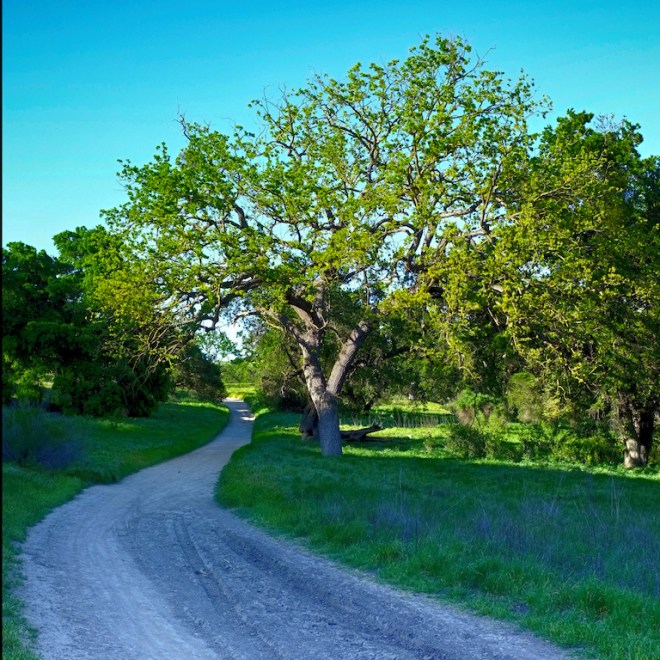
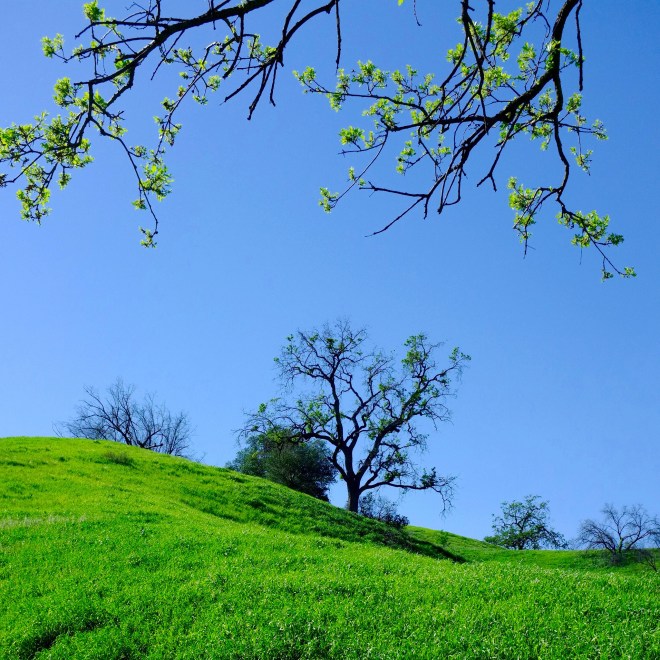
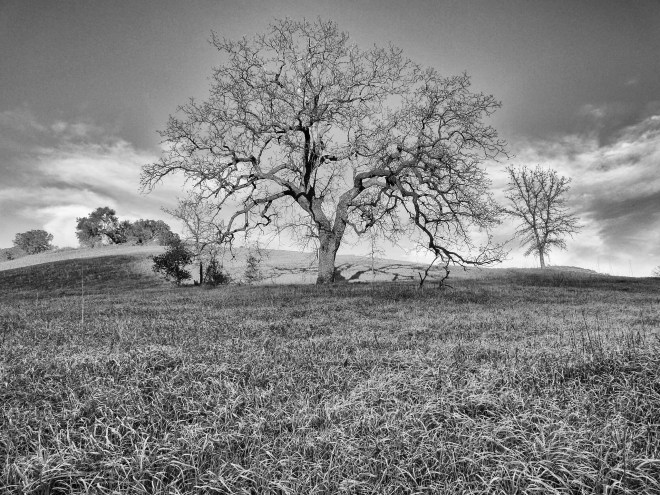
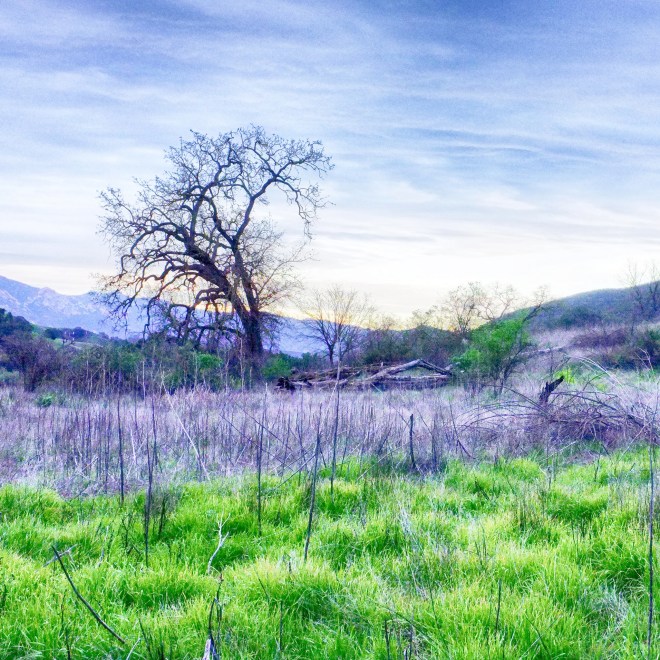
I thought it would be fun to capture the transition of some of our oaks from winter to spring, from cold to warm, from brown to green.

Allow me to start with a short poem.

Nothing Gold Can Stay

Nature’s first green is gold,
Her hardest hue to hold.
Her early leaf’s a flower;
But only so an hour.
Then leaf subsides to leaf,
So Eden sank to grief,
So dawn goes down to day
Nothing gold can stay.

– Robert Frost / 1923

Oak 8
Oak 8
DSCF5522 small
Oak 7
Oak 6
Oak 6
Oak 5
Oak 5
Oak 4
Oak 4
Oak 3
Oak 3
Oak2
Oak 2
Oak 1
Oak 1
Change of Seasons: California Oaks

Prior Recognition & Landscape Photography

Of late, I’ve been thinking a great deal about landscape photography. It’s not just because spring is drawing closer every day. In fact, the prime motivation is the fact that after eight years of using Flickr, I’ve struck up a couple of very interesting internet friendships. It happened quite out of the blue but soon I found myself exchanging emails on subjects that had previously been confined to the hollow space between my ears. To top it off, there were actually discussions about our actual photographs; imagine that.

Of course, there was a bit of the old, does my photography matter and a touch of is photography art sorts of questions. These are old and tiresome points of discussion yet somehow they can seem (briefly) new when bandied about by hopeful folks who simply love the potential of their photography. Anyway, one of the Flickrites offered the idea of his landscape photography as a kind of visual recollective of the places he’s been. I’ll admit that I cringed slightly at this idea. I thought of the millions who had come before him and the thousands of images they recorded, the vast majority possessed with the very same humble intent and I thought to myself, what is the point of that?

Now it’s true that far too much of my own landscape photography has been similarly simplistic and banal. If you have a camera, you tend to use it. If you’re standing before beauty, you record it. But, the problem, the point of a disconnect for me anyway, is the lack of the photographer’s own collective vision and intentionality effectively mating with the images that are in front of him.

Last December, I attended an exhibition of a guy I know from a local golf course. I knew the exhibit photos were from Namibia, a place I had never been. So, obviously, I was curious about the visual elements of the landscapes of Namibia. But I was wondering if I would see something more. The photographer’s name is Ding Kalis. I’d seen some of his work online but somehow that did not fully prepare me to see the richness and depth of his Namibia photographs up close and personal. Then on a cool December night, I stood gazing at this:

Ding 2
The Elements Collide © 2016 Ding Kalis

I realized at that moment that one rare element of landscape photography is the ability to see something, or even imagining if something can be seen, before a scene is witnessed. Of course, Ding knew these borders, these separations, existed before he climbed into the Cessna. This scarce and precious element of landscape photography is a kind of prior recognition that can show something that is entirely common in what is likely a wholly unexpected way. The end result is that the viewer is given a gift; the gift in seeing something new, or at least in a new way. The fact that the photo was taken tens of thousands of miles away is secondary to the novelty of the photographer’s vision. This could well have been taken on the coast of southern Oregon, or here in California, and it would still stir my imagination in the same way. It’s the way Ding saw the scene that mattered, far more than the exotic nature of the location.

Here’s another one of Ding’s photographs from the same exhibit:

Ding 1
Three Degrees © Ding Kalis 2016

Again, Ding had to have had the separations, the boundaries, between these dunes keenly in his mind before he actually witnessed and captured them. This is a huge part of good landscape photography and maybe the element with the potential to nudge this kind of photography toward art. It is, as I said before, the art of prior recognition. The scene may unfold before all of us in the very same way. But, when we have the ability to see what’s there in a way we recognize a priori, or maybe even expect before we see it, we have a fleeting chance to capture something of meaning, to ourselves at least, if possibly no one else.

I liken this to a writer settling down to write some verse. For his verse to be true, he must think before he writes. He must know what he needs to say while still striving for the best mechanism to convey it using the crude code of words. I dare say he must plan before he writes if he’s to have any chance of saying something of meaning. He cannot merely react to feelings or recollections no matter how strong they live in his consciousness. He must at once look to the future and into the past to have any chance of choosing his words in a way that matters to whoever reads them. Mere recitations of recollections, in either poetry or photography, no matter how well-crafted, simply cannot be possessed of relevance.

So this is the hurdle I see for the aspiring landscape photographer (and that includes me). He must learn to see before he sees and then, confronted with the vision he wishes to capture, must strive to recognize the relationships that were in his mind before he raises his camera and releases the shutter. If not, all of what’s regarded as the good landscape of the future will be captured by drones, hovering overhead with ideal perspectives, 24 hours a day, clicking away and recording images with perfect exposure and massive dynamic range. And, all of them will mean the same thing to those who see them. Nothing.

So now spring draws nearer still and with it comes opportunity for me to capture images of meaning and relevance. I want to thank Ding for the unspoken lessons that his Namibia photographs have instilled in me. I’m not sure the results will be visible in the images I capture this year, but I am hopeful.

Note: I sent a draft of this article to Ding and he was kind enough to add some thoughts of his own. I’m pleased & grateful to give him the last word:

Ansel Adams talked about “previsualization” though for him it meant seeing the final print in your mind’s eye and exposing for the result you had foreseen.

 I believe what you talk about is somewhat akin…but to achieve either, one needs to be very ready to grasp the image as it presents itself. The more time spent looking at everything, framing every scene, imagining every light, looking for connections, for graphics within an image, boundaries and how and where the edges of things are, the better prepared one is as a photographer to find ways of expressing the meaning one searches for …

 …This stuff starts to sound like “arty gibberish” until one finds oneself on the Cessna. 

 For me, that two hour ride was one of the more intense creative moments of a lifetime. In a short two hours I captured some fifteen images that were good. 

 That was only possible as a distillation of everything photographic that came before. No time to think about framing the image, no way to go back the next morning and get a different light. No time really to understand, just grab the image as it flies (literally) by and hope to recognize something afterwards. 

 Not to stretch a metaphor too far, but, to stretch a metaphor too far…There is no time to think of all the learning and practice that go into a golf swing between teeing up a ball and hitting it, the thing needs to be instinctive…so with photography…


Prior Recognition & Landscape Photography

Tempus Fugit: A Friendly Reminder

looking-west

I was sorting through my photos on Flickr and I came across this humble snap.

It was taken just east of Independence, CA right as the sun was settling in behind the mighty Southern Sierra. For a few wonderful moments, the granite ridge lines of the mountains grew sharper with the dimming of the sun.

The moment was special. We were cruising around those old roads in a battle-scared yet trusty old jeep, just before sunset, trying to keep warm in the totally exposed cockpit. I had lost track of when the photo was taken. But, I clearly remember what I was thinking in the moments before I took the photo.

These are the good times & the great places of your life; pay attention to them and try to have more of them while they’re still within your grasp.

The fact is the photo was taken nearly a year ago. I was very surprised; it seems like yesterday. Now, over the course of the last year I have been blessed with good health, seen some lovely sights and taken a few more photographs I enjoy.

But, one of my resolutions is that I’m going to try to go more places and I’m going to try to have more moments like these and take more photographs that will live on in my memory as clearly as this one. My advice to everyone like me, those who have likely lived more days in their past than they will see in their future is simple:

Get out there & live.

Today.

Now.

Tempus Fugit: A Friendly Reminder

Choosing to Live the Dream

I have a friend who likes to ask me what I would have liked to have done with my life. The unspoken assumption is pretty obvious; there’s no way I could be happy the way things turned out.

But the fact is I am with the way my life turned out.

My friend likes to wonder if I would have enjoyed being a full-time writer. I don’t believe I would have. I can’t imagine enjoying the grinding existence of the working writers I know. Life is more than writing for me. In fact, it’s hard for me to understand how many writers manage to squeeze in enough living to justify the amount of time and energy they devote to writing. Writing, for me anyway, is my response to some aspect of the life I’m living. Put another way, you can have a full life without writing but I don’t believe you can write anything worthwhile without living a full life.

There are other fundamental limiters to my writing and those are the honest and undeniable limits of my talent and inspiration. My inspirations simmer, they seldom boil. Also, I have many other pulls in my life and some of them also involve a kind of creativity and a smattering of inspiration. I love to golf and to hike and to take photographs. More than anything I enjoy being around the people whom I like and love. Writing much more than I already do would vacuum up precious time that could be spent actually doing other things and enjoying other people.

Today I bought new tires for my beloved Mini Cooper instead of buying a new car. I would like to be able to buy a house but the housing market rises faster than I can earn more money. I’ve been working to develop a business association with a high-end manufacturer in Sweden for the last five years. Would it have been easier to do if I had more cash on hand? Most certainly. Still, as has been better said by a million other writers before me the only thing I would truly like more of is time. In the end, it seems to me that we have a choice; we can either embrace life’s limitations or thrash against them.

By accepting those limitations, we allow ourselves to get started on some of the things we say matter to us. But, if we spend too much time thrashing about we’re likely to find our energy sapped before we even have a chance to bring our better selves to bear on projects that could be worthwhile.

Now that’s what I call wasted energy.

And so, I am truly living the dream. My health is good. My loved ones are many and nearby and the world is full of things that fascinate me. From time to times those fascinations inspire me to write. Living the dream is a choice I’m happy I made.

Choosing to Live the Dream

Role Audio Sampan Music Box Review

In the beginning, there were speakers, big speakers in the corners of a living room, and the sound was good. The problem was that having a pair of Altec Voice of the Theater speakers meant for a severe intrusion into the typical living space found in an American home. But, for the next forty or so years, we coexisted with big speakers and big amplifiers and managed to enjoy our music despite the fact that our speakers weighed as much as a golf cart.

Thank goodness for the internet.

The internet has brought us a great deal of convenience along with everything else, both wanted and unwanted. For someone who works at home as I have for most of the last thirty years the ability to get proper music off of the internet proved to be elusive until very recently.

Bluetooth audio was OK but the sound quality of even the best bluetooth speakers is still marginal. Think of the the sound of AM radio when you think of bluetooth audio. Still, Americans want it all even as their living spaces get smaller. Fortunately, WiFi gives us the potential to get a little closer to the sound we want and the Role Audio Sampan Music Box takes full advantage of WiFi’s promise. The Music Box is a 42 by 5 by 4.5 inch box that sits happily behind my Mac on my faithful (though plain) 62 and 31.5 inch Ikea work table. Its slender, stealthy black enclosure looks sharp against the light red faux veneer that Ikea does so well.

For most of my review period, I’ve used the Music Box with my new Chromecast Audio which is very cool indeed. If you’ve yet to buy one you owe it to yourself to try one. It’s a little miniature hockey-puck-shaped device that sets up in a breeze and has proven very reliable. It’s the opposite of obtrusive.

I also used the Music Box directly from my CD player as a kind of resolution reference point. Lastly, I used the Music Box directly from my trusty 64 GB iPhone 5 and an ancient iPod I have laying around. In any case, a wired connection to the Music Box is simple. You can also use a stereo mini plug on the front or traditional left and right RCAs on the back.

musicbox-chrome-sht
Chromecast Audio atop the Music Box…Photo courtesy of Role Audio

I wasn’t really thinking about testing the dynamic capabilities of the Music Box when I first hooked it up, but the music playing seemed to demand it so I figured I’d crank the little guy up just for fun. Wow. The Music Box can play quite loudly and without a hint of strain. The benefit of matching a speaker’s design to the 100 watt amp is clear.

Still, I ramped things down for a few hours. The Music Box had just bumped its way across the country all the way from North Carolina and it seemed wise to let it settle in before doing any careful listening.

First up was Jim Steinke’s Finland Road Song from his Playing by Heart CD (Blind Guava Music OWR 0077). This is an amazingly well recorded HDCD of some superb solo guitar music played by a little-known virtuoso. The tracks are unique for their ability to capture transient attacked without a trace of electronic artifact. Through the Music Box the sound is clear with a great sense of presence to the plucking of the guitar strings.

The Sampan Music box should not be thought of as just another desk-top speaker. Its voicing is far more sophisticated and resolving than that and on this point I think mentioning a little set up care is in order. First, even though it sounded good when I sat closer to it, I try to stay at least 3 feet away from the speaker when I am putting forth an effort to listen carefully. Second, I find that the vertical listening axis is somewhat important. A little rearward tilt makes the upper mids sound more integrated with the lower treble making voices more natural.

Speaking of vocals, one of my critical tests for the Music Box came on Call it a Loan from Jackson Browne and David Lindley’s Love is Strange record (Inside Recordings INR5111-0). A couple minutes into this track there is a brief but exceptional bit of harmony between Browne and Lindley. David Lindley is singing in full voice, which he does rarely but always to great effect. A good speaker like the Music Box can at once separate and define each voice, letting the tones and timbres stand apart, yet blend sweetly in harmony. The voices need to sound at once as one and separate and the Sampan Music Box pulls this trick off nicely.

More of the this rare brand of musical integration is heard when I play Iris DeMent’s Broad Gold from her record The Trackless Woods (Flariella Records CD-FER-1006). The first part of the track blends DeMent’s voice in its lower range and piano. With the Music Box, her voice never seems pushed forward or pulled back. The presentation is solid, stable and musical. It’s easy to forget the gear and lean back and enjoy.

The Sampan Music Box remind me of my B&W P7 headphones except that my head doesn’t get tired when I listen the music box. It has the same crisp, clear ease to its sound and superb integration. Everything is there and easily discerned. I regard both devices at once as a reviewer’s tools and wonderfully musical components anyone can enjoy.

The simple fact is that you could easily build a main system around the Sampan Music Box. In any configuration it has the capacity to come very close to the dynamic ease you’re used to hearing from traditional two-speaker stereo systems that are far larger and cost far more. There’s very little from a musical standpoint it can’t handle, and handle with ease.

If you simply want better sound in your office or den, or if you finally want to get rid of those huge Altec Voice of the Theaters your wife has been threatening you about, do yourself a favor and give the Music Box serious consideration.

No matter how you use the Sampan Music Box you will be amazed by the quality and quantity of music it can bring into a room and your life.

Role Audio Sampan Music Box Review

Tiger Woods, Barbara Boxer, the Rules of Golf and the Electoral College

Bear with me for a minute.

Let’s say it’s 2000 and Tiger Woods is charging toward the 72nd hole of the Masters. Were he to win, it would give Woods all four major professional majors in 2000. We’re not talking about some feeble Tiger Slam. No, I’m talking about all four majors in the same calendar year.

Wow. What happened?

On the 72nd, hole, the legendary par-4 finishing hole at Augusta National Tiger Woods smashed a perfect drive, just right of the fairway bunkers. But, as it bounced to a stop it skipped into a fairway divot. The announcers and Woods moaned in near-poetic unison.

Pure injustice…

tiger-woods-ball-in-divot

Woods glowered at the ball and the divot. He cursed the golf gods. He cursed the player who created that horrid divot. He cursed his bad luck. But, more than anything he cursed the rule of golf that prevented him from taking relief from a tiny bit of missing turf in the middle of the fairway. Clearly, this was an area of the golf course that was damaged and according to the rules, ground under repair. But it wasn’t…So Woods played the ball as it sat; made bogey and missed winning the 2000 Masters by a single stroke.

Then. again in my alternate time, just a few months ago at the 2016 PGA Championship, Woods stood over a putt that would have won him  his 15th major championship. Halfway to the hole was a nasty spike mark, dead in Woods’ line. Again, he stared at the mark and cursed the universe and the USGA rule that prohibits the repair  of such marks. He settled over his putt and made the perfect stroke.

The ball rolled end over end, destined for the hole, right until the moment that it hit that single unrepairable spike mark.

Tiger Woods was denied another major and the legions of golf fans felt denied. Through no fault of his own, the arbitrary, senseless rules of golf had seemingly conspired to the deny the best player of our era a deserved win.

Also in this fantasy world, imagine this:

Tiger Woods saw fit to use his immense wealth and fame to coerce the USGA and the R&A to correct the silly, foolish rules that upset his path to history. The golf world would have turned against him instantly. This would not be the actions of another athlete who cheated on his wife and children. No, these would be the actions of a man who found himself at odds with the very same rules he had played under his entire professional and amateur career. His motives would be clear to everyone and so his legend would be destroyed. The same fans who could forgive his foolish and inexplicable banging of strippers and Perkins’ waitresses could never accept his effort to change the rules for the sake of his own record. Woods’ fans could accept any weakness but a surrender to the same rules that everyone plays by.

This is exactly the mistake Barbara Boxer has made in the aftermath of the hotly contested 2016 presidential election. She has seen her party and platform stung by the effect of the electoral college for the second time in less than a generation and she’s not going to stand still for it. But, the problem is that her motivation is too clearly in the interest of her party rather than her country. I think there’s a simple test to prove my belief. Boxer has been a US senator since 1992. In that time, there have been seven presidential elections but the only other time she has devoted any energy to the electoral college was in 2005 when she challenged Ohio’s electors in a futile effort to delay the re-election of George W. Bush, who had just won the popular vote over John Kerry by more than 3 million votes.

Me? I’m on the fence about the electoral college. However, I do firmly believe that Rule 16-1c (the rule that prohibits repairing a spike mark on the green) is fundamentally unfair.

At the same time, I think the rule that disallows taking relief from a fairway divot should stand. The text of Rule 13 is simple.

Play the ball as it lies.

I wonder if Barbara Boxer plays golf?


Tiger Woods, Barbara Boxer, the Rules of Golf and the Electoral College

What’s Really Bothering Everyone About Trump Being Elected?

I spent the morning researching what it takes to move to Canada; I’m serious.

I’m so fuckin’depressed.

What gets me is that 60,000,00 people were stupid enough to elect him.

What about the supreme court?

Me? I’m not depressed, but I am disappointed. I’m disappointed that a 70 year old rich guy learned to use the internet to greater advantage than the republican and democratic parties combined. Worse, I’m disappointed that Trump’s use of the internet exploits its worst quality; that being the ability for a person to write something really shitty about someone who’s in no position to mount a contemporaneous defense.

I’m also disappointed that many of the people who supported Donald Trump don’t realize how lucky Trump is that the constitution (that old musty document they’ve never read) provided for the electoral college and that it alone circumvented the will of the people to elect Hillary Clinton, just like it did to Al Gore.

Of course, I’m also disappointed that many people are having a problem simply hoping that Trump will do a better job governing than they think he’ll do. Isn’t hope what you have left when your candidate doesn’t carry the day? Didn’t we hope back in 2008 and 2012 that those who did not support Obama could at least hope for his success, for the sake of everyone, for the sake of the country? President Obama’s efforts to do exactly that, now that the election is over, make me very proud indeed.

Pessimism serves us no better now than it ever has. At the same time, there’s nothing wrong with speaking up. As John McCain said regarding some of Trump’s early appointments, “Be very vigilant, America.”

Now let’s talk about lies and the people who tell them.

For some reason, the people who elected Trump don’t seem to care that Trump doesn’t care when he lies. They like the lie that Apple will bring its jobs back to the US from China because Trump tells them to. They like the lie that Trump will deport millions by fiat and that Mexico is busy getting ready to take out its check book to pay for the wall, I mean the fence, or whatever Trump says he’s building today. They loved the idea that the election was rigged, at least when they thought their man was about to go down in defeat. They love that Trump keeps telling them that he won big, that his victory is some kind of mandate. But, surely their favorite lie is the one that holds that sometime in the not-so-distant past an uneducated doofus was guaranteed a good job at a fair wage for doing something that didn’t require a lot of knowledge or skill. As if that day ever existed.

The best of our politicians act with what is called enlightened self interest (don’t blame me; this is a term from political science. That’s right, I said science. Sorry.). This explains why a guy like Trump (and Mitt Romney back in 2012) ran on the promise of lower taxes for the rich people of this country.

Bummer. I guess that was a bad example. Lower taxes for the rich pretty much only rang the bell for the idea of self interest. I guess enlightenment is a tougher nut for politicians.

Surely Hillary Clinton was all about enlightened self interest. I mean, she likes minorities and women, doesn’t she? Crash. There went the highest glass ceiling of all. I ask one question and one question only. Had Clinton been any other State Department employee do you think she would have dodged prosecution by the justification that carrying an extra cell phone constituted an undue burden?

Not a chance.

Hillary Clinton has nearly as poor a record on the enlightenment test as Trump. She was as tone deaf to the genuinely progressive chords struck by Bernie Sanders as she was to the non-xenophobic aspects of the populism that Trump campaigned on.

Free college tuition? Sanders’ idea. Take a hard look at trade deals? Trump’s idea.

What was Hillary Clinton’s idea? To ride into the White House on the heels of Barack Obama’s 51% approval rating under the clever campaign slogan: “You like this guy? I’m just like him. Except I’m not. By the way, please ignore the way I savaged him in the 2008 primary contest. I really like him; he’s a cool dude!”

You really have to wonder what really makes Hillary Clinton tick.

So, we are now left to face the results of our living democracy. The country has elected a man who will likely enjoy being called Mr. President far more than he will like actually being our president. He spent his first interview with 60 Minutes walking back much of the feature points of his campaign. Big surprise. This is not a man who has a problem with revision. As time passes, the people who elected Trump will come face to face with a man without a single concern for their plight. Who knows? They may finally learn the difference between the truth and a lie.

What’s Really Bothering Everyone About Trump Being Elected?

A Lesson from the Past: Trump & Schwarzenegger

While I was watching the election results it came to me: Donald Trump is to the United States as Arnold Schwarzenegger was to California. Arnold became governor after the citizens of California voted to recall Gray Davis way back in 2003. This left a choice between Cruz Bustamante and Schwarzenegger. If you’re unfamiliar with Bustamante just imagine Hillary Clinton as a paunchy latino who was never a first lady but was the 45th Lieutenant Governor of California. Schwarzenegger had money and a dazzling level of name recognition. But, more than this, he had answers to everything wrong with California. He promised to, “pump up Sacramento.” He said that Gray Davis had terminated hope and that it was now time to terminate Gray Davis. The Governator won the election by 1.3 million votes.

Then reality crashed down on him.

Schwarzenegger had difficulty passing a budget which led to him likening California legislators to kindergarteners who needed a time out. His most memorable line was branding those same legislators as girlie men. A couple years later, after watching his popularity tumble further, he changed his tone. The very same unions Arnold had earlier dismissed so readily showed why they have been such longstanding houses of power in this state.

In the end, it turned out that Arnold’s fame and money didn’t mean he had the answers to everything that was wrong with California.

And now there’s Donald Trump…

He has money, but no one’s quite sure how much. He has experience in business, but he also had a $200,000,000 head start. And, like Arnold, Trump says he has the answers to everything that will help make our country great again. Yet, he never told the electorate when exactly the country was previously great and what had robbed its greatness.

Like Arnold, he’s adept at identifying enemies but not so quick to identify allies or to show an interest in building consensus. For that matter, he has done and said little to indicate that he thinks consensus is even something of value.

Say what you want about Schwarzenegger. He was born with nothing and built his fortune by capitalizing on his gifts. In the end, he learned some hard lessons in his time as governor. The longer he held office, the less bombastic he sounded.

We will have to wait to find out whether Donal Trump the president will be a different man than Trump the candidate. I suspect he won’t like the job. He won’t be able to free himself from the relentless schedule. There will be no reality TV shows, no openings of hotels and golf courses just the constant pull in all directions that have plagued every president since Washington.

Then, there’s his age. He’ll be the same age when he’s inaugurated as Reagan was when he took office. Trump displayed great energy throughout the campaign. But a campaign is, by its nature, founded on rhetoric. That’s Trump’s strength. Being president is a grind of details that is not something Trump would seem to enjoy, just as Reagan did not. I’m not even going to talk about the beating Trump’s golf handicap is bound to take.

Then there’s his money and his business. Even though the Trump family seemed blissfully unfamiliar with the concept of a blind trust during the campaign they will surely know all about them by the time Trump takes office. Trump’s term in office will mean he won’t be able to trade stocks or be anything like the head of his own empire that he’s been for decades.

Instead, Trump will be like Eisenhower, giving orders that no one follows.

I also think Trump will find that TV time is a lot more difficult to get when you’re president than when you’re running for president. This is man who needs attention like most men need oxygen. He’ll get plenty, but I’m quite sure it won’t be the kind he likes. His ideas, such as they are, will have to turn into actions at some point. And, when they do, they will be questioned by the press corp, the democrats, the people and inevitably by members of his own party.

Donald Trump doesn’t like being questioned but presidents are questioned endlessly.

I wish Trump luck in renegotiating trade deals, which may have been made without the interests of American workers’ jobs or wages taken into account. I wish him luck in dealing with our county’s immigration issues, but I know that his is the party of cheap labor and I know that minimal control of immigration helps to preserve low wages. I wish him luck dealing with foreign powers though I think he’ll soon learn that Vladimir Putin’s interests don’t align with Trump’s interests, or America’s interests, quite as often as he hopes they will. I wish him luck in lowering taxes but know that doing such constitutes a path this country has gone down before, and that it’s a path that led to massive debt and budget shortfalls. I wish him luck in battling our country’s foes. He has said he can defeat them all easily yet the forty-four presidents who came before him tried to do the same over the last two hundred and twenty seven years. Still, America has never seen a sunrise without a host of new enemies to replace our many vanquished foes.

Still, I don’t need to have faith in any one man to maintain my faith in our republic.

It will long endure beyond the time of Trump and me.


A Lesson from the Past: Trump & Schwarzenegger