Reaching for the past with Zeke Zarchy

I played trumpet in junior high school, high school and college. I never got very good but I was better than a some hapless trumpeters. Let’s say I was a lukewarm player on a good day. Some years ago I wrote this essay. Jeez, 2017. I didn’t think it was that long ago. The Schilke I mention was eventually loaned to my brother in law and later moved on to youthful embouchures unknown, likely to one or more of his grandchildren. I loaned it at my late-sister’s request. I didn’t much care having given up playing decades earlier but once it changed hands I admit to not wanting it back. I knew each one of the trumpet’s minute flaws and didn’t really care to see what additional character might have been added by someone else’s carelessness. I remain trumpet-less to this day and life has gone on.

For a while, a few years ago, I had the idea of playing again. This was before tennis but after golf began to fade away. I had given away all of my mouthpieces by then, even an Irv Bush I bought from the man himself back in the late 1970s. At first, I thought to buy something old and cool so considered an Olds Recording, made in Fullerton back in the days when they made stuff like musical instruments in SoCal. But then I thought about it, it being how brass instruments are made and just how much progress must have been made in materials science and manufacture since the 1940s-60s. Sure, there is still a lot of hand-work done when it comes to making a brass instrument but overall fitment and consistency has to be miles better these days at all price points. Once I got my head around this fact, I came to believe that a trumpet equivalent of a Stradivarius likely does not exist. My guess is trumpets made in the last few decades outperform older instruments. I could be wrong of course but I tend to doubt it.

The trumpet flame gradually cooled and finally went out altogether. I realized that my desire to play again and to own a trumpet was largely fueled by nostalgia rather than an actual passion for playing. Still, I used to play and I used to own a really good trumpet. What’s more I took lessons from one amazing teacher, Tony Plog, who is now retired from playing trumpet but relentlessly active as a composer. The most recent of his operas, Theramin, just came out and it’s fantastic. I was thirteen when I started to study trumpet with Tony. It was an easy RTD bus ride (no transfers) right to his apartment. That was back in the early 1970s and I can only assume people were a lot more patient back then. Otherwise, it’s hard figure out why Tony wasn’t evicted. If you told me a neighbor in the house next door planned on giving trumpet lessons I’d be on the phone to my HOA. Trumpet lessons in an apartment? Maybe those really were better days. Tony Plog was relentlessly positive, but always in a way I could believe. If I had problems doing something (like playing the trumpet) Tony always managed to see and hear the positive in what I was doing and knew a good path toward improvement. Plus, Tony was just a nice guy, very easy to talk to and very easy to like. He still is.

It was a huge disappointment when Tony told me that he would be leaving Los Angeles to play with with the Utah Symphony. Tony had been a studio cat in Los Angeles since he got out of college, even before, actually. So, who could blame him for grabbing the opportunity for a real gig with a real symphony? Not me. For a while I just played on without an instructor. It’s funny but one of the worst feelings is of reaching a plateau. At times like that, it’s easy to feel struck after losing a mentor like Tony. Off days somehow felt more off and on days became fewer. One of my directors finally told me to reach out to Zeke Zarchy, an old-school studio guy who was big back in the day. It was as difficult to get to Zeke’s as it had been easy to get to Tony’s. Zeke lived way up in the hills above Studio City so my mom drove me to my first lesson so I could figure out the transfers and timing once I was taking the bus. Zeke lived in a dark, wooded ranch style house and had a dedicated room for lessons. He only took one student at a time which made me feel special but also more than a little on the spot. Zeke was friendly toward my mom but quite formal to me, which was fine. Before we started my first lesson asked my mom if she liked trumpet music. When she said she did he asked her to name her favorite song. My mom thought for a minute and said, “I always loved Tennessee Waltz.” Zeke bowed his head for a minute, mentally flipping through the thousands of charts strewn about his memory, amid the decades of music he had played. Then he played Tennessee Waltz from start to finish in a full and lovely tone.
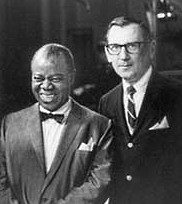
Zeke & Louis, Circa 1960

“Like that?”

Zeke was cool, but a little odd. I have nothing against odd and like Tony Plog told me, “Strange dudes are sometimes the most interesting!” Tony’s right and I got better studying with Zeke but there was something subtly bitter about him. Maybe it was a feeling of declining relevance, the sense of the world slipping away from him while he still wanted and needed to be part of things. It made me wonder if maybe he only took one student at a time because there wasn’t exactly a long line of players who wanted to work with Zeke. I don’t know. I do know, and it may have been the first time I had ever had the experience, that Zeke seemed more comfortable in the past than the present and that created a strange vibe for me. The room we played in was full of photos but I never had the nerve to get up and look at any of them carefully. The photos were all black and white. Zeke might have been disappointed I wasn’t more interested in who he had been rather than who he was to me. That, as they say, was then.

A few months ago I Googled good, old Zeke. The Guardian had a nice obit about him.

Here’s their lead back in 2009:

Zeke Zarchy, who has died aged 93, found fame and fortune as a lead trumpeter in the swing era and was celebrated for his long-term association with the bandleader Glenn Miller. He was very possibly the last survivor of Miller’s 1940s orchestra. Zarchy also performed with Benny Goodman, Artie Shaw, Boyd Raeburn and Woody Herman. Once the big-band era was over, he recorded film soundtracks (including The Glenn Miller Story in 1953) and album sessions for Frank Sinatra, Peggy Lee and Judy Garland, among others.

Born in New York, the son of Russian immigrants, Zarchy was encouraged by his housepainter father, an amateur mandolin player, to learn the violin but soon switched to the trumpet. A professional from his teens, he joined the Joe Haymes Orchestra, aged 20, and made his recording debut in 1935. Recalling Goodman’s invitation to join his band, Zarchy said, “I almost fainted.”

The Zeke who almost fainted at Goodman’s invite was looking toward the future. The Zeke I knew was looking for the past but it was gone, as it always is. I didn’t realize what an important lesson that was at the time. On the other hand maybe the lesson was something I only felt in my bones. I think a lot about the difference between pure nostalgia and a genuine belief things were better in the past. Now, having more days behind me than ahead makes that an easy question to ask but not so easy to answer. We all know where each of our futures inevitably lead. Still, it has been interesting to learn a little more about who Zeke had been and who he’d known and played with and I’m glad to have a slight but real connection to such an illustrious past. I’ve been lucky — in a lot of ways. I was lucky to have my Schilke when I needed it and two fine, if very different, trumpet masters.

Reaching for the past with Zeke Zarchy

The trumpets of Lee Morgan (and mine, too)

Last week, my dear friend and fellow jazz-lover, Eric, told me about the movie, I Called Him Morgan. It’s a fascinating film about the short, brilliant life and tragic end of jazz trumpeter, Lee Morgan. It’s an amazing movie full of fantastic music, and interviews along with lovely black & white photographs. Many of the photos clearly showed the trumpets Morgan played at various stages in his career. I recognized a Conn 8B, a French Besson Brevete and what I’m almost positive was a lowly Olds Ambassador. My guess is that the Olds was the lone survivor during Morgan’s hard times when his more valuable instruments likely found their way into the local pawnshop.

It’s always a sad day, especially for such a great musician, to give up a special instrument.

Me? When I was in junior high school I got really lucky when it came to trumpets. When I was in 7th grade our junior high school got a new music director. The outgoing teacher was a local legend and the 8th and 9th graders had come to love and respect him. The 24-year-old newcomer inspired great skepticism from the older kids but I liked him right from the start. It was easy for me to like him because he liked me so much. We had a kind of simpatico especially about music. He taught me a lot about jazz, different recording techniques and the acoustical qualities of concert halls. He had been a successful musician before he decided to become a teacher and he taught as if his students all felt the same as he did, and all had the same ambition to play professionally. But, though his attitude was contagious to me, not everyone caught the passion.

He thought I had talent and told me as much. I can recall his note on my first report card. Talented! Should have private lessons now! Kind of heady stuff for a 13 year old just learning to play the trumpet. I’d been struggling with a school loaner trumpet up until then. Even though I was a beginner I had a sense that the humble Buescher was making things harder than they needed to be. The new music director was horrified by the dismal condition of the school’s instruments. There was no money (has there ever been?) for new instruments so he encouraged students who he thought had talent to coax their parents into buying them a quality instrument. He knew that money was going to be an issue with the average parent so he cultivated a relationship with a local music store called, Zep’s.

Zep was a somewhat grizzled old reed player who owned a tiny store in Burbank that was stuffed, floor to ceiling, with some of the finest woodwinds and brass instruments available anywhere. One day, the new director drove me to Zep’s after school he had me try a number of different trumpets. Every trumpet I tried was freer-blowing than the old Buescher and every one sounded and felt different. It was quite a revelation. They also cost a lot of money. I didn’t know much, but I knew that a $750 dollar instrument was totally unrealistic for me.

So, I struggled along with the Buescher. Still, I loved to go to Zep’s. I was there when Amy, who would go on to play with the Portland Symphony Orchestra, got her Armstrong flute and when Patricia picked up her beautiful Buffet Crampon clarinet. Both girls were genuinely talented and driven musicians. I loved hearing them try different instruments and hearing the way they described the differences between different brands and models. Sometimes the differences were subtle and other times they were obvious. Our new music director was endlessly patient. We’d often be at Zep’s for hours and he never, ever seemed to be in a hurry.

I was hanging around the music room one Friday when the director asked me what I was doing on Saturday. I told him I had a baseball game at 3 in the afternoon but I wasn’t doing anything until then. He told me he wanted me to go with him to Zep’s; there was a trumpet there he wanted me to try. By then I had played a bunch of professional instruments. There was the ubiquitous Bach Strad which I always found to be a tad stodgy sounding and feeling. Then there was the flashy King Flair with its clever (or so I thought at the time) first-valve trigger. My early favorite was the Benge. It was sleek and smooth both in sound and action. But, it cost even more than the other totally out of reach trumpets. Still, I was very intrigued by what he wanted me to play.

Zep had been expecting us and as we walked toward the counter he went into the back room and emerged with an unmarked, black case. He opened it, exposing the luxurious dark blue drape of the velvet lining. The trumpet beneath was unlike any I had ever seen. It was a silver Schilke B5. I could see that it was used, but it was in perfect condition. At the time, I had never heard of Schilke, but Zep knew all about it. “Schilke’s back in Chicago. He makes pretty much all of Herseth’s trumpets,” Zep said as he took the trumpet out of the case. I took my mouthpiece out of my pocket and vanished into the practice room with the Schilke. It felt light in my hands and the trumpet looked beautiful. The main tuning slide was staggered and the only engraved markings were the words, “Schilke, Chicago USA” on the second valve and the “B5” mark on the lead pipe. Years later I adopted the look of the Schilke’s classic engravings for a putter design I was involved with, but that’s a story for another day. A lot of trumpets had garish engravings on their bells. I never liked the way that looked. The Schilke was sleek and clean from every perspective and it played amazingly well and sounded even better. Still, I couldn’t quite figure out why I was there. Even used, an instrument like that would be far more expensive than anything my family could afford.

The funny thing was that the music director didn’t seem concerned and he never spoke to me about how much it cost. He just watched and listened to me play, finally asking me if I liked it. Who wouldn’t? He then asked me if I wanted to borrow it for a couple weeks. I was so enthralled with the instrument that I said yes without really thinking about it. While we were driving back to North Hollywood in the director’s cool Audi 100LS he told me the story: The Schilke had been owned by a local session player who had just landed a gig that included a Holton contract for the entire trumpet section. So, one day while the player was at Zep’s trying out mouthpieces he asked Zep if he knew of a promising student who might enjoy the Schilke. Zep called our director and there I was riding home with the Schilke. The truth was that my family still had to come up with $150 to buy the case. Believe it or not, even with the amazing value of the trumpet explained, it still wasn’t easy to get my mom and dad to pony up the $150, but they finally did.

Even when I was a kid I had a tendency to write letters to people I didn’t know so a few weeks later I wrote a letter to Schilke at their old address on South Wabash Avenue in Chicago. Little more than a week later I got a handwritten letter back from Renold Schilke, the founder of the company. He confirmed the year my trumpet had been made and its exact specifications. He also wrote some advice about the preferred valve oil needed for an instrument that was built to such tight tolerances. In fact, I had already learned this having tried some standard valve oil only to find the action of the Schilke slowed badly. Having that letter from Schilke bonded me to that trumpet for a long, long time.

Schilke
Renold Schilke

I wasn’t the only kid who got lucky when it came to trumpets. One of my close friends was a nice little guy with a sharp crew cut named, Harris. We started out together in kindergarten and we soon learned that we lived right next door to each other. He and his family had come to the US from Israel a couple years after he was born. His father was an electrician who loved exploring California’s great deserts and searching for what Harris liked to call Thunder-Eggs. All through elementary school Harris would bring in beautiful geodes for Show & Tell. He and his father would search out the rough looking stones in the desert and bring them home before cutting them in half to reveal the hard, colorful crystals within. All these years later I’ve come to enjoy the desert in many of the same ways Harris and his father did nearly 50 years ago.

Like me, Harris had been saddled with a nearly unplayable school trumpet. His father had a different solution; pawn shops. He and Harris scoured the many pawn shops on Van Nuys Boulevard until one day he showed up at school with a beautiful instrument made by Calicchio in Hollywood. It was a beautiful trumpet, heavier than my Schilke, and with a slightly darker sound and a smaller bell. The Calicchio was older than my Schilke and the valves were a touch slow and the third slide was sticky. Harris wanted to take the bus down to have his trumpet looked at by the folks at Calicchio in Hollywood.

One Saturday we planned out our trip and headed south. I think it took three RTD buses to get from North Hollywood down to Calicchio’s near Hollywood & Highland. Calicchio’s shop looked like an old house. The only evidence we had actually found the right place was one of those old black signs you might see in a deli that showed the hours. The sign on the door said simply, Calicchio. We walked into a dimly lit room with a wooden counter on one side. In the corner was a simple glass case with a trumpet inside. A few minutes later an old man walked up to the counter. Harris put his case on the counter and started to explain about the valves and the third slide. The old man put his hands out, indicating that Harris should hand him his trumpet, which he did. The old man held the trumpet up, checking a couple of the braces. Then, he took a cigarette out from under the counter. He looked at both of us gravely and said, “Not for smoke…” We didn’t get what he meant right away but then we did. He didn’t want us to think that he was going to smoke. Instead, he took a quick drag and blew the smoke into the trumpet and then he depressed the troublesome third valve. He vanished for a few minutes and came back out with a brazing rod, a small torch, a tiny leather mallet and a small hammer. For the next 15 minutes we watched as he repaired a brace and tapped a tiny indentation out of the third slide. He showed Harris the evidence of the braze. It was almost unnoticeable. Anyway, Harris had intended to have the trumpet re-plated so the repair would be invisible once it was done. Harris tried the third valve slide that then happily held any position yet moved freely and he smiled at the old man. Then Harris pulled out his wallet and unfolded a check signed by his father made out to Calicchio. The old man bowed his head slightly and turned it slowly from side to side. Then, he shook hands with each of us as he smiled for the first time. As he shook our hands he said, “I am Calicchio.”

pic_manwithtrumpet (1)
Domenick Calicchio

“I thought he was only the repair guy, ” Harris said once we got outside. “So did I!” All the way home we wondered out loud how old Calicchio was and whether there was anyone back there to help him build the trumpets (there wasn’t) and whether he lived in that little house (he didn’t). No matter our petty questions, I believe we both had a sense of how special our brief encounter had been. We were only 13 going on 14 but we knew without really knowing why that we had been around someone who possessed an enduring connection to the instruments he created and that somehow that had connected him to my friend in a precious and unique way.

I lost track off Harris after high school. I think about him from time to time and I miss his smile and good nature. Neither of us ever got any good at playing trumpet, but we kept trying right on through high school and, in my case, college. Of course, Renold Schilke and Domenick Calicchio are now long dead. Trumpets emblazoned with the names Calicchio & Schilke are still made today, and I’m certain they are fine instruments. But, none of those trumpets have ever been held in the hands of anyone who shares their name. I find it sad that the Calicchio website doesn’t even have a biography of the great and humble man behind the name. The website has a section called tradition but virtually nothing about the man who made the Calicchio name relevant to musicians while he lived and the continuance of his name, as a brand, viable now that he’s gone.

Still, I’m grateful that in 1974 my friend Harris and I owned and played instruments that were true extensions of the men who had designed and built them. That kind of connection seems all too rare these days. I don’t know where Harris is, or whether he still plays his Calicchio. But, I’m certain he would recall that day as clearly as I do and likely still revels in the bond created by a simple handshake and his own connection to a master trumpet builder.


The trumpets of Lee Morgan (and mine, too)