January 4: Storing (my) music

It used to be easy, kind of anyway.

In my life I’ve stored music on LP, CDs and cassettes. 8-track? Nope, I never went down that rabbit hole, not even in the bad old days of Madman Muntz. Cassettes are miserable. They suffer from nasty compression (though some like a more compressed sound) but, worse, even commercial cassettes were prone to stretching and print-through. I did have an early fondness for making my own cassettes from radio broadcasts of classical and jazz back in the 70s. Some of them sounded Ok, especially when they were new. I found a cache of them in the basement of my parents house when they died back in 2008. I thought, for a brief moment, about trying to play one of them but quickly thought better of it…another rabbit hole avoided.

Me? I choose bigger and better rabbits holes like LP, CD and now digital music. LPs used to rule my world like dinosaurs. It was very difficult to listen to CDs when you have easy access to a quality LP playback system and good LPs. But, CDs got better and at a fairly rapid rate. Digital music is hurtling forward in quality. Even everyday bluetooth (especially later versions). Technologies like Qualcomm’s aptX will just keep on coming. Now, just as a brief reality check even aptX taps out at the limits of commercial CD (16 bit / 44.1 kHz) which is good but even better is sure to follow. This reality causes my enthusiasm for LPs to hold steady if not lose a little steam. Hey, as luscious as LPs are to hold, play and listen to I don’t like the feeling of emphasizing the medium over the music.

Good LPs, those pressed from virgin vinyl are extremely durable. I have records from the 70s that have been played thousands of times that still sound fantastic. The records themselves will certainly last well over a century (absent another flood). Until recently I’m not sure the same could be said of CD. Some early CDs suffered from fatal de-lamination. I have no doubt that the materials will be stable for the same century plus. The encouraging recent development I referred to earlier was the sudden increase in the availability of new one-box CD players. For a while it was looking like buyers would have to settle for a DVD player (until those went the way of the dinosaur) or a more elaborate and expensive two-box (transport/DAC) solution. I haven’t heard any of the new CD players but I’m sure they’re all good to excellent. Everyone has access to superb chips today and that’s a win for everyone. My suspicion is that most two-box solutions from smaller companies use chip sets that are inferior to those used by the big boys. That’s just how it is when it is comes to digital. If you can’t buy in quantity you have to get by on less.

So, both CDs and LPs are archive quality. But both formats take up space and it’s starting to annoy me. Tomorrow I’ll tell you about where that annoyance is taking me.

By the way, it hit 64 today with 70 on tap for tomorrow. I like the sound (and feel) of that!

January 4: Storing (my) music

January 2: Quality, music & nostalgia

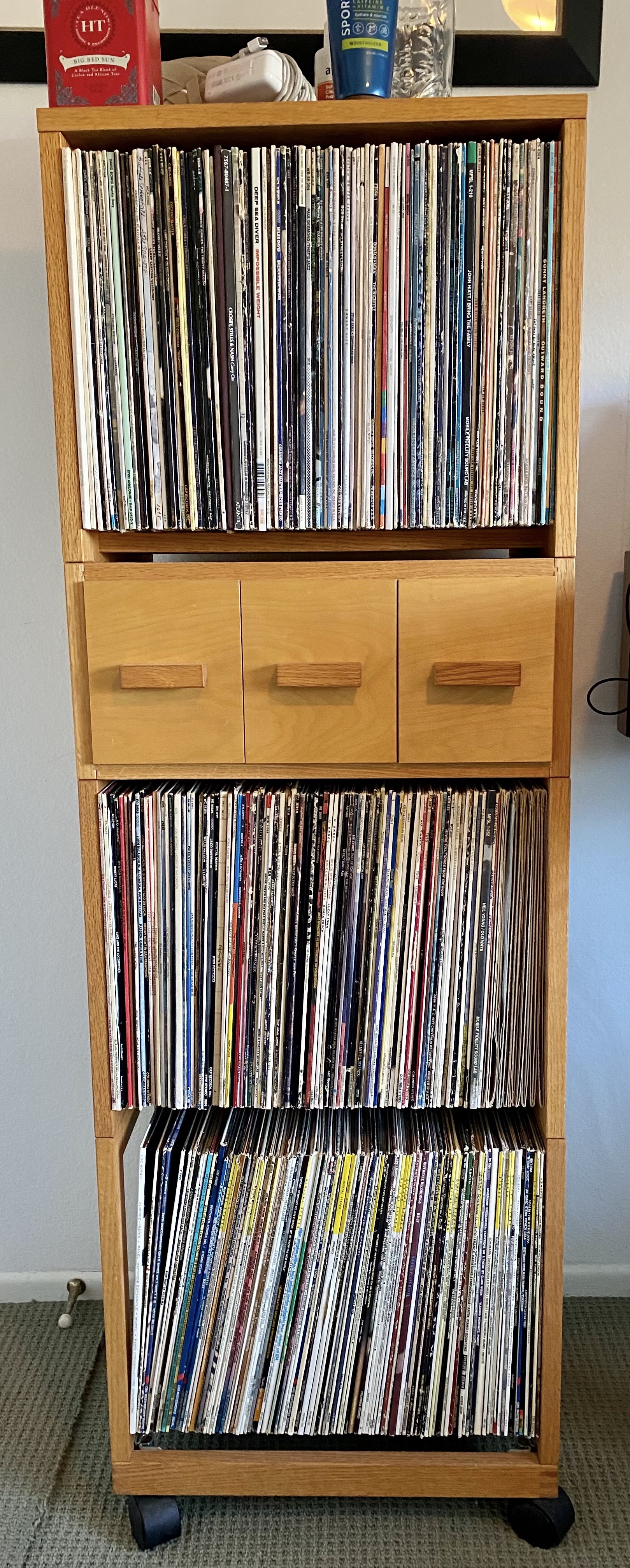
2020 was a year that I started to try to get a handle on my music collection. Years ago I lost over 2,000 treasured LPs in a flood. The insurance company first offered me $1 per record and ended up paying me $3 each. Still, that pretty much took out my collection save for the few hundred that escaped the hot, ravaging waters of the broken pipe.

A few of the survivors and my beloved Per Madsen Rack.

I would include a photo of my CDs, but they’re just so boring looking. Yesterday I wrote about Paul Simon’s disdain for contemporary music and I alluded to my music collection. I find that the more I write the more music I listen to. The listening is different, for the most part, than when I worked in and wrote about the high end audio industry. It is more of an accompaniment or a soundtrack. I no longer have a system, though I can still play LPs and CDs and hear them in free space. When the music or my brain demands it I listen on headphones, either wired or bluetooth. This is all heading toward how I intend to manage and grow my collection without as much physical mass to manage. The idea of using FLAC and dumping what’s left of my LPs onto a bunch of really big (an well backed up) hard drive is appealing. So is buying most (but not all of my music digitally through either iTunes or Bandcamp. I can’t quite wrest myself from the appeal of the physical so when I bought Deep Sea Diver’s new record I bought the LP from Bandcamp and it arrived signed by Jessica Dobson herself. Plus, Bandcamp tends to pay musicians a high percentage than iTunes.

C’mon, Jessica sent me Xs and Os…How do you pass that up?

It’s cool, but it’s also pretty damn physical. There may come a day where my enjoyment of buying and listening to records goes away altogether but I am not quite there yet. Digital and digital storage is just so convenient and it usually sounds fairly good. There’s a good chance one of the few benefits of aging will be the fact that my ability to discern good sound from bad sound will continue to decline. If I end up being happy to listen to a portable radio that’ll be just fine. My hearing already rolls off above 14kHz so I’m on my way!

Enough preamble. The word of the day is nostalgia. And my question is this: If you like something that happens to be old is your appreciation inherently possessed with nostalgia? What do we say when what’s old is really good let alone possible better than what’s new? Say we’re talking about Van Halen’s 1978 eponymously titled record or Steely Dan’s Katy Lied from 1975. Yup, I grew up with both. Still, each record is still fantastic by any measure. Do I have to admit that some of my appreciation for either work is dripping in nostalgia? Think about it and let me know. More tomorrow. I’m trying to keep the daily posts between 300-400 words. Wish me luck…

January 2: Quality, music & nostalgia

January 1, 2022

Seriously, I have to write more already?

Overnight I realized that this whole one year journal idea meant writing on something like a schedule, like other writers do. I read that Shelby Foote started each day writing 500 words, using a quill pen no less. I think I realized this in the back of my mind. As some of you might know, I finished my second novel, Cottonwood, a month or so back. I’m now waiting for my faithful formatter and cover artist to be available so I can get the book up on Amazon where it’s sure to make big bucks. I have a handful of ideas for my next book and I figured that writing everyday would keep me sharp in case any of those ideas suddenly grew from acorn to seedling. That fit in nicely with the one-year countdown to the end of my job at the law firm. Anyway, here I am on the first day of the year. To paraphrase Joe Friday, it’s breezy and cool in Los Angeles today. The high is supposed to hit 57…a tad chilly for me.

A while back I heard an interview with Paul Simon. In it, he was asked what music he was listening to these days. He mentioned that he’d been listening to the Elvis station (disappointed), along with B.B. King and Sinatra. He went on to say that he didn’t really listen to any contemporary music. I thought to myself, what the hell and I’m not totally surprised. Paul Simon’s a somewhat prickly old guy but I would emphasize old more the prickly. It struck me that he had either lost the energy he once had to sift through the crap that is most of everything to find the contemporary music that had worth or that he was simply more comfortable with music that was contemporaneous with his early life and what came before it. That gets me to the word nostalgic. I’ve been thinking about the word off and on and I’ll have more to say about it later. Anyway, I’m glad I haven’t thrown in the towel when it comes to contemporary music. There is some very good new music out there. Is it harder to find than it was in days gone by? I suppose that’s possible, but so what? If you love music you have to take the time to seek it out.

Drop by tomorrow if you’d like to hear more about my efforts to simultaneously organize, preserve and grow my music collection.

January 1, 2022

A sheep or a good man?

Yesterday I was sitting in a restaurant, waiting for my brother, when I saw a man come in and make his way toward the cashier. When he was a few feet away one of the employees said, “Excuse me, sir, do you have a mask?” The man sighed and nodded as he reached into his pocket. After he had the mask on the man said, “I’ll be a sheep.” Then, he kind of turned to look around and I caught his eye and said to him, “It’s funny, but you don’t look like a sheep. You look like a good man.”

A sheep or a good man?

I’m 168,000 words into my novel, Cottonwood

I really regret not keeping up with progress reports on Cottonwood over the time I’ve been working on it. The funny thing is that I until I checked I couldn’t even remember how long I’ve been working on the book. Now that I have checked I see it’s been a good long time since my first novel, John J. McDermott & the 1971 U.S. Open came out in April of 2019.

Cottonwood is a sequel of sorts. No, I guess it’s just a plain old sequel. It takes the lives of the two main characters from the early 1970s in Pennsylvania all the way to the desert of California and the late 1970s. I didn’t really have another book with the same characters, or at least some of them, in mind when I was putting the finishing touches on JJM. But suddenly, when I was totally done with it, I realized that I wasn’t totally done with it.

I imagined the book continuing into the future, the future being nearly a decade later. I saw the book continuing into my own time and closer to some of my own places. So much of the first book was an educated guess. Oh sure, I’d been to Pennsylvania when I was a kid but I didn’t have any real memories of it, other than staying with my mom’s cousin in an ancient row house in Reading, Pennsylvania one summer when I was about 12. Worse, I’d never been to Wales or anywhere in Europe for that matter (still haven’t, in fact). That was a huge problem. I spent hours looking at maps, imagining how the sun rose and set in various parts of the country. I read about how much it cost to take a ship from New York to Wales and how long the voyage took. I came to know some of that stuff, as we know facts that are printed on the page, but I couldn’t know them as experiences.

They say to write what you know. It makes a kind of intuitive sense but the need to know breaks down quickly when you start to write. The important thing for me has been to know and understand my characters. From there, my book is only a measure of how well I can bring my imagination and my relationship with my characters together. I think that Cottonwood will be a better book than JJM, or at least I hope it will be. It’s certainly a longer one and it’s not quite done yet. I wanted Cottonwood to have a more leisurely quality than JJM but life over the last two and a half years got in the way, both for me and the main characters. Life up and took away some of the meandering feel that I had hoped for the book and replaced it with something more intense, and I guess that’s Ok. We all write, partly, to make a character come to life. I hope that Cottonwood will do more than keep the characters from JJM alive. I hope it will show them as they change and meet challenges in the world they exist in much as I try to do in my own.

Anyway, it’s been a long effort and I happy to have made as much progress as I have. I can see the end of Cottonwood coming and also the beginning that will follow it close behind.

Looking down on the setting for Cottonwood

I’m 168,000 words into my novel, Cottonwood

Wires, Baby!

I know, it’s been a good long while. The good news is that Cottonwood, the sequel to my first novel now tips the scales at over 150,000 words. The pandemic initially quickened my productivity but in the end slowed it down significantly. Oh well, it’s only time and we all have plenty of that (he writes sardonically).

Even less interesting is the fact that I managed to lose my Apple AirPod Pros. Actually, they weren’t exactly lost. After all, the Find My app showed their last position (laying helpless and pitifull in a parking planter) but they were unable to find their way home. So, I tried other Bluetooth buds from Skullcandy, Sennheiser and Jabra but was disappointed badly each time. The AirPods were disappointing, too, I never did like the way they sounded though their feature set was impressive.

So, I’ve gone wired. I’ve decided that it’s better to battle a wire than it is to have marginal sound. I use a pair of now-discontinued Beats urbeats3 and a pair of Flares Jet2. The Beat’s rather enthusiastic bass is tamed nicely and easily via my iPhone’s EQ while their native midband and treble is surprisingly good out of the box. The Flares are more balanced overall if a little less musical (and less fun) than the Beats. Both of them whip the pants off of any of the expensive Bluetooth buds I’ve tried. I also keep a couple pair of old-school Apple buds for emergencies. Someday I may go wireless but not today. Why switch when you can fight?

Wires, Baby!

Wires, Baby!

120,000 words & conventional wisdom

I was fooling around looking at the word count of my novel the other day and I stumbled across a number of amusing articles contending that 120,000 words is some kind of magic number that one was unwise to exceed, especially as a first or second novel writer.

My favorite quote so far is:

“Word count limits can seem like they stifle artistic flow, but they exist for a reason.”

Uh, not really.

This is 2020. There are front list books. There are back list books. There long and short list books. But, there is no inherent relationship between word count and quality and I don’t care if the author is a newbie or Dostoyevsky.

The fact is that duration or word count might well be inextricably bound to the depth and complexity of the writer’s vision. If ebooks and contemporary printing technology has brought us anything it should be freedom from arbitrary limits respective to word count and the like.

So, if some stodgy old editor tells you differently, feel free to ignore what they say.

Only the author (and his or her trusted editor) can say whether a book has too many words (or too few).

To say otherwise would be to go back to the 20th or 19th century.

Let’s not…


120,000 words & conventional wisdom

We know very little about talent

We know very little about talent. When I saw, we I mean the entirety of folks who have ever asked themselves what talent is. Everyone is pretty sure they can recognize it when they see it. But isn’t there something more? I had a music teacher when I was  kid who said: “A lot of people have talent and a lot of people have discipline and tenacity. What you’ll find in most professional musicians is a combination of the two, and it can’t be beat.”

I agree, but there’s another question: Are discipline and tenacity simply additional manifestations of talent or are they qualities that all of us have access to and thereby not a function of innate ability?

Because if discipline and tenacity are innate talents aspiring to develop them may be like aspiring to be taller.  I think this is one of the most ignored questions in all of creativedom. My belief is that you cannot readily divide talent from drive. And, there’s a good chance that the combination of what we call talent and drive are different sides of the same coin that help our betters to attain artistic heights that are hard for we mere mortals to imagine, let alone  realize in our work.

Bummer, I say.

If all a given writer has on me is that he’ll outwork me, and for whatever reason I do not have what it takes to work at the same level, is he truly the more talented? We’re now likely on the cusp of trying to come up with another better descriptor like capable but every new word you or I come up with will take us right back to the same unanswerable question.

I am a believer is the search for small improvements. I believe that if I can affect an improvement in my drive as a writer, not to the level of someone who can crank out 50,000 words in a couple months, but just an improvement of a couple thousand words a month I’ll be really happy. And, the sequel to may first book will be done sooner.

But, I won’t be any more talented. I guess that will have to be good enough for me.


We know very little about talent

Social Isolation Part 2

Why have I always found it so pleasant to drink while I sit in the sun?

IMG_2245

I’m sure I can’t explain it. But, in these days of Social Isolation it still has its pleasures even though for now outside is a front yard rather than one of my local bars or brew pubs.

Plus, I’m dodging some clouds. Still, you know what they say about beggars and their lack of choices.

Now, the thing is I find outside & alcohol mentally provocative. Many times I will find myself enjoying a good IPA (like this one: Santa Monica Brewing Inclined IPA) and about halfway through I’ll get an idea and have to mosey on home to put it down. It’s not true every time but the reaction, or effect, always surprises me when it happens.

And, I do wonder why.

Is it the sun or the IPA or more likely a symbiotic combination? I vote for a symbiotic combination that flows from the sun’s gathering warmth and the mental softening effect of the IPA.

But, there’s something else and again it works in concert with both solar radiation and a good IPA; the lack of hurry, the feeling of easy contemplation, the sense that one is where one should be for that moment.

It’s often hard to create a lack of hurry sense, but that’s what I need.

Anyway, it’s a hard balance to strike and it’s all to easy to take it too far (IPA wise) and to become insensitive (idea wise). The key is to create a combination of balance & opportunity. If I can achieve that balance perhaps I can make some inroads on my book while staying safe. I’m well over halfway through but it’s still a little hard to see the end of tunnel.

I encourage all of you to do the same while being safe.


Social Isolation Part 2

Roger Modjeski Obituary

I wrestled with myself about writing this, I really did. I have known and worked and fought with Roger Modjeski since the 1990s. He has been an immense influence on my life as I know I was on his.

He was brilliant.

He was generous.

He was greedy.

He was visionary.

He was shortsighted.

He was my friend & I’m truly sorry he left this world so soon.

This is not an attempt to tell Roger’s life story. It’s more of  stream of consciousness obituary. If any dates  or the timeline of events are incorrect, I’m not really bothered. And, I’m not telling anything that I wouldn’t have said in Roger’s presence. We had an occasionally difficult relationship but an honest one and we were always civil toward one another during our battles.

Roger grew up in Richmond, Virginia, the son of the dean of the dental school at UVA, Peter Modjeski. I mention Roger’s father because it was he who got Roger interested in electronics, tubes and circuit design when Roger was little more than five years old. When Audio Advisor wanted a photo of Roger to include in their catalog, Roger wanted to use the photo of him at six, sitting in his pajamas with the first tube amplifier he ever designed, a single-ended triode, of course. He was a surprisingly outdoorsy kid, loving to fish the local rivers and streams. Roger spoke many times of grilling fresh fish and making hush puppies out in the woods near his family’s home.

Roger experienced a very strong push & pull toward the last of the 1970s that ended with him in California, first working at IBM and later at his then dream job with Harold Beveridge. Bev used Roger’s abilities wisely (for the most part) and Roger developed the RM-1/2 preamp and power supply while he was at the company but soon thereafter Roger felt the push and pull, again that only going into business for oneself can satisfy.

RAM Labs came first, followed by RAM Tube works and finally Music Reference. I heard my first Music Reference product at Brooks Berdans’ store in Monrovia way back when. A few years later I was publishing The Audio Observatory. Being an admirer of his designs, I always sent an issue to Roger. At some point, he wrote me a letter, inviting me to meet with him in Santa Barbara.

RAM 1

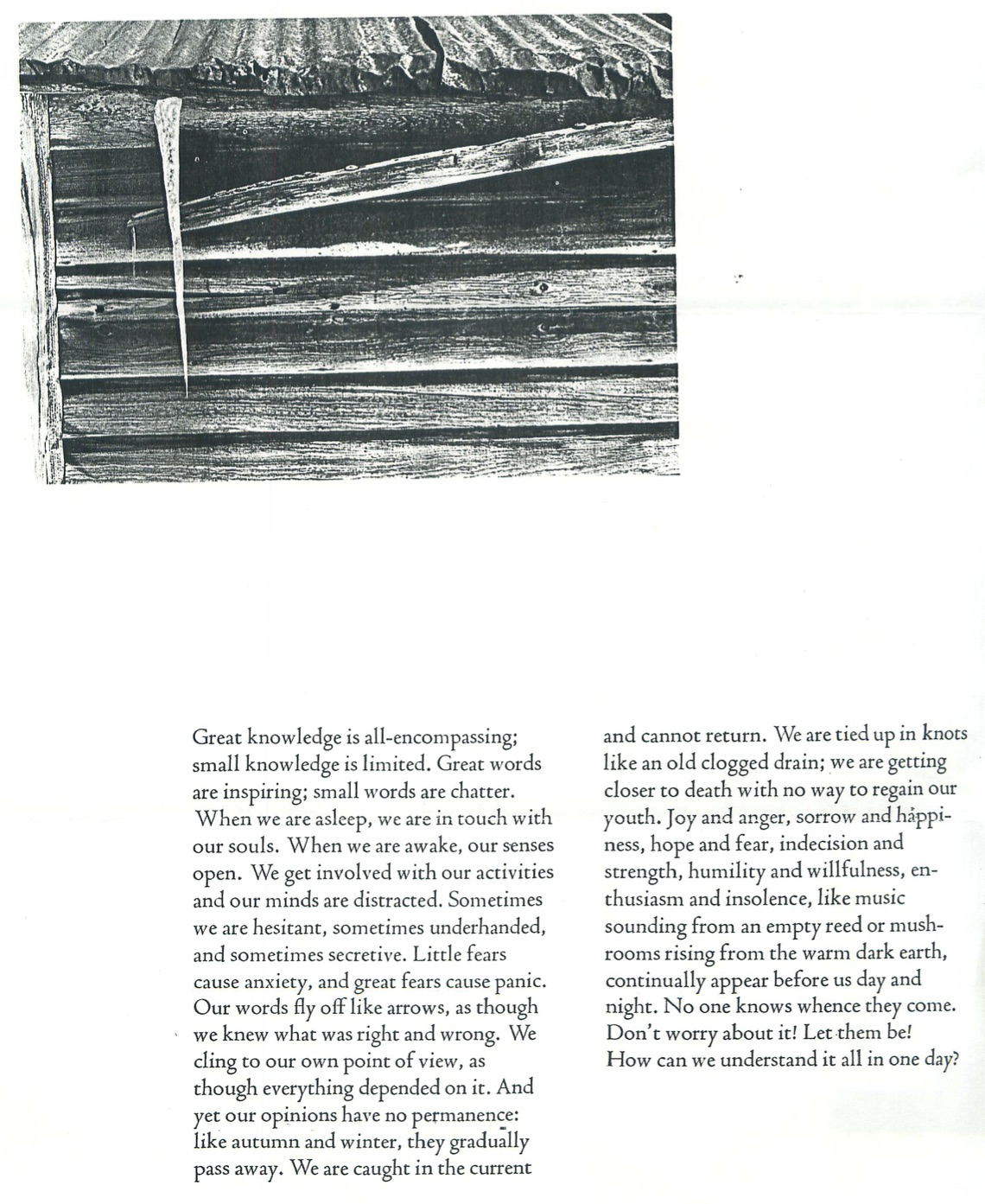
Really, though, the real Roger came through in the bit of verse he included on a separate page.
RAM 2

I say the real Roger, but I really meant that this was Roger as he could be, and as I know he strove to be. But, it was hard for him to sustain this kind of sensitivity and reflectiveness, especially when it came to his business.

RAM Labs was born at the perfect time. Had it started a decade later few would have valued his properly tested tubes and engineering rigor. But, in the early 80s folks were just beginning to yearn for it and the attraction to his tubes, once established, continues to this day. Music Reference was founded on Roger’s personal investment of $4,000. That cash built the first run of RM-4 pre-pres and the rest is history.

One of the reasons I sold The Audio Observatory was to go to work for Roger. I’m not sorry I did it though nothing turned out like I expected (does it ever?). Roger detested the processes of building gear as much as he loved designing and prototyping it. The RM-10 was born of his desire to build both an eco-friendly amp and one that got way more power out of a humble pair of EL84 output tubes. Given the right speakers, it sounded (and sounds) spectacular. Its small size kept it from being as respected as it should have been but to those who know there’s no amp anything like it designed or built anywhere.

The RM-200 was my idea. I waxed lyrical to Roger about my Audio Research D-70 MkII and what I regarded (and still regard) as the magic of two 6550s in a hard-driven circuit. Roger listened to me, and he listened to the D-70 MkII. Still, the ARC offended his sensibilities. The driver and input stage were overly complex and the 6550s were simply driven too hard. One day, Roger asked me if a reverse hybrid, one with a balanced solid-state input driving (you guessed it…a pair of 6550s) would have any appeal. I asked him how much it would cost and he said we could sell it for $1850. That number fit nicely with the RM-9 MkII so I loved the idea. Well, by the time the RM-200 hit the market it cost nearly $3000.

Why? Because Roger hated the process so much that he kept raising the price, even before the amp was available and even though out best dealers and distributors had placed cash deposits based on the old price. The truth was that building the RM-200 was fairly easy (especially compared to the RM-9 MkII). Still, it nearly killed Roger and I do not exaggerate. His doctor advised him no fewer than twice to abandon the project and sell the company if he wanted to preserve his health. The RM-200 was everything it was designed to be though a lot of people just didn’t get it. It broke too many rules, spoiled too many assumptions about hybrids, and feeding tubes with transistors. Though we knew selling it would be an uphill battle, the reception (save for Stereophile’s Class A Recommendation) was hurtful to both of us. The price increase simply killed that amp and prevented it from being the unusual classic it could have easily been.

By the time I moved on from RAM Labs we were basically out of the equipment game. There was nothing being built. We had RM-9 SEs on hand and a smattering of RM-4 but that was it. The RM-5, the RM-10 and the RM-200 were all in suspended animation at that point. I had grown tired of making promises to dealers and especially our distributor in Singapore who had made a sizable investment in our gear and tubes. As Roger admitted to me one day, “It’s hard not having anything in your cart to sell.”

I visited Roger a few times while he was still in Santa Barbara and we always had fun hanging out and chatting, never about business. By then, he was building his custom SE stuff. That had been a kind of dream for him for a long time; build one, sell one. You see for Roger, the joy was in The Study as he called it. That was his process of going from inspiration to finished circuit. That was the part he loved and it had nothing whatever to do with business. Most high end companies are the opposite. The designs fly together, be they good or not so good, and then move on to production. It’s time to sell the damn thing is the collective battle cry of the high end.

Roger was caught between those two desires. He believed his real value was as a designer and, of course, it was. He used to say, “Why can’t I just design it and someone else build it?” That made sense, but in the end it was always his company and the idea of prototyping something let alone moving it on toward manufacture without him was unsound. Still, the glory of his designs do and will endure. The RM-10, the RM-9, the RM-5 and the Counterpoint SA-4 are among the most enduring high end products ever; and for good reason.

RAM 3

RAM 4

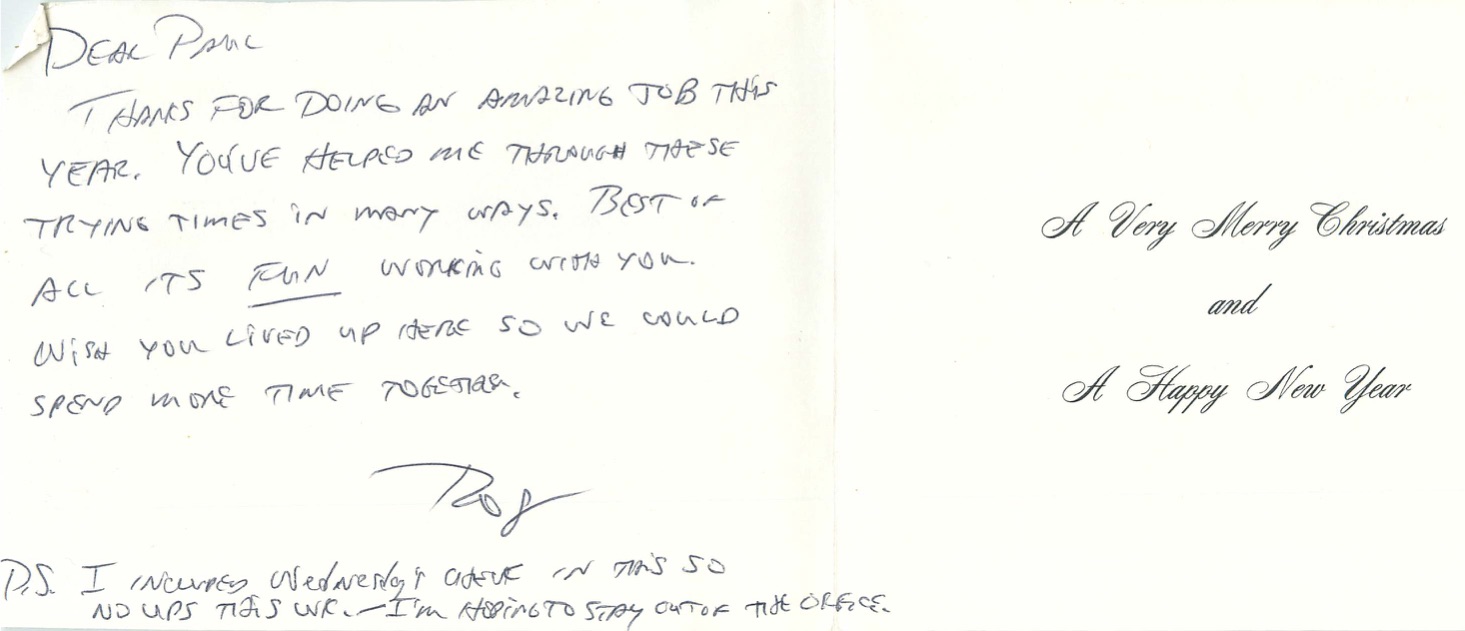
This Christmas card from way back when will always be how I remember Roger Modjeski. Working alongside him was many things, including fun. I will always wish that we could have accomplished more, with Music Reference especially. But, in the end, we did what we could and we did it our way. I know all of the owners of Music Reference gear will treasure their gear all the more now that he has slipped away from us. For myself, I wish only for one more sunny day in Santa Barbara with him, sitting outside one of our favorite restaurants, talking about the high end and music and life.

 

Roger Modjeski Obituary