I know most of you had your hearts set on three or four hundred more words about the future of my music collection but I need to make a brief detour. Today I woke up thinking about what’s next. My promise to myself was to milk every one of 2022’s days to the fullest, and I’m still about that. The problem with thinking about what’s next is that it takes one out of the present and the present is all any of us have. No matter, what’s next is what I was thinking about.
I’ve been a paralegal who moonlights doing marketing and ad copy writing for a long time. I’m Ok with both but supporting myself on the marketing gig alone strikes me as a dubious proposition. Sure, I like macaroni and cheese but not for all three meals. The problem with the paralegal game is twofold. First, I’m old. It’s hard to imagine a bunch of firms being into hiring a 61 plus year old with a boatload of experience. Of course, I’m only in need of one job so a bunch of firms is unnecessary. The other problem is me. I’m only willing to do certain kinds of legal work (read: plaintiff) and I have no interest in ever, ever having another long commute that relies on public transportation or sitting in traffic while the second or third best years of my life slip quietly away.
Then there’s the internet and the idea of a being a freelancer. I’m at least somewhat comfortable with that idea having worked with freelancers quite a bit over the years and even getting some of my writing gigs through elance (now Upwork). That would be workable except for the 800 pound gorilla; medical insurance. Over the last fifteen years my insurance (which has been mercifully and graciously paid for by my employers) has gone from a shade over $200 a month to well over $1000.
We all know that there’s something fundamentally wrong with that kind of increase and we all know there’s not a thing we can do about it. Car insurance? Relatively steady over the same period. Medical? How about double the cost, then triple then $1000, then more. Well, I did get a prescription for my dermatitis. Thank God for the Affordable Care Act. I cannot imagine the slaughter we would all be facing without it.
So, those are the thoughts I had when my sleepy eyes opened this morning. I’d rather have woken up worrying about what to do with my damn LPs.
Oh well, there’s always tomorrow.
By the way, I can write a little about music today: While I’m writing this I’m listening to one of my earlier iTunes purchases from way back in 2006, Björn Olsson’s The Lobster. It’s been a while since I’ve listened to this and it’s cool to be reminded by just how clever and musical it is. It sounds like an otherworldly and unheard soundtrack to an unreleased Sergio Leone film, almost as if Ennio Morricone was born in Gotebörg, Sweden rather than Rome. There’s no flash and dazzle to Olsson’s style though his guitar playing is elemental and beautiful. He’s confident to let his songs bring the message, just the way I like it.
The source, you ask? My iPhone 11 streaming to my Skullcandy Crusher Evo. Damn nice and, yes, I do think I’ll write about these headphones someday soon.
In my life I’ve stored music on LP, CDs and cassettes. 8-track? Nope, I never went down that rabbit hole, not even in the bad old days of Madman Muntz. Cassettes are miserable. They suffer from nasty compression (though some like a more compressed sound) but, worse, even commercial cassettes were prone to stretching and print-through. I did have an early fondness for making my own cassettes from radio broadcasts of classical and jazz back in the 70s. Some of them sounded Ok, especially when they were new. I found a cache of them in the basement of my parents house when they died back in 2008. I thought, for a brief moment, about trying to play one of them but quickly thought better of it…another rabbit hole avoided.
Me? I choose bigger and better rabbits holes like LP, CD and now digital music. LPs used to rule my world like dinosaurs. It was very difficult to listen to CDs when you have easy access to a quality LP playback system and good LPs. But, CDs got better and at a fairly rapid rate. Digital music is hurtling forward in quality. Even everyday bluetooth (especially later versions). Technologies like Qualcomm’s aptX will just keep on coming. Now, just as a brief reality check even aptX taps out at the limits of commercial CD (16 bit / 44.1 kHz) which is good but even better is sure to follow. This reality causes my enthusiasm for LPs to hold steady if not lose a little steam. Hey, as luscious as LPs are to hold, play and listen to I don’t like the feeling of emphasizing the medium over the music.
Good LPs, those pressed from virgin vinyl are extremely durable. I have records from the 70s that have been played thousands of times that still sound fantastic. The records themselves will certainly last well over a century (absent another flood). Until recently I’m not sure the same could be said of CD. Some early CDs suffered from fatal de-lamination. I have no doubt that the materials will be stable for the same century plus. The encouraging recent development I referred to earlier was the sudden increase in the availability of new one-box CD players. For a while it was looking like buyers would have to settle for a DVD player (until those went the way of the dinosaur) or a more elaborate and expensive two-box (transport/DAC) solution. I haven’t heard any of the new CD players but I’m sure they’re all good to excellent. Everyone has access to superb chips today and that’s a win for everyone. My suspicion is that most two-box solutions from smaller companies use chip sets that are inferior to those used by the big boys. That’s just how it is when it is comes to digital. If you can’t buy in quantity you have to get by on less.
So, both CDs and LPs are archive quality. But both formats take up space and it’s starting to annoy me. Tomorrow I’ll tell you about where that annoyance is taking me.
By the way, it hit 64 today with 70 on tap for tomorrow. I like the sound (and feel) of that!
Yesterday, I laid out the raw numbers of my current music collection. There are a few hundred LPs and maybe 500-600 CDs. But wait, I’ve forgotten about the digital music from iTunes, Bandcamp and even a small smattering of music I bought from Amazon. Each purchase has one thing in common; it is as available and reliable as the company that has granted the me use rights to the music.
Like pretty much all rights, iTunes rights are beset by limitations. Hey, .99 cents (now $1.29) only buys you but so much. Let me tell you the story of a handful of songs I purchased by a fairly obscure singer named Brendan Campbell (from his 2008 record, Burgers and Murders). I bought the songs from iTunes quite a while back. But, earlier this year when I tried to play them I found that the songs were MIA (at least on my iPhone).
Well, that’s weird thought I…
Once I was back in my home office I checked my master iTunes library, which resides on the lovely if aged, 1TB drive of my elderly MacMini. There the missing songs were right where they were supposed to be, ready to play.
The cover of Campbell’s 2008 record…
WTF?
It took me and Mr. Google a couple minutes to solve this minor league tech puzzler. The answer resides not so much with iTunes but rather with the license granted to them by Mr. Campbell. It seems the two had a spat of some sort and the result is that iTunes can no longer sell (or allow access to) Campbell’s music even though I had previously purchased the songs.
The only reason I still have the songs is because a long time ago I downloaded (remember that 1TB drive?) the songs in question. If I had left them to float around the digital ether all this time the songs would be gone forever, or at least until Campbell’s work pops up somewhere else. Going forward who can say whether the rights granted by iTunes, et al are ephemeral or long standing?
I raise this issue because it serves to emphasize how important it is to have a downloaded, nailed-down (read residing on an actual hard drive you own) version of all the music you own. Sure, Campbell’s music comprises a financial investment of exactly $5.94 but the point is that I cannot find that music anywhere else, at least not as of this writing. The loss of those songs would go beyond the mere pittance I originally spent on them.
In the end, a valued music collection has to be archivable.
More on that tomorrow. By the way, it actually warmed up fairly well in the valley today. The mercury made it all the way to 64 today.
2020 was a year that I started to try to get a handle on my music collection. Years ago I lost over 2,000 treasured LPs in a flood. The insurance company first offered me $1 per record and ended up paying me $3 each. Still, that pretty much took out my collection save for the few hundred that escaped the hot, ravaging waters of the broken pipe.
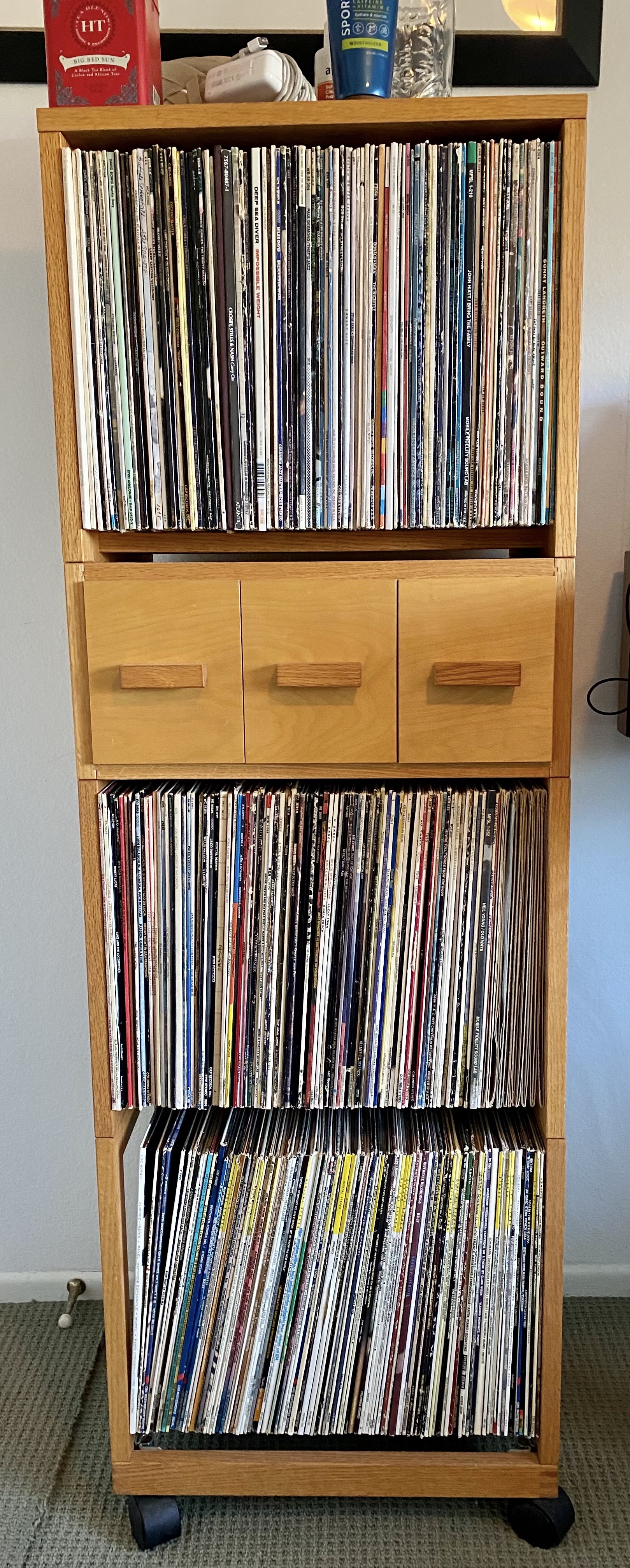
A few of the survivors and my beloved Per Madsen Rack.
I would include a photo of my CDs, but they’re just so boring looking. Yesterday I wrote about Paul Simon’s disdain for contemporary music and I alluded to my music collection. I find that the more I write the more music I listen to. The listening is different, for the most part, than when I worked in and wrote about the high end audio industry. It is more of an accompaniment or a soundtrack. I no longer have a system, though I can still play LPs and CDs and hear them in free space. When the music or my brain demands it I listen on headphones, either wired or bluetooth. This is all heading toward how I intend to manage and grow my collection without as much physical mass to manage. The idea of using FLAC and dumping what’s left of my LPs onto a bunch of really big (an well backed up) hard drive is appealing. So is buying most (but not all of my music digitally through either iTunes or Bandcamp. I can’t quite wrest myself from the appeal of the physical so when I bought Deep Sea Diver’s new record I bought the LP from Bandcamp and it arrived signed by Jessica Dobson herself. Plus, Bandcamp tends to pay musicians a high percentage than iTunes.
C’mon, Jessica sent me Xs and Os…How do you pass that up?
It’s cool, but it’s also pretty damn physical. There may come a day where my enjoyment of buying and listening to records goes away altogether but I am not quite there yet. Digital and digital storage is just so convenient and it usually sounds fairly good. There’s a good chance one of the few benefits of aging will be the fact that my ability to discern good sound from bad sound will continue to decline. If I end up being happy to listen to a portable radio that’ll be just fine. My hearing already rolls off above 14kHz so I’m on my way!
Enough preamble. The word of the day is nostalgia. And my question is this: If you like something that happens to be old is your appreciation inherently possessed with nostalgia? What do we say when what’s old is really good let alone possible better than what’s new? Say we’re talking about Van Halen’s 1978 eponymously titled record or Steely Dan’s Katy Lied from 1975. Yup, I grew up with both. Still, each record is still fantastic by any measure. Do I have to admit that some of my appreciation for either work is dripping in nostalgia? Think about it and let me know. More tomorrow. I’m trying to keep the daily posts between 300-400 words. Wish me luck…
No, you won’t be replacing your real system, assuming you still have one, with a HomePod.
Yes, you will be impressed by how fundamentally musical it is.
The Apple HomePod is the first mass-market product, designed by a company with real engineering wallop, that was actually designed by people who wanted it to sound good and that fact should put existential fear into every high end company that’s still on the right side of the grass.
Let’s talk about setup. It’s OK, but like all new Apple products it entails a few more steps than it should and Apple’s Home app is kludgy. Bummer, that, but once you’re done with it you’re done with it, or so it seems so far.
On the operational front I’ve observed that Pandora skips momentarily about every ten to fifteen minutes. The funny thing is that it never skips on my iPhone or when I’m using my Air Pods.
What the?
That problem gave me the chance to test Spotify.
Odd, no skipping whatsoever.
Who knows what’s up there but I’m willing to blame Pandora until and unless it starts to happen with other sources. Not surprisingly, playback from iTunes / Music is just dandy.
What the folks at Apple have done here is to swing a big, heavy hammer at what should be an easy target, and for them it was. The HomePod is a technically and acoustically complex product. They’ve crammed a bunch of drivers into that little pod. If a high end company, or a lesser tech company, tried to do what Apple has done the result would have been a sonic or functional mess and probably both.
The HomePod sounds remarkable coherent from top to bottom. Even though I’m using it as what would be regarded as a monophonic speaker the result is quite natural from a spatial perspective. Remember, stereo is a trick. This kind of mono is simply another kind of trick, and it works because Apple figured out how to make it work.
But wait, let me talk about why I felt I needed a better speaker in my office than my beloved Soundfreaq Sound Spot Wood + White. There are two reasons, really. The first is that I need a speaker in my bedroom, and the Sound Spot is perfect for that. The second and more important reason flows from the damn book I’m writing. This whole book-writing thing entails seemingly endless hours of ass sitting, which I already hate. I’m actually thinking of hiring a personal trainer so that all this extra time sitting doesn’t knock too much time off my life expectancy.
The HomePod’s fundamental listenability and (comparatively) full range presentation brings just enough music into my office that I’m not constantly driven to get up and change the record or put in another CD or whatever. I can turn it up to annoyingly high levels when the music or mood calls for it or turn it down to the edge of silence when I’m trying desperately to think and it stays musically convincing.
The Pod simply sounds good. Yes, it takes some liberties and creates a sould-warming upper-bass hump so you won’t notice the lack of mid and lower bass. And, yes, all those drivers lead to an occasional if surprisingly minor megaphone effect that’s especially noticeable on female vocals.
But then, something will come on that will catch your attention. Right now that’s Telegraph Road from Dire Straits. The cut has a lot of electronically generated space and a fairly high dynamic range for a rock recording. But, the Pod pulls it off. Somehow, especially at rational volumes, the musical presentation holds together is the exact way you need to draw your attention into the music.
Wow.
$250?
I cannot think of a $500 pair of stereo speakers from any high end manufacturer of any era that can match the Apple HomePod’s essential musicality.
That fact, all by itself, is why I regard the HomePod and all of the amazing stuff that will surely come after it such a threat to what’s left of the high end.
In closing, I’m trying to imagine what would be involved in streaming to the HomePod from an analog turntable. Obviously, a really good phono preamp (got one) and a really good DAC (ditto). Then, all I have to do is trick AirPlay2 into streaming the resulting data at full resolution to the HomePod.
Hmmm…
Who knows? Maybe this will be possible by the time I’m working on the sequel to the sequel.
All you high end audio folks should have heard this kind of product coming and from this kind of company because it’s already too late for you to get out of the way.
Last week, my dear friend and fellow jazz-lover, Eric, told me about the movie, I Called Him Morgan. It’s a fascinating film about the short, brilliant life and tragic end of jazz trumpeter, Lee Morgan. It’s an amazing movie full of fantastic music, and interviews along with lovely black & white photographs. Many of the photos clearly showed the trumpets Morgan played at various stages in his career. I recognized a Conn 8B, a French Besson Brevete and what I’m almost positive was a lowly Olds Ambassador. My guess is that the Olds was the lone survivor during Morgan’s hard times when his more valuable instruments likely found their way into the local pawnshop.
It’s always a sad day, especially for such a great musician, to give up a special instrument.
Me? When I was in junior high school I got really lucky when it came to trumpets. When I was in 7th grade our junior high school got a new music director. The outgoing teacher was a local legend and the 8th and 9th graders had come to love and respect him. The 24-year-old newcomer inspired great skepticism from the older kids but I liked him right from the start. It was easy for me to like him because he liked me so much. We had a kind of simpatico especially about music. He taught me a lot about jazz, different recording techniques and the acoustical qualities of concert halls. He had been a successful musician before he decided to become a teacher and he taught as if his students all felt the same as he did, and all had the same ambition to play professionally. But, though his attitude was contagious to me, not everyone caught the passion.
He thought I had talent and told me as much. I can recall his note on my first report card. Talented! Should have private lessons now! Kind of heady stuff for a 13 year old just learning to play the trumpet. I’d been struggling with a school loaner trumpet up until then. Even though I was a beginner I had a sense that the humble Buescher was making things harder than they needed to be. The new music director was horrified by the dismal condition of the school’s instruments. There was no money (has there ever been?) for new instruments so he encouraged students who he thought had talent to coax their parents into buying them a quality instrument. He knew that money was going to be an issue with the average parent so he cultivated a relationship with a local music store called, Zep’s.
Zep was a somewhat grizzled old reed player who owned a tiny store in Burbank that was stuffed, floor to ceiling, with some of the finest woodwinds and brass instruments available anywhere. One day, the new director drove me to Zep’s after school he had me try a number of different trumpets. Every trumpet I tried was freer-blowing than the old Buescher and every one sounded and felt different. It was quite a revelation. They also cost a lot of money. I didn’t know much, but I knew that a $750 dollar instrument was totally unrealistic for me.
So, I struggled along with the Buescher. Still, I loved to go to Zep’s. I was there when Amy, who would go on to play with the Portland Symphony Orchestra, got her Armstrong flute and when Patricia picked up her beautiful Buffet Crampon clarinet. Both girls were genuinely talented and driven musicians. I loved hearing them try different instruments and hearing the way they described the differences between different brands and models. Sometimes the differences were subtle and other times they were obvious. Our new music director was endlessly patient. We’d often be at Zep’s for hours and he never, ever seemed to be in a hurry.
I was hanging around the music room one Friday when the director asked me what I was doing on Saturday. I told him I had a baseball game at 3 in the afternoon but I wasn’t doing anything until then. He told me he wanted me to go with him to Zep’s; there was a trumpet there he wanted me to try. By then I had played a bunch of professional instruments. There was the ubiquitous Bach Strad which I always found to be a tad stodgy sounding and feeling. Then there was the flashy King Flair with its clever (or so I thought at the time) first-valve trigger. My early favorite was the Benge. It was sleek and smooth both in sound and action. But, it cost even more than the other totally out of reach trumpets. Still, I was very intrigued by what he wanted me to play.
Zep had been expecting us and as we walked toward the counter he went into the back room and emerged with an unmarked, black case. He opened it, exposing the luxurious dark blue drape of the velvet lining. The trumpet beneath was unlike any I had ever seen. It was a silver Schilke B5. I could see that it was used, but it was in perfect condition. At the time, I had never heard of Schilke, but Zep knew all about it. “Schilke’s back in Chicago. He makes pretty much all of Herseth’s trumpets,” Zep said as he took the trumpet out of the case. I took my mouthpiece out of my pocket and vanished into the practice room with the Schilke. It felt light in my hands and the trumpet looked beautiful. The main tuning slide was staggered and the only engraved markings were the words, “Schilke, Chicago USA” on the second valve and the “B5” mark on the lead pipe. Years later I adopted the look of the Schilke’s classic engravings for a putter design I was involved with, but that’s a story for another day. A lot of trumpets had garish engravings on their bells. I never liked the way that looked. The Schilke was sleek and clean from every perspective and it played amazingly well and sounded even better. Still, I couldn’t quite figure out why I was there. Even used, an instrument like that would be far more expensive than anything my family could afford.
The funny thing was that the music director didn’t seem concerned and he never spoke to me about how much it cost. He just watched and listened to me play, finally asking me if I liked it. Who wouldn’t? He then asked me if I wanted to borrow it for a couple weeks. I was so enthralled with the instrument that I said yes without really thinking about it. While we were driving back to North Hollywood in the director’s cool Audi 100LS he told me the story: The Schilke had been owned by a local session player who had just landed a gig that included a Holton contract for the entire trumpet section. So, one day while the player was at Zep’s trying out mouthpieces he asked Zep if he knew of a promising student who might enjoy the Schilke. Zep called our director and there I was riding home with the Schilke. The truth was that my family still had to come up with $150 to buy the case. Believe it or not, even with the amazing value of the trumpet explained, it still wasn’t easy to get my mom and dad to pony up the $150, but they finally did.
Even when I was a kid I had a tendency to write letters to people I didn’t know so a few weeks later I wrote a letter to Schilke at their old address on South Wabash Avenue in Chicago. Little more than a week later I got a handwritten letter back from Renold Schilke, the founder of the company. He confirmed the year my trumpet had been made and its exact specifications. He also wrote some advice about the preferred valve oil needed for an instrument that was built to such tight tolerances. In fact, I had already learned this having tried some standard valve oil only to find the action of the Schilke slowed badly. Having that letter from Schilke bonded me to that trumpet for a long, long time.
Renold Schilke
I wasn’t the only kid who got lucky when it came to trumpets. One of my close friends was a nice little guy with a sharp crew cut named, Harris. We started out together in kindergarten and we soon learned that we lived right next door to each other. He and his family had come to the US from Israel a couple years after he was born. His father was an electrician who loved exploring California’s great deserts and searching for what Harris liked to call Thunder-Eggs. All through elementary school Harris would bring in beautiful geodes for Show & Tell. He and his father would search out the rough looking stones in the desert and bring them home before cutting them in half to reveal the hard, colorful crystals within. All these years later I’ve come to enjoy the desert in many of the same ways Harris and his father did nearly 50 years ago.
Like me, Harris had been saddled with a nearly unplayable school trumpet. His father had a different solution; pawn shops. He and Harris scoured the many pawn shops on Van Nuys Boulevard until one day he showed up at school with a beautiful instrument made by Calicchio in Hollywood. It was a beautiful trumpet, heavier than my Schilke, and with a slightly darker sound and a smaller bell. The Calicchio was older than my Schilke and the valves were a touch slow and the third slide was sticky. Harris wanted to take the bus down to have his trumpet looked at by the folks at Calicchio in Hollywood.
One Saturday we planned out our trip and headed south. I think it took three RTD buses to get from North Hollywood down to Calicchio’s near Hollywood & Highland. Calicchio’s shop looked like an old house. The only evidence we had actually found the right place was one of those old black signs you might see in a deli that showed the hours. The sign on the door said simply, Calicchio. We walked into a dimly lit room with a wooden counter on one side. In the corner was a simple glass case with a trumpet inside. A few minutes later an old man walked up to the counter. Harris put his case on the counter and started to explain about the valves and the third slide. The old man put his hands out, indicating that Harris should hand him his trumpet, which he did. The old man held the trumpet up, checking a couple of the braces. Then, he took a cigarette out from under the counter. He looked at both of us gravely and said, “Not for smoke…” We didn’t get what he meant right away but then we did. He didn’t want us to think that he was going to smoke. Instead, he took a quick drag and blew the smoke into the trumpet and then he depressed the troublesome third valve. He vanished for a few minutes and came back out with a brazing rod, a small torch, a tiny leather mallet and a small hammer. For the next 15 minutes we watched as he repaired a brace and tapped a tiny indentation out of the third slide. He showed Harris the evidence of the braze. It was almost unnoticeable. Anyway, Harris had intended to have the trumpet re-plated so the repair would be invisible once it was done. Harris tried the third valve slide that then happily held any position yet moved freely and he smiled at the old man. Then Harris pulled out his wallet and unfolded a check signed by his father made out to Calicchio. The old man bowed his head slightly and turned it slowly from side to side. Then, he shook hands with each of us as he smiled for the first time. As he shook our hands he said, “I am Calicchio.”
Domenick Calicchio
“I thought he was only the repair guy, ” Harris said once we got outside. “So did I!” All the way home we wondered out loud how old Calicchio was and whether there was anyone back there to help him build the trumpets (there wasn’t) and whether he lived in that little house (he didn’t). No matter our petty questions, I believe we both had a sense of how special our brief encounter had been. We were only 13 going on 14 but we knew without really knowing why that we had been around someone who possessed an enduring connection to the instruments he created and that somehow that had connected him to my friend in a precious and unique way.
I lost track off Harris after high school. I think about him from time to time and I miss his smile and good nature. Neither of us ever got any good at playing trumpet, but we kept trying right on through high school and, in my case, college. Of course, Renold Schilke and Domenick Calicchio are now long dead. Trumpets emblazoned with the names Calicchio & Schilke are still made today, and I’m certain they are fine instruments. But, none of those trumpets have ever been held in the hands of anyone who shares their name. I find it sad that the Calicchio website doesn’t even have a biography of the great and humble man behind the name. The website has a section called tradition but virtually nothing about the man who made the Calicchio name relevant to musicians while he lived and the continuance of his name, as a brand, viable now that he’s gone.
Still, I’m grateful that in 1974 my friend Harris and I owned and played instruments that were true extensions of the men who had designed and built them. That kind of connection seems all too rare these days. I don’t know where Harris is, or whether he still plays his Calicchio. But, I’m certain he would recall that day as clearly as I do and likely still revels in the bond created by a simple handshake and his own connection to a master trumpet builder.




 Paul Cervantes