My recovery from angst day #1 of 2022 is complete and I’m relieved there appears to have been no obvious follow-up to the attempted insurrection of 2021. Thank God for small and large favors. Things were better today. I took delivery of a new-to-me watch and I also took a hike and I also took a slice of pizza and an excellent blood orange IPA.
How can you go wrong with any, let alone all, of those?
The weather was doing an excellent impression of summer and the trails were empty save for a few hikers and even fewer mountain bike guys. Anyway, part of what made today better was the self-reminder that changes and transitions are inevitable whether or not they are known or anticipated. Come 2023, I will be doing something different than what I’m doing today. But, really, that has been true of every year of my life since I’ve been a substantively different person each new year, even though my finger prints have stayed the same. What is really at issue is the question of one’s response to the unknown.
Mine is Ok so far. I see a lot of ways for things to be just fine a year from now even though all of the typical existential question marks are right where they always are. In the end, I have just enough ego to like my odds and just enough appreciation for the world around me to enjoy the ride, whether it’s smooth or bumpy. I’ve done some bumpy before as I may or may not write about in a future installment.
A quick story. Right before I learned that our firm was moving toward closing I was busy surfing used watches on the web. My finger was poised over a message making a solid offer on a Sinn UX, one of the only quartz watches I’ve ever lusted after (the other is the Omega X-33 Skywalker).
So I’m sitting there, ready to make my deal when one of my bosses comes into my office and asks me to join him and my other boss for a closed-door chat. The mood in the room was heavy. I knew they’d both been taking at length but I didn’t know what was up. That was when I found out one of my bosses had a nasty case of prostate cancer. At that point, no one new how well he would respond to treatment or how soon, if ever, he would be able to come back to work. The decision was made to let our lease expire and gradually close things out. I was pretty damn surprised. I knew something was up but it’s rare news that combines someone’s health with the cessation of a business that provides your employment. It was a lot to take in. The three of us talked for about an hour before I was back in my office, the message about the UX still staring me in the face. I closed the window without sending it. It was a hard time to think about a watch, no matter how desirable it was. That was way back in the summer of 2015.
And another thing: Don’t read any Charles Dickens while you’re getting ready to publish your own book. It’s not good for the writer’s psyche and ego, I can assure you. For some reason, I’ve been reading A Christmas Carol. It’s a very conventional story and the sequences are readily imagined, nearly predictable. But, the descriptions are so rich and creative that it’s a continual amazement. I cannot imagine creating anything like it. I would have to spend an unimaginable amount of time on a myriad of simple descriptions of routine things and places and people. And, even if I did I don’t think I could match Dickens’ mastery any more than about 5% of the time. It would take me decades to write what I’ve done in a couple years. Talk about sobering. Then again, maybe the experience should be telling me something I can’t yet grasp. I can read contemporary novels, even ones that sell well and have attained a degree of critical acceptance, and not be so taken with the fundamental art of what’s been accomplished.
Geez, this got more than a little long and meandering.
Sorry about that but be sure to check back tomorrow for more of the same.
I know most of you had your hearts set on three or four hundred more words about the future of my music collection but I need to make a brief detour. Today I woke up thinking about what’s next. My promise to myself was to milk every one of 2022’s days to the fullest, and I’m still about that. The problem with thinking about what’s next is that it takes one out of the present and the present is all any of us have. No matter, what’s next is what I was thinking about.
I’ve been a paralegal who moonlights doing marketing and ad copy writing for a long time. I’m Ok with both but supporting myself on the marketing gig alone strikes me as a dubious proposition. Sure, I like macaroni and cheese but not for all three meals. The problem with the paralegal game is twofold. First, I’m old. It’s hard to imagine a bunch of firms being into hiring a 61 plus year old with a boatload of experience. Of course, I’m only in need of one job so a bunch of firms is unnecessary. The other problem is me. I’m only willing to do certain kinds of legal work (read: plaintiff) and I have no interest in ever, ever having another long commute that relies on public transportation or sitting in traffic while the second or third best years of my life slip quietly away.
Then there’s the internet and the idea of a being a freelancer. I’m at least somewhat comfortable with that idea having worked with freelancers quite a bit over the years and even getting some of my writing gigs through elance (now Upwork). That would be workable except for the 800 pound gorilla; medical insurance. Over the last fifteen years my insurance (which has been mercifully and graciously paid for by my employers) has gone from a shade over $200 a month to well over $1000.
We all know that there’s something fundamentally wrong with that kind of increase and we all know there’s not a thing we can do about it. Car insurance? Relatively steady over the same period. Medical? How about double the cost, then triple then $1000, then more. Well, I did get a prescription for my dermatitis. Thank God for the Affordable Care Act. I cannot imagine the slaughter we would all be facing without it.
So, those are the thoughts I had when my sleepy eyes opened this morning. I’d rather have woken up worrying about what to do with my damn LPs.
Oh well, there’s always tomorrow.
By the way, I can write a little about music today: While I’m writing this I’m listening to one of my earlier iTunes purchases from way back in 2006, Björn Olsson’s The Lobster. It’s been a while since I’ve listened to this and it’s cool to be reminded by just how clever and musical it is. It sounds like an otherworldly and unheard soundtrack to an unreleased Sergio Leone film, almost as if Ennio Morricone was born in Gotebörg, Sweden rather than Rome. There’s no flash and dazzle to Olsson’s style though his guitar playing is elemental and beautiful. He’s confident to let his songs bring the message, just the way I like it.
The source, you ask? My iPhone 11 streaming to my Skullcandy Crusher Evo. Damn nice and, yes, I do think I’ll write about these headphones someday soon.
In my life I’ve stored music on LP, CDs and cassettes. 8-track? Nope, I never went down that rabbit hole, not even in the bad old days of Madman Muntz. Cassettes are miserable. They suffer from nasty compression (though some like a more compressed sound) but, worse, even commercial cassettes were prone to stretching and print-through. I did have an early fondness for making my own cassettes from radio broadcasts of classical and jazz back in the 70s. Some of them sounded Ok, especially when they were new. I found a cache of them in the basement of my parents house when they died back in 2008. I thought, for a brief moment, about trying to play one of them but quickly thought better of it…another rabbit hole avoided.
Me? I choose bigger and better rabbits holes like LP, CD and now digital music. LPs used to rule my world like dinosaurs. It was very difficult to listen to CDs when you have easy access to a quality LP playback system and good LPs. But, CDs got better and at a fairly rapid rate. Digital music is hurtling forward in quality. Even everyday bluetooth (especially later versions). Technologies like Qualcomm’s aptX will just keep on coming. Now, just as a brief reality check even aptX taps out at the limits of commercial CD (16 bit / 44.1 kHz) which is good but even better is sure to follow. This reality causes my enthusiasm for LPs to hold steady if not lose a little steam. Hey, as luscious as LPs are to hold, play and listen to I don’t like the feeling of emphasizing the medium over the music.
Good LPs, those pressed from virgin vinyl are extremely durable. I have records from the 70s that have been played thousands of times that still sound fantastic. The records themselves will certainly last well over a century (absent another flood). Until recently I’m not sure the same could be said of CD. Some early CDs suffered from fatal de-lamination. I have no doubt that the materials will be stable for the same century plus. The encouraging recent development I referred to earlier was the sudden increase in the availability of new one-box CD players. For a while it was looking like buyers would have to settle for a DVD player (until those went the way of the dinosaur) or a more elaborate and expensive two-box (transport/DAC) solution. I haven’t heard any of the new CD players but I’m sure they’re all good to excellent. Everyone has access to superb chips today and that’s a win for everyone. My suspicion is that most two-box solutions from smaller companies use chip sets that are inferior to those used by the big boys. That’s just how it is when it is comes to digital. If you can’t buy in quantity you have to get by on less.
So, both CDs and LPs are archive quality. But both formats take up space and it’s starting to annoy me. Tomorrow I’ll tell you about where that annoyance is taking me.
By the way, it hit 64 today with 70 on tap for tomorrow. I like the sound (and feel) of that!
Yesterday, I laid out the raw numbers of my current music collection. There are a few hundred LPs and maybe 500-600 CDs. But wait, I’ve forgotten about the digital music from iTunes, Bandcamp and even a small smattering of music I bought from Amazon. Each purchase has one thing in common; it is as available and reliable as the company that has granted the me use rights to the music.
Like pretty much all rights, iTunes rights are beset by limitations. Hey, .99 cents (now $1.29) only buys you but so much. Let me tell you the story of a handful of songs I purchased by a fairly obscure singer named Brendan Campbell (from his 2008 record, Burgers and Murders). I bought the songs from iTunes quite a while back. But, earlier this year when I tried to play them I found that the songs were MIA (at least on my iPhone).
Well, that’s weird thought I…
Once I was back in my home office I checked my master iTunes library, which resides on the lovely if aged, 1TB drive of my elderly MacMini. There the missing songs were right where they were supposed to be, ready to play.
The cover of Campbell’s 2008 record…
WTF?
It took me and Mr. Google a couple minutes to solve this minor league tech puzzler. The answer resides not so much with iTunes but rather with the license granted to them by Mr. Campbell. It seems the two had a spat of some sort and the result is that iTunes can no longer sell (or allow access to) Campbell’s music even though I had previously purchased the songs.
The only reason I still have the songs is because a long time ago I downloaded (remember that 1TB drive?) the songs in question. If I had left them to float around the digital ether all this time the songs would be gone forever, or at least until Campbell’s work pops up somewhere else. Going forward who can say whether the rights granted by iTunes, et al are ephemeral or long standing?
I raise this issue because it serves to emphasize how important it is to have a downloaded, nailed-down (read residing on an actual hard drive you own) version of all the music you own. Sure, Campbell’s music comprises a financial investment of exactly $5.94 but the point is that I cannot find that music anywhere else, at least not as of this writing. The loss of those songs would go beyond the mere pittance I originally spent on them.
In the end, a valued music collection has to be archivable.
More on that tomorrow. By the way, it actually warmed up fairly well in the valley today. The mercury made it all the way to 64 today.
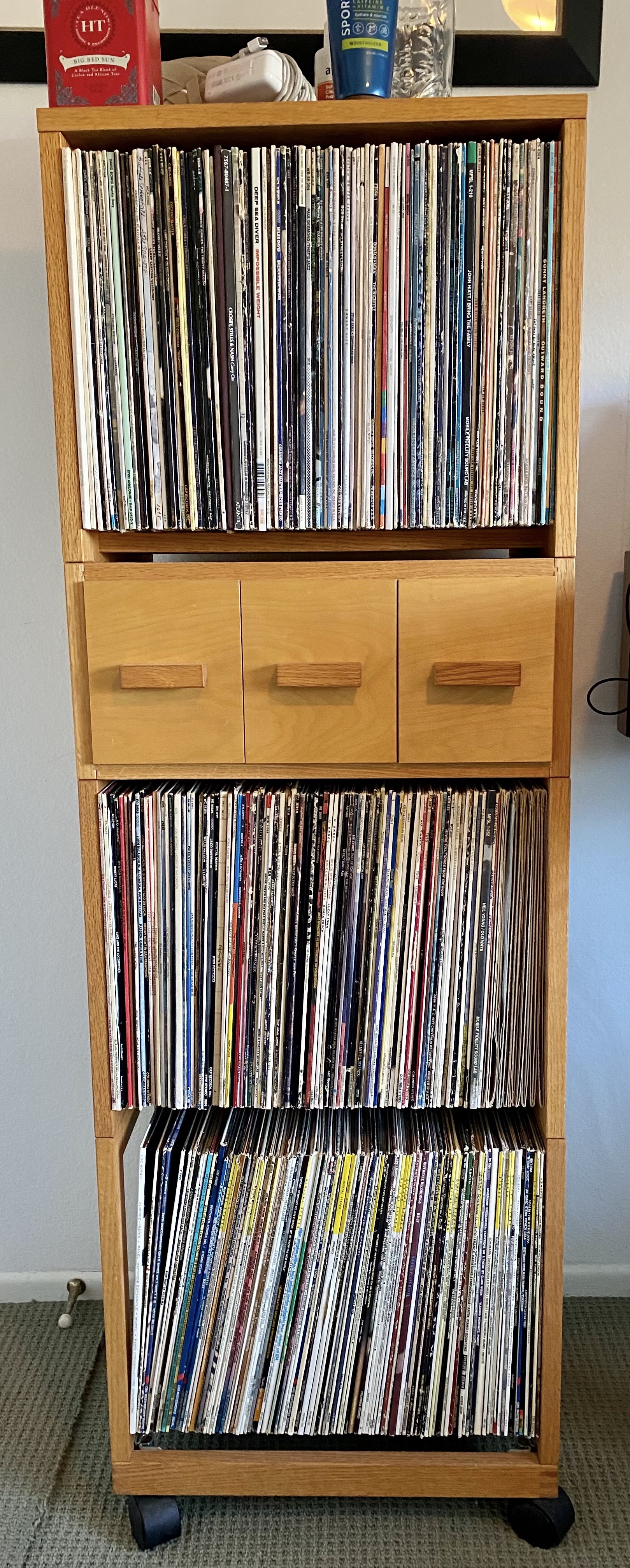
2020 was a year that I started to try to get a handle on my music collection. Years ago I lost over 2,000 treasured LPs in a flood. The insurance company first offered me $1 per record and ended up paying me $3 each. Still, that pretty much took out my collection save for the few hundred that escaped the hot, ravaging waters of the broken pipe.
A few of the survivors and my beloved Per Madsen Rack.
I would include a photo of my CDs, but they’re just so boring looking. Yesterday I wrote about Paul Simon’s disdain for contemporary music and I alluded to my music collection. I find that the more I write the more music I listen to. The listening is different, for the most part, than when I worked in and wrote about the high end audio industry. It is more of an accompaniment or a soundtrack. I no longer have a system, though I can still play LPs and CDs and hear them in free space. When the music or my brain demands it I listen on headphones, either wired or bluetooth. This is all heading toward how I intend to manage and grow my collection without as much physical mass to manage. The idea of using FLAC and dumping what’s left of my LPs onto a bunch of really big (an well backed up) hard drive is appealing. So is buying most (but not all of my music digitally through either iTunes or Bandcamp. I can’t quite wrest myself from the appeal of the physical so when I bought Deep Sea Diver’s new record I bought the LP from Bandcamp and it arrived signed by Jessica Dobson herself. Plus, Bandcamp tends to pay musicians a high percentage than iTunes.
C’mon, Jessica sent me Xs and Os…How do you pass that up?
It’s cool, but it’s also pretty damn physical. There may come a day where my enjoyment of buying and listening to records goes away altogether but I am not quite there yet. Digital and digital storage is just so convenient and it usually sounds fairly good. There’s a good chance one of the few benefits of aging will be the fact that my ability to discern good sound from bad sound will continue to decline. If I end up being happy to listen to a portable radio that’ll be just fine. My hearing already rolls off above 14kHz so I’m on my way!
Enough preamble. The word of the day is nostalgia. And my question is this: If you like something that happens to be old is your appreciation inherently possessed with nostalgia? What do we say when what’s old is really good let alone possible better than what’s new? Say we’re talking about Van Halen’s 1978 eponymously titled record or Steely Dan’s Katy Lied from 1975. Yup, I grew up with both. Still, each record is still fantastic by any measure. Do I have to admit that some of my appreciation for either work is dripping in nostalgia? Think about it and let me know. More tomorrow. I’m trying to keep the daily posts between 300-400 words. Wish me luck…
Until I finished my first novel I didn’t think of myself as the kind of writer who would or could write a novel. But, after I finished the first book I started in on the second without even thinking about it, or enduring a moment’s uncertainty about whether I could pull it off. The same may go for memoirs and journals. Outside of a less than half-hearted attempt to keep a journal back in high school this is the first time I’ve tried to write one. I enjoy autobiographies. But the truth is I enjoy autobiographies because I enjoy learning about noteworthy people. Bobby Jones wrote about himself when he was still in his 30s, or maybe even younger. Then again, he was Bobby Jones. I’m 60 now, heading for 61 in April. Things have changed, and a definitive change is coming at the end of 2022. My longtime employers will be closing their law firm. It’s time. Their decision is understandable. One of them is 66 and I think the other is pushing 70. One just lost his wife to cancer and the other’s daughter is battling a form of lymphoma. When the end of the firm finally comes I will only have one emotion…gratitude. Both of my bosses have been more than employers to me. They’ve been friends and will remain friends until that other end. I’ll have more to say about both of them later on, I think. The point is that this journal is about a particular transition, from one job to another, at the time in life where I now find myself. The determinate nature of the transition period allows me to focus and plan for the future but also to experience the days of the coming year in an unusual way. Most big changes hit without notice but this one has announced its impending arrival quite conveniently.
I don’t anticipate this to be a traditional journal. Then again, I don’t know what a traditional journal is like, having never knowingly read one. My anticipation is that it will include more than a few ideas about things I’d like to write. I’m also thinking that it will look back more than I want it to but I’m going to try hard to keep my eyes looking forward. They say a writer has to know the beginning and ending of a novel before sitting down to write it. I agree with that. A journal is a different proposition. No one knows how anyone’s journal will end, even and perhaps especially, their own. There’s a kind of freedom to writing without knowing the ending.
It should be interesting anyway. The year, I mean. No promises about the journal.
Yesterday I was sitting in a restaurant, waiting for my brother, when I saw a man come in and make his way toward the cashier. When he was a few feet away one of the employees said, “Excuse me, sir, do you have a mask?” The man sighed and nodded as he reached into his pocket. After he had the mask on the man said, “I’ll be a sheep.” Then, he kind of turned to look around and I caught his eye and said to him, “It’s funny, but you don’t look like a sheep. You look like a good man.”
I’ve followed Tom Slighter of Slighter Golf for a long time, all the way back to the days when I consulted to Jim Von Lossow of Von’s Golf. Back then, I was very impressed by the purposeful look of Slighter’s early putters.
A while back, while researching new putter companies, I happened across the Slighter Golf website again and realized that the guy who had been a relative newcomer way back when had become one of the stallworts of the independent putter craft.
And here I emphasize the word craft. CNC and 3D printing are amazing and I am glad I live in a world where they exist and help make our lives easier. But, craft is as important as programing. Tom Slighter is a man with the rare ability to take an idea and make it real and to give it a kind of soul.
The putters Slighter Golf makes are more than mere tools or products. Rather, they’re invested with something of the man himself and that’s what appeals to me about Slighter Golf. I want to thank Tom and his entire team for being so generous with their time.
Paul Cervantes Back when you started out there weren’t many small putter companies in the US or anywhere for that matter. What made you decide to make your own putters?
Tom Slighter I first began changing grips and shafts on my own clubs in 1990. Later that year I began repairing golf clubs for local clubs in Salem, Oregon for several years. I was able to repair golf clubs for pay and free golf. I was working for State Farm insurance at the time and in 1998, I transferred to Seattle, WA. The golf courses in that area already had golf club repair shops so I did not pursue club repair. I had about 30 putters of my own that I decided to sell and pay off some debt from the move. I used eBay to sell my putters and after selling all of them I realized there might be a market to refinish putters and sell them on eBay.
I began refinishing putters in 1999 and used eBay to sell the putters I had refinished. I didn’t notice any one else refinishing putters at that time so I received numerous requests for refinishing work. After working on hundreds of putters and slowly building up my shop with equipment I decided to design my own putter. I looked all over the Seattle area for a machinist to help me make my putter. After being turned down multiple times, I found a machinist who had a small machine shop in Arlington, Washington who was willing to assist me.
I spent a year prototyping a design and after many attempts we made my first putter I named the Seattle. I manufactured twenty-seven Seattle putters and listed one on eBay in September 2002. I was very nervous that it would not sell and be embarrassed. To my surprise it did sell and in fact I sold out of the rest of the Seattle putters shortly thereafter. I then designed the Tacoma, Bellevue, etc. I purchased my first knee mill and started to learn how to use it. I watched my machinist and practiced frequently. I continued to develop my skills on the milling machine and became fairly proficient. I began building a good size shop with all the necessary equipment to specifically work on putters. I had become nearly a completely self-sufficient machine shop that strictly was for building putters. I could see that building and refinishing putters was beginning to be fairly lucrative. I applied for my business license under Slighter Golf, developed a website and was off and running.
Paul Cervantes These days there are a whole slew of New Kids on the Block making putters, companies like Brandon Matthew, Logan Olson’s Olson Manufacturing & Tyson Lamb are a few that come to mind. In some ways, it seems like it must have gotten easier for a new company to get started (because of CNC, 3D printing and the like). Are you glad you got your start when you did or would you rather get a putter company off the ground today (assuming you were twenty years younger)?
Tom Slighter I have noticed over the last 10 years there have been quite a few new and very talented putter designers. Some are very gifted and may very well be the leaders in the industry. The CNC process is pretty much the same, but the machines have more memory, newer programs and capabilities. I never did learn to program however I wish that I had. I was too busy making putters to really dive into that aspect. There are many great programmers, but I believe they should learn how to build a putter from the bottom up by hand. Very few of those individuals are still around. In my opinion, watching a craftsman build a putter from a solid block of steel using a knee mill is fun to see. I am very proud to have started when I did many years ago, when there were only a few of us putter makers. Even then, it was a very difficult market to break into with so many trusted putter makers already on the market.
Paul Cervantes I mentioned earier that I consulted to Jim Von Lossow (founder of Von’s Golf) when he was still making putters back in the 90s. At the time keeping up with production was an ongoing challenge for his company. As back order and lead times got longer customers got impatient. What are lead times like for a new Slighter putter? Is it a challenge to keep up or do you and your team have it down?
Tom Slighter Jim Von Lossow is a pioneer in his own right. I remember meeting him in the early 2000s. He was very well known in the Seattle area for club repair, fitting and putter design. I, unfortunately, did not chat much with Jim about his line of putters but I am sure he struggled with keeping up with demand and dealing with the reliability of machinists. My early years, I was always backed up with orders. I remember being ninety putters behind and fulfilling orders as quickly and efficiently as I could. I was always up front with my customers on lead-time and followed up with progress updates. I would not sell a putter to anyone who paid more for a rush order. It was not fair to my other customers. I have a wonderful team today that can typically produce a custom putter in two weeks or less.
Paul Cervantes What’s your favorite material to work with? And, I mean both from an ease of production perspective and from the perspective of the quality of the resulting putter?
Tom Slighter I enjoy milling carbon steel as it is very soft and cuts like butter; not a fan of welding on carbon because it is so dirty. I love to weld on stainless steel because it so clean to work with. The harder stainless steel metals like 15-5, 17-4, nitronic are difficult to mill and hard on cutters. Copper is like milling gum but easy to stamp. Brass will throw some fine chips and is also easy to stamp but both are just too soft for hosels and do not really offer the best feel. Aluminum is good for larger putters like mallets to keep the weight reasonable; good for inserts and easy to mill.
Paul Cervantes Beyond appearance do you think there’s an actual difference in feel (or sound) between a one-piece head and a putter with a welded hosel? I have a hunch about your answer but I’m very interested to learn what you think.
Tom Slighter I have not noticed any difference in sound or feel between a putter with a welded neck to that of a one-piece putter. If a weld is done correctly, it is very solid.
Paul Cervantes How has your machining equipment and technique evolved over the last couple decades? Do you have any old equipment that you remain dedicated to even though there are newer & better machines out there?
Tom Slighter That is a great question. I have a Sharp TMV-50 Knee mill I purchased new in 2006. I have made countless putters with it and modified hundreds of other putters. I know every inch of that machine and it is definitely my go-to mill. I was lucky to purchase a 1970 Grazziano SAG 12 lathe from a shop that was closing down. The owner had purchased his Grazziano brand new when he started his business in his garage. When I purchased it in 2011 I was the second owner. I have completely enjoyed this lathe ever since. It is an awesome piece of equipment and knowing its past makes it all that much more special. We do have multiple CNC machines for production runs.
Paul Cervantes Tom, this is just me being me and getting in the way of my own interview. I think every putter maker on the planet who makes a Ping Anser variant ought to get out of bed every morning and be thankful that Karsten Solheim was so damn smart. Isn’t it amazing that the essential head shape of the Anser is still as viable as it is? It’s so ubiquitous that putter makers really have to make one, even the young guns and so-called innovators pretty much bow to Redwood City and Phoenix. As an aside I’m always surprised that even though Ping invented the dang thing they’ve nearly forgotten how to make a good one. Sorry, I’m not sure there’s even a question in there but maybe you can help me and tell me your thoughts about Karsten and the Ping Anser and Slighter Golf’s unique spin on it.
Tom Slighter Paul, you have a great understanding of the putter market. I could not agree with you more. PING’s design of the Anser was iconic and in turn was developed into the Anser 2 and Anser 4. Cameron completely redesigned the Anserputters into works of art. He redesigned most of the PING line into works of art. PING had a dynasty in the putter market and in my opinion missed the boat by resting on their laurels. I admire Cameron’s ability to re-invent the wheel so to speak. Genius. When I started out I was intrigued by the old school TaylorMade T.P.A. series. I loved the TaylorMade T.P.A. 8 of the 1980s. I was influenced by their design and incorporated my spin to develop my line.
I did not want to steal an idea but rather take what was already known and make it better. If I could dab into the market that way and gain the trust of my customers anything else I design would be hopefully be accepted. I understood that I was not going to ‘storm’ into the market, but rather work my way in the back door. With that said, it is clear to me that the PING style putters are here to stay in one way shape or form. You can always design a crazy new putter that may flood the market for a while (Cameron Detour is a great example) and then slowly ride off into the sunset. However, I have noticed over the years that customers will fall back on the old classic putters. Re-making them will always be a solid market. PING just hasn’t been able to match anything Cameron has made with respect to the Anser.
Paul Cervantes What’s next for you and your company? Do you want Slighter Golf to evolve into something new over the next decade or are you just happy to keep on keeping on?
Tom Slighter We are steady as she goes at this time. We are looking to expand more in the next year or so. This situation with the pandemic has been interesting to say the least and hopefully when it has settled down more we will begin to develop in areas we have planned. I would also like to say that I don’t do all of this alone and with that in mind I’d like to recognize the rest of my team, Jason Smith, Mike Place & Will Borg.
My name is Mike Place. I have over 30 years of machining experience. Although I do not golf on a regular basis, I admire the same high standards golfers expect. Whether it is a simple adjustment, small modification, or a complete refinishing, I get satisfaction out of applying my same high standards to working on putters; I come to appreciate them for what they are and how important they are to our customers. Working with Tom Slighter has been a great experience on all levels. I have learned so many things about the sport. I get excited every time I see a new putter come in. It is an opportunity for me to use my many years of machining in ways I never thought I would. Thanks so much to our customers for trusting in Slighter Golf. Thanks to customer feedback I have come to learn just how important a putter is.
My name is Will Borg. I have been a machinist for over 15 years. I have always liked working with metals, whether it is welding, milling, or fabricating. “To make something that didn’t exist into something that someone can enjoy is very rewarding.” I have been lucky enough to have worked with Tom and learn from one of the best, and learning all the fine details that go into building high end putters.Mike Place & Will Borg of Slighter Golf
I’m Jason Smith. I’ve had the pleasure of Tom’s acquaintance for more than 12 years. Since our introduction, I have been extremely enthused to work with Tom designing, machining putters and the occasional day on the course. I have a real passion for golf, I grew up on a golf course and have been playing since I was a little boy. These days, I enjoy the game with my entire family, especially my son Preston. Preston played varsity golf on the local high school golf team. Anytime we want to test out a new prototype, Preston quickly volunteers to take on the task. Along with golf, I’m passionate about manufacturing, specifically designing and producing product. I’ve had the pleasure of designing product used all over the world and beyond, from the bottom of the ocean to outer space. It’s nice to see literally millions of components in use, designed with my team, but nothing is more satisfying than playing a game with something so innocent as a high-quality putter co-designed and CNC machined with Tom Slighter. Being 50 years old, I havemade an enormous circle of friends and resources throughout my life. That being said, I hold very few on a throne as high as I hold Tom Slighter, when it comes to excellence as a human being. I am truly grateful to be working along side of him, I look forward to many more years.
I thoroughly enjoy my family time especially now that I have more time with my wife, Bonnie. I cannot thank my family enough for being there for me in so many meaningful ways. I used to work 7 days a week for a combined 70 hours at my day job and the putter business for 18 years. I embraced every minute developing my putter business through the ups and downs. I met so many interesting people along the way that I would not exchange for the world. Partnering up with my dear friend, Jason Smith has allowed me, for the most part to retire from the putter business. I am now able to golf twice a week, snorkel, fish, work out in the gym, hang out with Bonnie at the beach, basically enjoy a whole different period of my life. Jason is a very gifted and brilliant machinist, incredible business entrepreneur, and down right kind hearted individual. It is an honor to work with Jason and his team. Working with Mike Place and Will Borg who are gifted machinists in their own right have honed their skills to that of the golf industry. They have increased the skillset of Slighter Golf to an entirely different level. Amy Reems, our office manager, Sarah Clogston, our office assistant and Justin Crawford, our consultant have a passion for our business and provide incredible service to our customers. I am truly honored to have the opportunity of working with each one of them in our effort to meet the needs of our customers. Thank you so very much.
I was fooling around looking at the word count of my novel the other day and I stumbled across a number of amusing articles contending that 120,000 words is some kind of magic number that one was unwise to exceed, especially as a first or second novel writer.
My favorite quote so far is:
“Word count limits can seem like they stifle artistic flow, but they exist for a reason.”
Uh, not really.
This is 2020. There are front list books. There are back list books. There long and short list books. But, there is no inherent relationship between word count and quality and I don’t care if the author is a newbie or Dostoyevsky.
The fact is that duration or word count might well be inextricably bound to the depth and complexity of the writer’s vision. If ebooks and contemporary printing technology has brought us anything it should be freedom from arbitrary limits respective to word count and the like.
So, if some stodgy old editor tells you differently, feel free to ignore what they say.
Only the author (and his or her trusted editor) can say whether a book has too many words (or too few).
To say otherwise would be to go back to the 20th or 19th century.
I know, I’ve been gone a long time. It’s not that I haven’t been writing. In fact I’m making significant progress on the sequel to my first novel. A friend of mine (to whom I text an occasional daily word count) told me I had written over 25,000 words in a week and that’s in addition to the 300,000 that were already on the digital page.
But, that’s not the point of this post.
I’m not sure why this is so much more appealing than a bucket list but it is. The devil’s in the details…
If you knew you would die peacefully in your sleep fifty days from now what would you do with the fifty days?
Sure, it’s an old idea but still worth thinking about. One of the first questions is how much of your time would be spent with a focus on other people like family and significant others. It’s not likely you’d be able to force the sense of special into the next fifty days just because you knew on the fifty-first day it would be lights out for you. You would get just as tired of other folks (and they of you) as ever. I’m thinking I might save the hanging with loved ones deal for the last five days, or maybe seven. That seems like plenty when I think about it.
Still, what to do with the rest of the time?
I am a tad disappointed with what I’ve come up with, but here’s what I have. I think I might rent a really nice car and drive to Arizona and play golf at some good golf courses, the type of course I’d ordinarily scratch off the list because of their cost. I’d stay at good hotels, probably nothing overly pricey but places with decent spas and well-stocked bars, that’s for sure. I’m thinking those last fifty days should each end with a damn good massage followed by equally damn good cocktails.
After Arizona, I’d spend a couple days driving to the California coast. I’m not sure I’d play Pebble. It’s never seemed like the kind of golf-course experience I would enjoy though the location is something I would love to see again, especially this time of year. No, I think I’d drive north from there and look for out of the way courses that I’ve never heard of. The weather would determine how far north I’d go. Remember, this is fifty days from now so I’m confining myself to warm weather fun and that means golf.
I’ve got a bud in Bend, Oregon and another one in Portland. I’m not thinking I’d tell them about the fifty days but I would try to make the time fun and to say some things that are true and to soak in everything that’s made them both so special to me for so many years. At some point I would probably work my way east, maybe to Coeur d’Alene. I’ve spent a quite a bit of time on the west coast but not so much time in the slightly east of the west coast. The last time I spent time with my buddy in Bend I was happily surprised by how right that region felt to me. It’s another kind of high desert, one with forests and rivers. Anyway, I understand there are some damn good golf courses there and I’d like to see if it’s true.
Then, it’s back to the west and a few days in Reno and a few more in Sacramento with another good friend. By the way, there are some fine golf courses in Sacramento and I would br looking to play some of the tracks I didn’t want to spend the cash on before the fifty days thing came along. I’m thinking especially of Del Paso CC. Hey if it was good enough for the 1957 U.S. Women’s Amateur it should be good enough for me, right? I guess I should start looking for a member who will invite me. From there it would be east to Truckee and Tahoe and there I’d be thinking of Lake Tahoe Golf Course, Northstar and then back to reality at the delightful looking Carson Valley Golf Course. From, there it would be down US 395 to Mammoth where I’d hit Snowcreek and Sierra Star, two courses I’ve played dozens of times and always enjoyed.
Driving south on 395 might be difficult, especially at that stage of the trip. There would be so many memories flitting about and the lingering realization that all trips, especially this one, come to an end. But, that ending would be something special and I think it would feel special, too. There is something otherworldly about the Eastern Sierra, something suggestive of something, many things really, beyond what is seen or known. It would be the road that would take me home for that last time.
If there was any time left and I rather think there would be, I’d roll back to Palm Springs and Palm Desert for some early morning and late afternoon golf. I’d need more than fifty days just to get started on all of the desert’s good golf courses but I know where I’d play.
And that makes me wonder, how would you think about they way you play, if you knew you’re playing the last rounds of your life?
Would you care about how you played? Would you be happy with whatever game you got from the gods of golf or might the experience end up leaving you with with the banal wish that you’d played better? Perhaps knowing with certainty how genuinely finite the number of your days on a golf course truly are might bring to sharp focus the answer to the question of why you play.
What is it you enjoy?
My last thing is this. I did a rough tally of how much those fifty days would cost me (money wise), and it’s a lot, but not so much that it would break me. I could do it and not have to resort to a mac & cheese diet after my last round. And that, of course, makes me wonder why I don’t just do it? Why save those fifty days for when I’m older, less fit, less able to walk a golf course carrying my own bag? Why wait until very likely never?
Because there will never be a better fifty days than the next, no matter how long you’re lucky enough to be swinging the club.






 Paul Cervantes