TRUE Linkswear Sensei: The Irreplaceable Golf Shoe

I have two pair of the the ugliest golf shoes ever made.

On the other hand, they’re also the best & most comfortable golf shoe ever made, at least for my feet.

It’s hard for me to imagine why TRUE Linkswear stopped making them, but they did.

So now what?

Well, anticipating the inevitable demise of my first pair I bought a second (used) pair on Ebay. Because the shoes have such low profile soles (perfect for SoCal golf and its typically dry conditions) they’re actually very durable. Heck, I drive to the course wearing them and keep them on right through dinner and the drive home. They take an occasional trip through the washer (medium water temp, air dry) and they seem to tolerate the procedure without injury.

Who cares how they look?

SnapseedCome on, they don’t look that bad!

I know. TRUE is still in the game but the Sensei are gone and I don’t know why.

I’m happy to try TRUE’s new offerings but I’ll be surprised if they measure up to these babies.

Sometimes progress isn’t progress.

Here’s hoping this time it is.


TRUE Linkswear Sensei: The Irreplaceable Golf Shoe

Is the Apple HomePod a genuine threat to high end audio?

Yes, it is.

No, it’s not a real high end product.

No, you won’t be replacing your real system, assuming you still have one, with a HomePod.

Yes, you will be impressed by how fundamentally musical it is.

HomePod

The Apple HomePod is the first mass-market product, designed by a company with real engineering wallop, that was actually designed by people who wanted it to sound good and that fact should put existential fear into every high end company that’s still on the right side of the grass.

Let’s talk about setup. It’s OK, but like all new Apple products it entails a few more steps than it should and Apple’s Home app is kludgy. Bummer, that, but once you’re done with it you’re done with it, or so it seems so far.

On the operational front I’ve observed that Pandora skips momentarily about every ten to fifteen minutes. The funny thing is that it never skips on my iPhone or when I’m using my Air Pods.

What the?

That problem gave me the chance to test Spotify.

Odd, no skipping whatsoever.

Who knows what’s up there but I’m willing to blame Pandora until and unless it starts to happen with other sources. Not surprisingly, playback from iTunes / Music is just dandy.

What the folks at Apple have done here is to swing a big, heavy hammer at what should be an easy target, and for them it was. The HomePod is a technically and acoustically complex product. They’ve crammed a bunch of drivers into that little pod. If a high end company, or a lesser tech company, tried to do what Apple has done the result would have been a sonic or functional mess and probably both.

The HomePod sounds remarkable coherent from top to bottom. Even though I’m using it as what would be regarded as a monophonic speaker the result is quite natural from a spatial perspective. Remember, stereo is a trick. This kind of mono is simply another kind of trick, and it works because Apple figured out how to make it work.

But wait, let me talk about why I felt I needed a better speaker in my office than my beloved Soundfreaq Sound Spot Wood + White. There are two reasons, really. The first is that I need a speaker in my bedroom, and the Sound Spot is perfect for that. The second and more important reason flows from the damn book I’m writing. This whole book-writing thing entails seemingly endless hours of ass sitting, which I already hate. I’m actually thinking of hiring a personal trainer so that all this extra time sitting doesn’t knock too much time off my life expectancy.

The HomePod’s fundamental listenability and (comparatively) full range presentation brings just enough music into my office that I’m not constantly driven to get up and change the record or put in another CD or whatever. I can turn it up to annoyingly high levels when the music or mood calls for it or turn it down to the edge of silence when I’m trying desperately to think and it stays musically convincing.

The Pod simply sounds good. Yes, it takes some liberties and creates a sould-warming upper-bass hump so you won’t notice the lack of mid and lower bass. And, yes, all those drivers lead to an occasional if surprisingly minor megaphone effect that’s especially noticeable on female vocals.

But then, something will come on that will catch your attention. Right now that’s Telegraph Road from Dire Straits. The cut has a lot of electronically generated space and a fairly high dynamic range for a rock recording. But, the Pod pulls it off. Somehow, especially at rational volumes, the musical presentation holds together is the exact way you need to draw your attention into the music.

Wow.

$250?

I cannot think of a $500 pair of stereo speakers from any high end manufacturer of any era that can match the Apple HomePod’s essential musicality.

That fact, all by itself, is why I regard the HomePod and all of the amazing stuff that will surely come after it such a threat to what’s left of the high end.

In closing, I’m trying to imagine what would be involved in streaming to the HomePod from an analog turntable. Obviously, a really good phono preamp (got one) and a really good DAC (ditto). Then, all I have to do is trick AirPlay2 into streaming the resulting data at full resolution to the HomePod.

Hmmm…

Who knows? Maybe this will be possible by the time I’m working on the sequel to the sequel.

All you high end audio folks should have heard this kind of product coming and from this kind of company because it’s already too late for you to get out of the way.

The Apple HomePod is simply good.


Is the Apple HomePod a genuine threat to high end audio?

One is not enough & four is not too many: My SeeMore FGP collection

I bought my first SeeMore FGP on a whim. The aged FGP was sitting forlorn deep in the used putter orphanage at my local golf shop.

I believe I paid $35 for my belovedFGP.

That FGP marked a significant development for my putting. Before I owned that putter, I had played many different styles of putters, never staying with any one design for long and always being disappointed with my putting.

Then came the FGP. That original SeeMore FGP forever changed my outlook on putting. Putts started to look makable and on good days, easy.

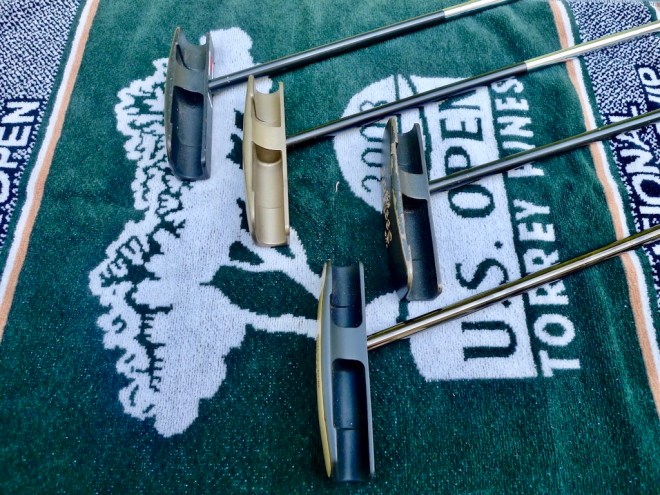
Yup, as of today I own four SeeMore FGPs. The original, the one my golf buddy has named, Big Daddy, stays home during most rounds. It will always be my favorite but I usually find myself using my only new FGP, a limited edition putter (mine is number 45 of 100), when I play. I like the all-black shaft a little better than the two-tone shafts of the originals.

All of my FGPs use brass heads. I have used a stainless version of the FGP before but something about the sound is slightly less satisfying to me. It took me forever to find an all-brass model then one day a fine example popped up with its original cover and a somewhat smooth SeeMore grip.

The SeeMore grip is great for originality’s sake but I prefer the superb Rosemark grip. The IOmic grip in the photo is a temporary stand-in while I wait for another Rosemark.

Used SeeMore head covers are hard to come by in good shape. I wish SeeMore would make a move to covers from AM&E but that’s only because I’m a relentlessly picky SOB. In addition to the old and new original SeeMore covers there’s my new UCLA cover and a simple but high quality leather cover from Stitch Golf.

My latest FGP acquisition is another adopted orphan. Its finish was rough but the face and top line were clean so I snapped it up for $30. I am waffling between the idea of refinishing the crinkle-black finish or leaving it rat-rod style. I did take one liberty with the putter. It was originally built to 36″ so I carefully cut it down to 34″ to match its stablemates and installed the IOmic for now.

In my opinion, the design of the SeeMore FGP is as relevant to putting as the Ping Anser and, arguably, the FGP is the better design from the standpoints of ease of use and pure performance. For players who are wise enough to adopt the design and learn to use SeeMore’s simple, logical system better putting is all but assured. You won’t have to buy four SeeMore putters to learn the lesson. Buy one and you’ll be sold forever.

One is not enough & four is not too many: My SeeMore FGP collection

A Quick Review of the Fifine K669B USB Microphone

Fifine

You can buy this little beauty here.

I’m grateful to Fred Greene, head honcho of the GolfSmarter podcast, for a number of things. One that I hadn’t anticipated was how much I enjoyed being interviewed by him for his podcast. Though it was a little out of my experiential-comfort zone, I really enjoyed it. I’m a born talker (as I think most writers are) but speaking formally over the course of 30 minutes is a different kind of talking than most of us are used to doing.

But, again, I liked it. I soon had the idea of doing an audio version of my golf short story, Kingdom of Dreams. I saw the effort as a study that would help me determine whether I could successfully narrate my novel, John J. McDermott & the 1971 U.S. Open.

I think I can.

Though I’m not bowled over by the quality of my narration so far the results seem workable and I’m hoping to get better as I gain experience and learn from my inevitable mistakes.

It didn’t take long to figure out I needed a microphone that was better than the built-in mics in any of my Macs or my iPhone. I asked around and did (very) little research.

A trusted podcaster I know recommended the Blue Yeti but I wasn’t all that enthusiastic about dropping $125 on something that could soon end up collecting dust on a shelf.

So, I decided on the Fifine K669B. I’m mean, it’s only $29 at Amazon and it’s Prime-eligible so there’s very little to lose.

Some of you may know I worked in high end audio for decades and have reviewed well over a hundred high end products. I’ve also been formally and informally involved of scores of recording sessions from pop to classical.

But, I’ve never actually reviewed a microphone. The more I thought about it the more I realized that something really critical to proper audio reviewing was missing.

There’s no reference.

Nearly all of the web and youtube reviews of mics compare one mic to another. I understand this temptation but the better or worse game that’s pretty much useless in evaluating playback gear is even more useless in evaluating source gear.

Why?

Let’s say it again…there’s no reference.

A given reviewer may like the way his voice sounds on Mic A instead of Mic B but that is no predictor of whether anyone else will like the sound of their voice when captured by Mic A.

A significant part of mic performance can be evaluated objectively but most reviewers confine their objective comments to describing features which is fine as far as that goes, but features do not relate directly to quality when you’re talking about audio fidelity.

So, what can I say about the Fifine? I can say it’s fine…for me. It has a fixed cardioid pattern that’s well suited to my simple needs and is truly plug & play (at least on a Mac).

Also, the little fellow is nicely put together, seemingly solid, yet not overly heavy. Some will surely complain about the captive USB cable but at least you know that if you remembered to bring the mic you also remembered the cable!

The only adjustment on the mic is for volume and I found the sensitivity to be plenty wide for my needs and is quite smooth. The volume knob has a reassuringly heavy feel and is easy to position precisely and consistently.

I found set up to be as simple as plugging the mic in and hitting record and I designate the sound quality as just dandy (I know; far too many technical terms).

For $29 there’s just nothing for me to complain about.

Lastly, the Fifine Folks appear to be very responsive at least related to their Amazon sales. This is especially impressive for such an inexpensive product and shows the company understands that early efforts related to customer service will help them build their brand over time.

Well done, Fifine. You’ve done a fantastic job with K669B.


A Quick Review of the Fifine K669B USB Microphone

The software I’m using to write my new book is…

I’ve been making good progress on my new book, especially considering the hodgepodge of software I’ve been using.

I wrote my first book in Microsoft Word and it was a harrowing and creativity-sapping process. Word is like a huge Swiss Army knife of a word processor. A knife with a shit-ton of tools can be impressive. You look at it wondering how many tools there are and whether you’re likely to use most (or any) of them.

Then you realize the damn thing’s heavy. Then you realize that using any of the tools except the main blade is a fiddly and frustrating experience.

In the end, you leave the knife at home more than you use it.

Don’t get me wrong. I’m grateful that Word exists. The choices made by the folks who created it result in a benchmark product. I would never refer to Word as a bad piece of software. It’s simply a bit of software that’s unsuited to the creative flow of my writing.

A while back, I was prattling on about Ulysses and iA Writer. Later, I discovered and used Bear for a while. I deemed each of them as interesting but not quite useful enough. Each design is good at pretty much keeping out of the writer’s way.

It’s the issue of sync that settled the matter, and not in favor of iA Writer, Ulysses or even Bear.

Each of those platforms rely on iCloud for sync. That’s OK if the writer uses the same Apple ID across all devices and the iTunes Store. There’s the problem for me. Also, I think the software companies should use their own system and servers for sync rather than relying on iCloud.

I think WorkFlowy does sync right. Their ingeniously simple software is truly web-based, syncing by username, seamlessly.

I encourage those folks to develop WorkFlowy for Writers and let me know when it gets to beta. If they can build on the way WorkFlowy works and apply it to the work of long-form writing it would be a real game changer.

The software I’ve chosen to write my book in is Apple’s very own Notes. File organization is simple and straightforward. You can choose your own font and basic formatting is a snap. I will continue to use Word as the destination software (and archived backup) for the eventual manuscript. Importantly, documents created in Notes paste cleanly into Word without any weird or unexpected formatting problems. Notes also syncs both immediately and perfectly across all devices, as one would expect of one of Apple’s own creations operating in their own ecosystem. The UI is clean and uncluttered and this helps me to focus on what I’m working on. 

I’m glad to be watching that hodgepodge of software vanish into my rearview mirror. I’m also glad there are software folks out there who are trying to make the challenge of writing easier and I’m really happy Apple did such a marvelous job with Notes.

The software I’m using to write my new book is…

Do apps like iA Writer and Ulysses really help you write?

I promised myself six months respite between finishing my first novel and starting on my second. The idea was to take some time to research and test drive various writing apps.

Having a mechanism that facilitated the organization of my writing was of primary importance.

Having a writing environment that facilitated the writing process was a plus.

I mean, who doesn’t hate Microsoft Word?

On the other hand, who doesn’t use Microsoft Word?

When it comes to writing, it’s easy to come to see Word as the devil you know which is nearly always preferable to the devil you don’t. Word is not anathema to the creative process. If it was, no one would get anything done with it and there are plenty of writers who do the majority of their work within its environment.

I’m one of them.

But, Word is distracting. Word is inscrutable. Word is ugly.

I narrowed down the initial candidates to iA Writer and Ulysses.

I’m prone to breaking promises I make to myself so rather than a six month respite I’m already working on my next novel. The fun part is that I’m alternating its among Word, iA Writer and Ulysses. You’re right…fun’s not the right word.

I compose for a while and then I cut and paste the copy into Word as a back-up. I also email the copy and dump another copy into A Google Doc but now I’m giving you a bit too much insight into how much I hate the idea of losing my work.

So far, I’m not sure if iA Writer or Ulysses will be of much help to me, anyway. I do like the stripped down nature of the interface but, at least so far, I’m not seeing it as transformational of either my writing process or of my ability to maintain organization of elements of plot, characters, scenes and timeframe.

Initial nit picks about Ulysses include the use of jargon like sheets rather than text or copy. I mean, I know about a sheet of paper and about rain falling in sheets but why use the word to describe something that a sheet isn’t? But, I’m not giving up on it yet.

iA Writer takes the stripped down feel a step further. This can lead to wondering about what, exactly, the app is supposed to be doing for the writer?

I’m going to give both apps more time and copy before I decide which of them (if either) to use.

Today, I am unconvinced about iA Writer and Ulysses but I’m still open to using something other than Word. If any of you use either of them (or any other writing app) I would love to hear your views and experiences.

Do apps like iA Writer and Ulysses really help you write?

A couple beers from Sacramento (and Bakersfield)

Do you really need to know why we end up in Sacramento a couple times a year?

No, you don’t.

Just know that in the summer Sacramento is a very cool place to play golf, drink craft beers, check out local wineries and to generally chill out. Since I click all of those boxes with enthusiasm it’s pretty easy to see why I like Sacramento.

But wait, this trip found us making a quick stop in Bakersfield. How can you say bad things about a place that has streets named after Merle Haggard and Buck Owens?

The answer is, you can’t.

Turns out that Bakersfield is home to a bunch of good craft brewers. We tried to stop by Temblor (second worst name in town) but the place was swamped on a Sunday night. Impressive, but not in a hey, I really want to elbow my way through the teeming, unwashed masses of Bakersfield for a pint of suds kind of way.

So, we rolled over to Ming Avenue to check out the Marketplace location of Lengthwise (winner of worst name in town). The place is hidden at the back of a pretty nondescript mall. The vibe inside and out was very cool. Plenty of the local gentry were there watching the World Cup. First up was their Red Ale which was excellent if a tad bit more hoppy than I think it needs to be. The color is a deep, rich red with just a touch of amber.

Red

Next up was their Razzberry Wheat. I was looking for something approximating my brother’s amazing Watermelon Berliner Weisse. The Razz was close but had a touch too much berry flavor.

Raz

Upon making this comment out loud the guy at the end of the bar said, “I was gonna warn you about the Razz; the Strawberry Wheat is much better.”

This friendly and full-bearded fellow was wearing a hat and shirt from Bike Dog Brewery in West Sacramento. I told him we’d be in town the next day and would be sure to check it out. Sadly, the WestSac brewery was closed Monday-Wednesday so we had to go to their Broadway Taproom which was fine and dandy but lacked the slight industrial grit that I feel adds the last little bit of flavor to a good beer, plus it was freezing inside.

Being on a red ale kick I tried their Klunker Red Ale which was nice on a warm evening at 5.5% ABV. It was less hoppy than the red ale at Lengthwise and a touch closer to the ideal red I’m always searching for.

BD
Bike Dog…get it? OK, so everyone’s pretty much running out of catchy names in the craft beer realm.

My rating for Lengthwise and Bike Dog and the beers I tried is:

Three Beers


A couple beers from Sacramento (and Bakersfield)

Review of Shinola’s Canfield Over-Ear Headphones

Canfield

Shinola is a fascinating company with a name that is, for me anyway, a little odd. I mean, come on; we all know what rhymes with Shinola. They make all sorts of interesting things from watches to wallets, from turntables to speakers, all assembled in their factory in Detroit, Michigan. The Canfield Over-Ear headphones are Shingle’s circumaural headphones. From a design standpoint the Canfield Over-Ears straddle a modern look with classic headphone shapes, contours and lines from the days of old. They are very solidly constructed. The lambskin ear cups are especially luxurious. The Canfield Over-Ear’s contemporary lineage is confirmed by the presence of an inline volume control and the fact that the (rather shortish) cable is terminated with a 3.5mm plug, though a good quality .25″ phone plug adapter is included.

Before I get into what it’s like to use and listen to the Shinolas I want to comment on its connectors. Disclaimer: I am a unreasonably obsessed by connectors and signal path issues. I accept the fact that the 3.5mm plug has become a kind of de facto standard when it come to the majority of headphones we use today. From this, I exempt really high end headphones which may operate in a fully-balanced mode and so may use XLR or other connectors that accommodate that topology. When it comes to the Shinola Canfield Over-Ears there are female connector jacks on each earpiece. So, there are soldered connections on each earpiece and another soldered connection on the other end. On one hand, this affords the user with an interesting opportunity; this configuration makes it easy to use another cable (that’s similarly terminated). Just pick your brand or make your own cables. The Shinola’s make swapping cables easy, if potentially costly.

But…

Under the best of circumstances you’ll be dealing with a significant number of extra solder points and plug-in connectors. That is not a recipe for a typical high end implementation. If Shinola is using what they consider to be good quality wire I would rather they ditch the female jacks on the earpieces and solder those wires directly to their drivers or crossovers. It’s a tough situation. I can see the advantage of what they’re doing but the downside, especially for a pair of $450 headphones, is significant.

The Shinola Canfield Over-Ear headphones are excellent. They are truly full-range and offer exceptional dynamic capabilities. But, maybe unfortunately and maybe not unfortunately, they do require some significant care and feeding. When driven by purpose-built headphone amps of commensurate quality the Canfields can dazzle. But, when driven by a phone or computer the Shinolas can sound a touch heavy. This problem results from a contemporary belief that’s poorly founded. The belief is that even the finest headphones can be happily driven by even the most modest of amplifiers. Quite simply, they can’t. A $450 pair of headphones deserve proper amplification.

When properly driven, the Shinola Canfield Over-Ear headphones sound marvelous. They are detailed, yet unfatiguing. They handle large dynamic swings with ease yet always preserve a deft portrayal of acoustic delicacy. The midband is slightly shelved back but vocals, both female and male, are always rendered clearly and with great articulation. The bottom end extension and impact are superb, easily besting my other reference headphones that are similarly priced. The Shinola’s even challenge significantly more expensive headphones, and they do so with a sense of ease and a lack of strain. The top end is smooth and extended if a tad soft. Every product is voiced and Shinola clearly voiced the Canfields to be kind to recordings that are not exactly what most would call high fidelity. All in all, though, the Canfields are superbly musical headphones, especially considering their price.

These Shinola headphones are beautiful and obviously lovingly assembled and finished. And, they look as if they would be quite comfortable to wear. The earpieces rotate freely and the length of the headband adjusts readily as well. I found it easy to adjust the Canfield Over-Ears to the point where they fit me just right. The texture of the lambskin ear pads is decadently smooth. My guess is that they’ll feel even better once they’re broken-in; rather like a fine baseball glove. The headband’s padding could be a little wider and more compliant. Since these are heavyish headphones their mass is concentrated on a relatively narrow area of the head. Could they be even more comfortable? For sure. Perhaps Shinola will reevaluate this as they evolve their headphones down the road.

As they are, the Shinolas are amazingly good headphones even in what is a very competitive section of the market, price wise. For a new company, they are a nearly miraculous product. I have every confidence that Shinola will better the Canfield Over-Ear headphones if they decide to stay in the headphone game. In this case, more than in other headphones at this price, the rewards you reap with the Canfields will have a direct relationship to the quality of the device that drives them. I, for one, do not see this as any kind of shortcoming or disadvantage. Think of it as a part of the price you’ll pay for enjoying the musical refinement that Shinola Canfield Over-Ear headphones can attain.

The Shinola Canfield Over-Ear headphones are very much worth the effort.

Shinola Canfield Over-Ear Headphones

$450 USD

Review of Shinola’s Canfield Over-Ear Headphones

Anderson Valley’s Boont Amber Ale & Hop Ottin’ IPA

I confess that most of my experience with Anderson Valley beers are from bottles…yes, I said bottles; the horror. But, the fact is that even out of a bottle their Boont Amber Ale runs a very close second to my all-time fav, Hangar 24’s Orange Wheat.

Again, the magic lies in the beer’s balance.

Today I was lucky enough to have this beer on tap and as is often the case the leap from bottle to tap is a huge one. Out of a bottle it’s great, on tap it is sublime. Boont is creamy yet crisp, it’s full-bodied but by no means heavy. Many ambers taste almost like a detuned IPA but Boont is a true amber in look, mouth feel and taste.

Here’s hoping that Anderson Valley (someday) will follow-up to the Boont with a red ale that matches it for character and quality.

Four Beers

Now it’s on to Anderson’s Hop Ottin’ IPA. This, like the Boont, has a lovely color. It’s citrusy constitution is offset by its full yet clean, malty finish. It’s 78 IBU but it’s really not that hoppy in the mouth. Me? I likes me a 7.0% ABV IPA.

Give me some wallop if I’m going to be drinking something with a good deal of bite to it.

Three Beers

Anderson Valley’s Boont Amber Ale & Hop Ottin’ IPA

A Study in Contrast: Pugachev’s Cobra & Orange Wheat by Hangar 24

First of all, I’ve been meaning to do some quick beer reviews for years. I mean, why drink all that beer if’n you’re not gonna write about it?

Well, some of the stuff tastes pretty good, plus, I’ve taken a bunch of notes so I figured I’d be a nice guy and share some findings here.

Warning: If you’re not into beer you’re not going to be interested in the old blog for the next few posts. This is gonna take a while…

Sorry (not really)…don’t you know that good beer is delicious?

Second, get your ass out to Hangar 24 in Redlands before some multinational corporation realizes how cool Hangar 24 is and how quintessentially California their main taproom is and buys the place and moves it to Colorado or Missouri or some other God-foresaken place. The main taproom is in Redland just a few miles off the 210. It is directly across the street from the Hangars of the airport (get the connection; hangars…hangar 24…airport?). Nearly all off the taproom’s seating is outdoors which can lead to an amusing experience when the temperature hits 106 as it during my first visit.

Ummm…toasty!

During that first visit I had what has become my measure of the very best all-around beer I’ve ever had; Hangar 24 Orange Wheat. Sure, lots of breweries make something similar but no one manages to match the balance of citrus aroma and flavor as well as Hangar 24. It’s great anytime but on a hot day it simply has no equal.

Oranges
That’s right. Those are Redlands-grown oranges ready to be made into Redlands-brewed Hangar 24 Orange Wheat. Ain’t nothin’ better that I can think of!

But wait, this is supposed to be a study in contrast, right? Oh, baby…I have me some contrast right here under the name of Pugachev’s Cobra. This is a very big beer. How big? 15% ABV, but that’s not the full story. This beer exudes the aromas of chocolate, vanilla, oak, bourbon, licorice and dark fruits, while flavors of chocolate-covered plum, sweet malt, bourbon, and roasted coffee dance on your tongue. In a word, it’s amazing, but it’s also BIG! Big, like kick you ass, Big. Big, like go easy on this stuff, big.

In the end, it’s the best big beer I’ve ever tasted and the Orange Wheat is the best beer over all. The fact that both beers come from Hangar 24 is, well, I’m not sure what it is but it’s true.

Both of these beers earn my highest four-beer rating.

Well done, Hangar 24!

Four Beers


A Study in Contrast: Pugachev’s Cobra & Orange Wheat by Hangar 24